
The Bourbon Coffee Variety: Origins, Flavor, and Legacy
Summary
Bourbon is one of the most historically important and commercially significant varieties of Coffea arabica, prized for its balanced sweetness, complex flavors, and strong specialty coffee performance. The variety originated from Typica plants taken to the French colonial island of Bourbon (modern Réunion) in the early 1700s, where natural mutations produced the distinctive Bourbon lineage. From this single island origin, Bourbon spread globally to become the genetic ancestor of dozens of important coffee varieties including Caturra, Catuaí, SL28, and modern specialty cultivars. Understanding Bourbon means understanding one of the cornerstone lineages of modern specialty coffee.
The Island Origin
Watch: Bourbon Coffee: Origins, Varieties & Flavour Profiles Explained
Bourbon's story begins in the early 1700s on the island of Bourbon (renamed Réunion after the French Revolution), a French colonial possession in the Indian Ocean east of Madagascar. The French, having obtained coffee plants through diplomatic gifts and commercial trade, planted arabica on Bourbon starting around 1708 as an experiment in coffee cultivation outside their Caribbean colonies.
The plants initially sent to Bourbon were Typica-lineage arabica — the same genetic stock being cultivated elsewhere in the French colonial empire. But something remarkable happened on Bourbon. Over several generations, the Typica plants gradually exhibited distinctive characteristics that differed from their parent stock. Leaves were slightly different, cherries matured differently, and crucially, cup quality showed distinctive characteristics.
Scientists later determined that a natural genetic mutation occurred on Bourbon, creating what became recognized as a distinct variety. This Bourbon variety, while genetically arabica, displayed enough distinctive traits to be recognized as separate from Typica and valuable enough to be spread actively to other growing regions.
Physical Characteristics
Bourbon plants differ from Typica in ways that experienced coffee farmers can identify:
Plant structure: Bourbon plants are more compact and bushy than Typica, with leaves that are broader and slightly different in shape.
Leaf appearance: Bourbon leaves often have a distinctive wavy edge and slightly bronze tinge on new growth.
Branch pattern: The branching pattern tends to be more angular, with distinctive angles between branches and stems.
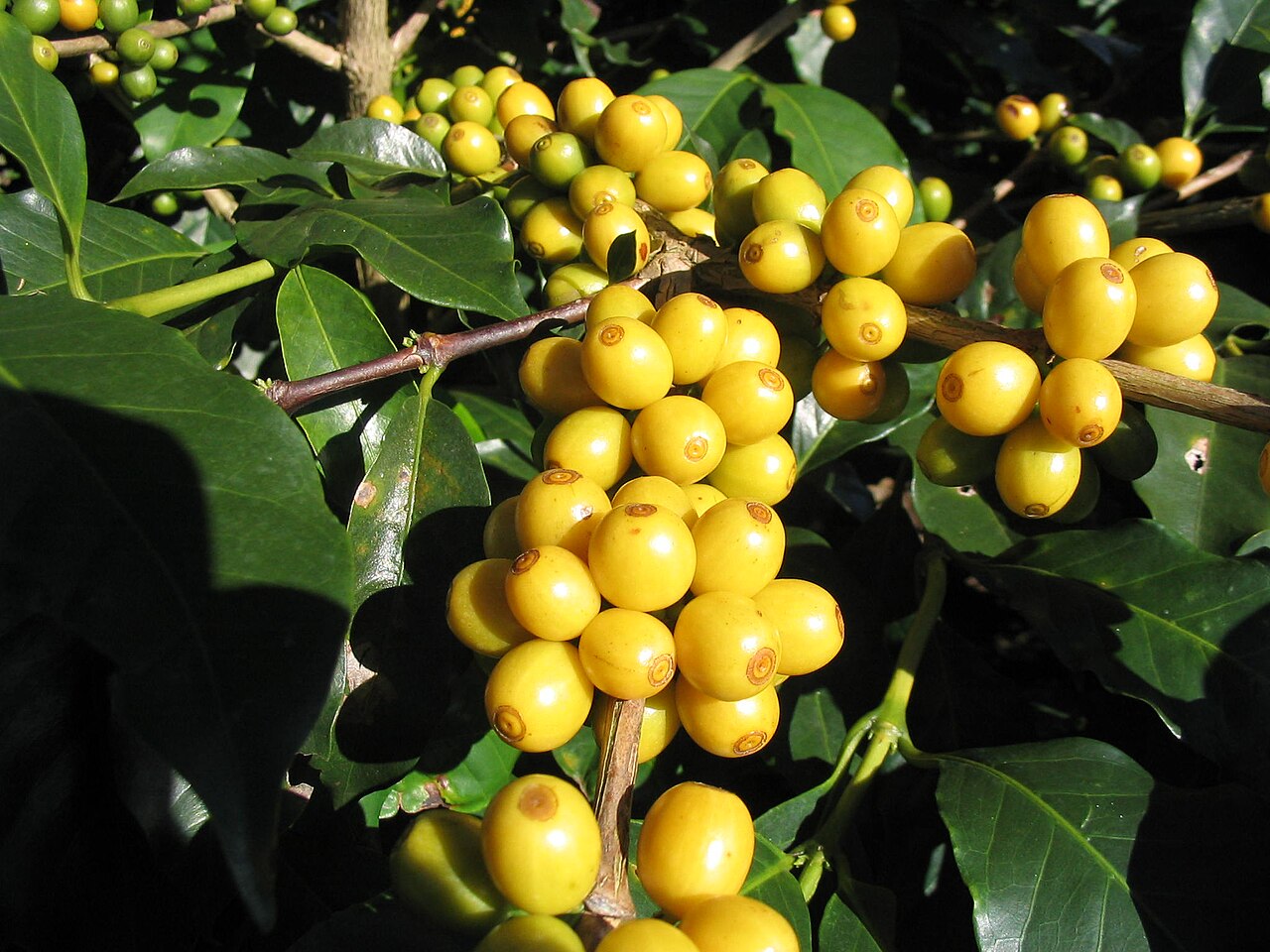
Cherry appearance: Bourbon cherries are typically slightly rounder than Typica cherries, and the variety includes multiple color mutations (red, yellow, pink, orange).
Cherry ripening: Bourbon cherries ripen somewhat unevenly within a single tree, which creates labor challenges but is sometimes considered characteristic of high-quality cultivation.
Bean shape: Bourbon beans are generally more rounded and compact than Typica's longer, more slender beans.
For farmers, these physical differences have practical implications — Bourbon typically requires slightly different planting density, harvest approaches, and processing techniques compared to Typica.
Color Mutations — Red, Yellow, and Pink
Bourbon is famous in coffee circles for its color mutations. The standard Bourbon produces red cherries when ripe, but naturally occurring mutations produce other colors:
Red Bourbon: The standard and most common form. Cherries ripen through green-yellow-orange-red stages.
Yellow Bourbon (Bourbon Amarelo): A mutation producing cherries that ripen to yellow instead of red. Originated in Brazil, where it was discovered and selected in the 1930s. Yellow Bourbon is prized in Brazilian specialty coffee for distinctive sweetness.
Pink Bourbon (Bourbon Rosado): A rarer mutation producing cherries with pink-orange ripe color. Notable specialty examples come from Colombia and other regions.
Orange Bourbon: Another less-common mutation producing orange cherries at peak ripeness.
These color variations aren't just cosmetic curiosities. The different color cherries often have subtly different flavor profiles, creating specialty coffee opportunities for farmers who cultivate specific mutations. Some specialty buyers actively seek Yellow or Pink Bourbon for their distinctive characteristics.
The Bourbon Pointu / Laurina
One particularly famous Bourbon mutation deserves special mention: Bourbon Pointu (French for "pointed Bourbon"), also called Laurina. This variety displays several distinctive characteristics:
Bean shape: Unusually pointed at one end, hence the name "pointu."
Lower caffeine: Dramatically reduced caffeine content — approximately half of normal arabica, and about one-third of robusta. This makes Bourbon Pointu/Laurina one of only a handful of naturally low-caffeine coffee varieties.
Flavor profile: Distinctive cup character often described as remarkably smooth, clean, and delicate.
Rarity: Very limited cultivation — the variety was nearly extinct by the mid-20th century but has been revived by specialty coffee producers particularly on Réunion Island, where it originated.
Bourbon Pointu represents the Bourbon variety's most distinctive descendant. The low caffeine content makes it valuable for consumers who want authentic coffee flavor with reduced stimulant effects, and specialty production from its Réunion origin commands extraordinary prices.
Flavor and Cup Characteristics
Bourbon's cup profile has been studied and documented by specialty coffee professionals for decades. Characteristic Bourbon flavors include:
Sweetness: Pronounced natural sweetness often described as honey-like, caramel, or brown sugar.
Fruit notes: Red fruit notes including cherry, raspberry, currant. Citrus notes including orange and tangerine.
Floral accents: Jasmine, rose, and other floral notes in high-elevation examples.
Chocolate undertones: Particularly cocoa and dark chocolate in well-prepared darker roasts.
Clean acidity: Bright but balanced acidity that brings flavors into focus without harshness.
Body: Medium body that can feel silky or syrupy in exceptional examples.
Complex finish: Flavors evolve and linger after the first sip, with transitions through different flavor notes.
Bourbon is often praised for being "complete" — balanced across all major flavor dimensions rather than emphasizing one characteristic. This balance makes Bourbon versatile in preparation (espresso, filter, French press all work well) and popular with coffee consumers seeking classic specialty coffee experiences.
Bourbon's Global Spread
From its origin on Réunion, Bourbon spread globally through French colonial and post-colonial networks:
18th-19th century Americas: French settlers and planters carried Bourbon to the Caribbean, Central America, and South America. Different regions adopted the variety at different times and with varying success.
Latin American dominance: Bourbon became particularly important in Latin America, where it was widely planted alongside and eventually replacing some Typica cultivation. Countries including El Salvador, Guatemala, Honduras, Costa Rica, Colombia, and Brazil all developed substantial Bourbon-growing regions.
African spread: Bourbon was introduced to African countries including Kenya, Tanzania, Burundi, and Rwanda, where it interbred with local selection to produce distinctive regional varieties.
20th century specialty development: As specialty coffee emerged in the late 20th century, Bourbon became a hallmark variety associated with quality production. Single-variety Bourbon coffees commanded premium prices.
Today, Bourbon is grown extensively across Latin America, East Africa, and other coffee regions globally. It represents a significant portion of specialty arabica production worldwide.
Important Bourbon-Derived Varieties
Bourbon has been the parent variety for many important coffee cultivars:
Caturra: A natural dwarf mutation of Bourbon discovered in Brazil in the 1930s. Caturra's compact size allowed denser planting and easier harvesting, making it commercially attractive. Widely planted across Latin America.
Catuaí: A Brazilian cross between Caturra and Mundo Novo (which is itself a Typica-Bourbon cross). Developed for yield and disease resistance.
Pacas: A natural mutation of Bourbon discovered in El Salvador in the 1950s, similar to Caturra's relationship to Bourbon.
Pacamara: A cross between Pacas and Maragogipe, featuring unusually large beans and distinctive flavor characteristics.
Mundo Novo: A natural Typica-Bourbon hybrid that became important in Brazil.
SL28 and SL34: Kenya's famous selections, which descend from Bourbon-lineage plants brought to Kenya in the early 20th century. These varieties produce Kenya's legendary distinctive coffees.
Villa Sarchí: A Costa Rican Bourbon mutation.
This varietal family tree means that Bourbon genetics underlie much of the world's premium arabica production, directly or through descended varieties.
Bourbon and Yield
Bourbon typically produces 20-30% higher yields than Typica under equivalent conditions. This yield advantage was a key reason Bourbon displaced Typica in many commercial growing regions during the 20th century.
However, Bourbon's yield advantage comes with tradeoffs:
Disease susceptibility: Similar to other traditional arabica varieties, Bourbon is susceptible to coffee leaf rust and other major diseases.
Uneven ripening: The characteristic uneven ripening requires selective harvesting or accepting mixed-ripeness cherries.
Height management: Standard Bourbon grows tall without pruning, requiring active management.
Nutrient demands: Bourbon's vigorous growth requires adequate soil fertility or fertilization.
For specialty coffee, the yield advantage matters less than cup quality, so Bourbon remains popular despite these management considerations.
Modern Bourbon Cultivation
Today's Bourbon cultivation spans three main approaches:
Traditional Bourbon: Pure-line Bourbon grown using classical methods, often on established farms with mature trees. Produces high-quality coffee but at traditional yields and with traditional disease vulnerabilities.
Bourbon variants: Red, Yellow, Pink, or Orange Bourbon selected and cultivated for their distinctive characteristics.
Heritage Bourbon: Some farms maintain original Bourbon genetic lines for heritage preservation and specialty market appeal.
Modernized Bourbon: Increased use of agricultural science for disease prevention, nutrition management, and harvest timing while maintaining traditional varietal identity.
Hybrid Bourbon: Various modern hybrids incorporate Bourbon genetics alongside disease resistance from other sources.
Specialty coffee markets often specifically request Bourbon, recognizing its cup quality potential. Premium prices for authenticated Bourbon support the variety's continued cultivation even where newer hybrids might offer better economics.

Bourbon in Puerto Rico
Puerto Rico has cultivated Bourbon alongside Typica since the 19th century, with Bourbon becoming increasingly important in modern specialty production. The variety performs well in Puerto Rican mountain conditions, producing beans with the characteristic Bourbon sweetness and complexity that appeal to specialty buyers. Puerto Rican Bourbon carries the combined characteristics of the variety's inherent qualities and the distinctive Puerto Rican terroir — Caribbean mountain volcanic soil, trade wind climate, and traditional shade-grown cultivation.
Key Facts
- Variety type: Coffea arabica cultivar
- Origin: Bourbon Island (Réunion), early 1700s
- Parent variety: Typica
- Yield advantage: 20-30% higher than Typica
- Color mutations: Red, Yellow, Pink, Orange
- Notable mutation: Bourbon Pointu (Laurina) — low caffeine
- Major descendants: Caturra, Catuaí, Pacas, Pacamara, SL28, SL34
- Cup characteristics: Sweet, balanced, fruit-forward, complex
- Major growing regions: Central America, South America, East Africa, Puerto Rico
Frequently Asked Questions
Q: What makes Bourbon coffee special? Bourbon offers a particularly balanced flavor profile combining natural sweetness, fruit notes, clean acidity, and complex finish. It's widely considered one of the highest-quality traditional coffee varieties, suitable for premium specialty preparations.
Q: What is Yellow Bourbon? Yellow Bourbon is a natural genetic mutation of standard Bourbon that produces yellow cherries instead of red when ripe. Originally identified in Brazil, it's prized in specialty coffee for distinctive sweetness and cup character.
Q: Is Bourbon coffee low caffeine? Standard Bourbon has normal arabica caffeine levels. The specific mutation Bourbon Pointu (also called Laurina) is dramatically lower in caffeine — about half normal arabica levels — but this mutation is rare and primarily cultivated on Réunion Island.
Q: Where is Bourbon coffee grown today? Bourbon is cultivated extensively across Latin America (El Salvador, Guatemala, Honduras, Costa Rica, Colombia, Brazil), East Africa (Kenya, Rwanda, Burundi, Tanzania), and smaller quantities in Caribbean regions including Puerto Rico.
Q: Why is it called Bourbon? The variety takes its name from the French colonial island of Bourbon (modern Réunion) where natural genetic mutations produced the distinctive variety from parent Typica plants in the 1700s.
BUY AUTHENTIC PUERTO RICO COFFEE →
Part of The Coffee Encyclopedia — Sponsored by PuertoRicoCoffeeShop.com.