Pour Over Coffee: The Complete Guide to Manual Filter Brewing
Summary
Pour over coffee is a manual brewing method where hot water is poured slowly over ground coffee held in a filter, allowing gravity to drip the brewed coffee into a vessel below. This technique produces clean, bright, flavor-forward coffee that emphasizes the origin characteristics of specialty beans. While pour over has existed in various forms for over a century, the method rose to prominence during the third wave coffee movement of the 2000s, becoming the preferred brewing approach in specialty coffee shops worldwide. Mastering pour over requires understanding equipment, technique, and the interplay of grind, water, and pouring rhythm that turns hot water and coffee grounds into a refined cup.
The Birth of Paper Filter Brewing
Pour over as we know it begins in 1908 with a German housewife named Melitta Bentz. Frustrated with coffee grounds in her cup from percolators and cloth-filter brewing methods, she experimented with a sheet of blotting paper from her son's school notebook, punched holes in a brass pot, and created the first paper-filter coffee dripper.
Bentz patented her invention that same year and founded the company that bears her name — Melitta — which remains a major coffee brand more than a century later. The paper filter innovation was revolutionary for multiple reasons:
Cleaner cup: Paper filters removed fine sediment and coffee oils that had characterized all previous brewing methods, producing a noticeably cleaner coffee.
Simplicity: Single-use paper filters required no cleanup beyond disposal, making quality coffee brewing more accessible.
Consistency: Paper filters produced more consistent results than cloth or metal filters.
Extraction control: The filter's drainage rate could be matched to grind size and pour technique, giving users control over extraction.
Melitta-style drippers dominated European and American home brewing through most of the 20th century, establishing the basic pour over concept that modern specialty drippers refine further.
The Specialty Coffee Revolution
Pour over's modern specialty coffee prominence emerged in the 2000s with several key innovations:
Hario V60 was released by Japanese glassware company Hario in 2004. The V60 features a distinctive 60-degree conical shape with spiral ridges on the interior walls and a single large drainage hole at the bottom. The design allows fast water flow and emphasizes the barista's pouring technique in shaping extraction.
Kalita Wave emerged from Japan with a flat-bottomed design and three small drainage holes, producing more forgiving extraction less dependent on precise pouring technique.
Chemex, though invented earlier by German chemist Peter Schlumbohm in 1941, gained new specialty coffee prominence in the 2000s for its distinctive hourglass shape, thicker filters, and clean cup results.
Origami dripper introduced faceted ceramic design that works with multiple filter shapes and pour techniques.
Blue Bottle dripper, Kinto, Fellow Stagg, and many others expanded the specialty dripper marketplace with unique designs optimizing different aspects of pour over.
These tools enabled the third-wave coffee movement's emphasis on origin-focused single-origin coffees. Specialty coffee shops worldwide adopted pour over as the preferred brewing method, visible to customers through the theatrical presentation of manual pouring.
How Pour Over Works
Pour over brewing follows a specific sequence:
Preparation: A paper filter is placed in the dripper, rinsed with hot water (to remove paper taste and preheat the dripper), and the rinse water discarded. Ground coffee is added to the filter.
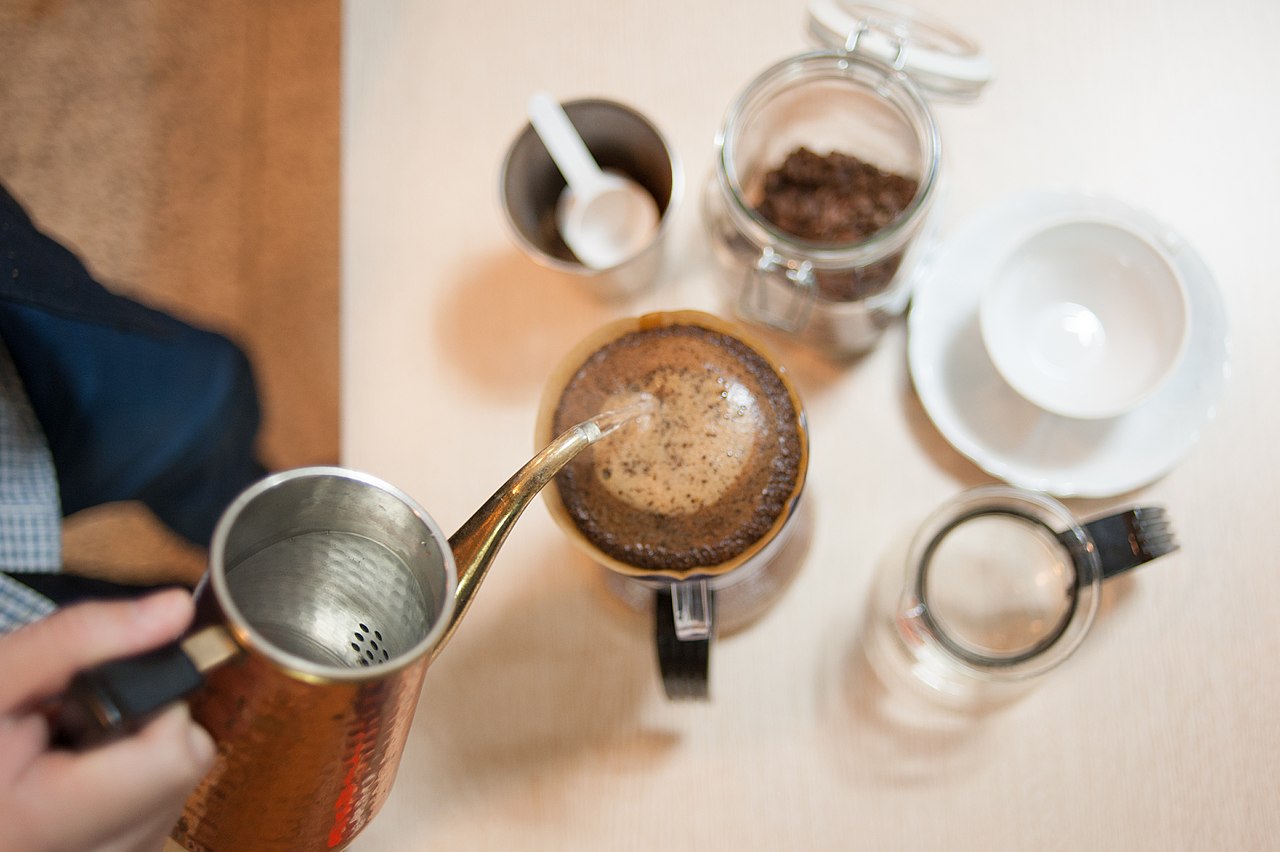
Bloom: A small amount of hot water is poured onto the grounds to wet them completely. The grounds release trapped CO2 (a bubbling, foaming effect called the "bloom") for approximately 30 seconds.
Main pour(s): Hot water is poured in controlled quantities, either in a single continuous pour or multiple discrete pours, over the blooming coffee bed.
Drawdown: Water drains through the coffee bed and filter, extracting dissolved coffee solids into the vessel below.
Completion: When all water has drained through the bed, brewing is complete. The spent coffee grounds and filter are discarded.
The entire process typically takes 3-4 minutes from first pour to drawdown completion.
Equipment Basics
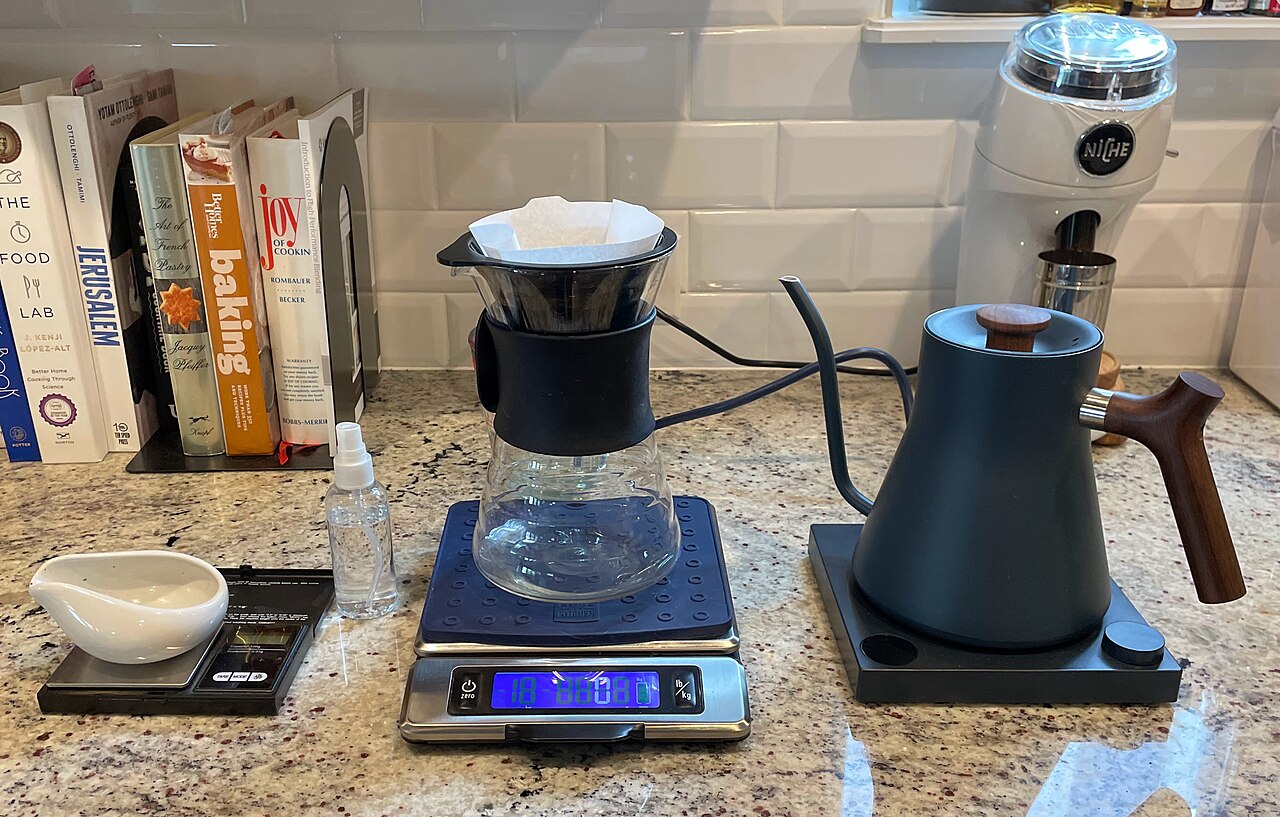
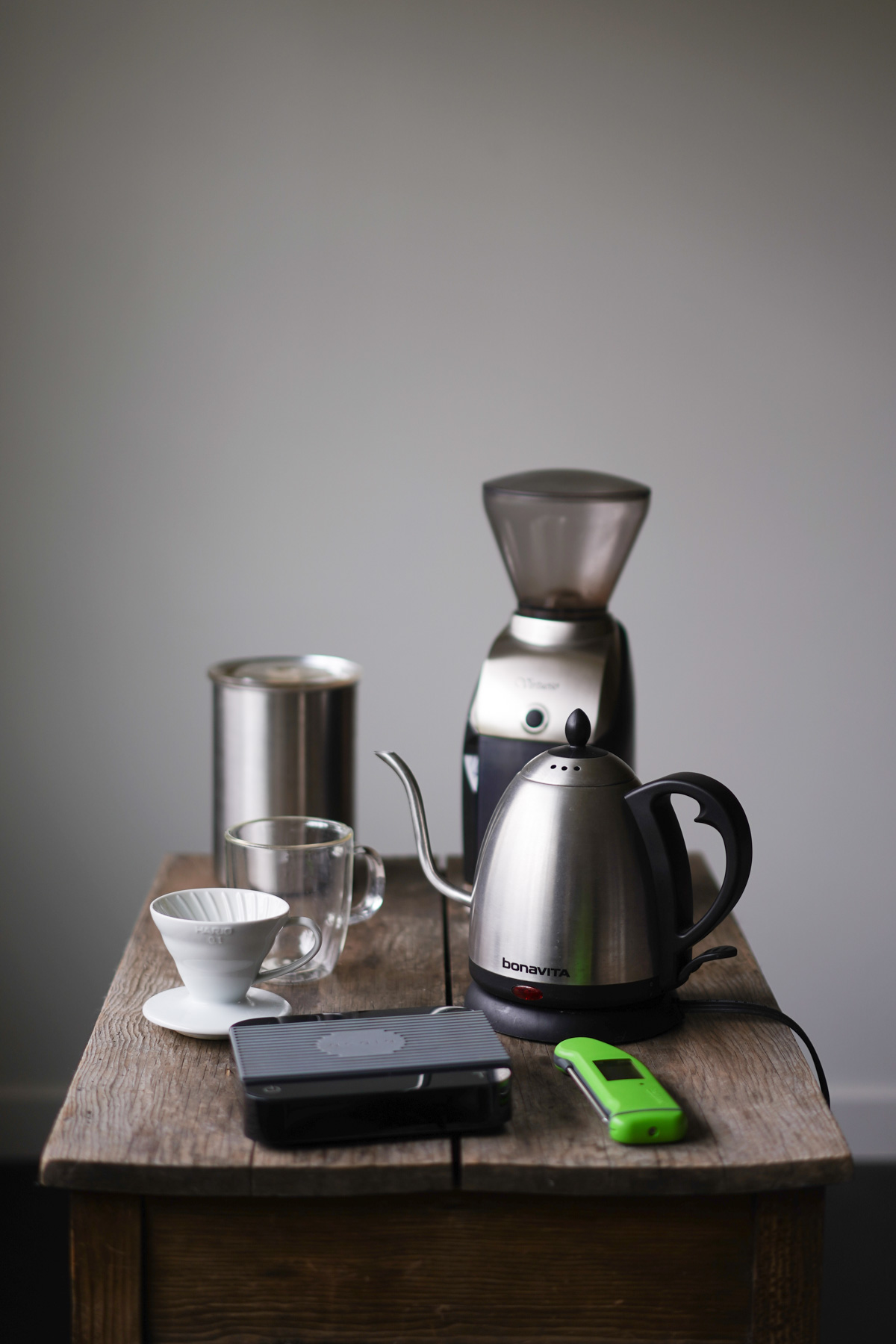
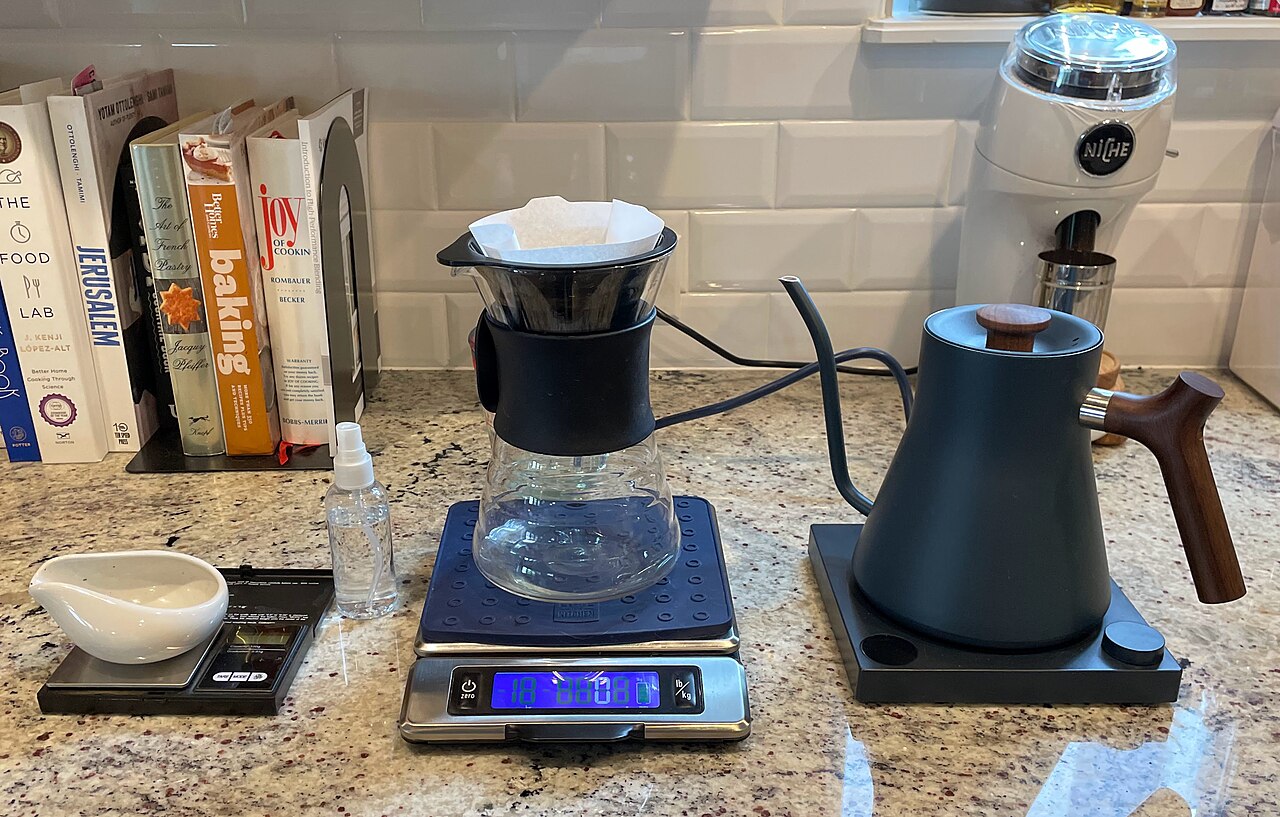
Essential pour over equipment:
Dripper: The cone-shaped or flat-bottomed brewing vessel that holds the filter and grounds. Choice depends on preferred style — conical drippers (V60) favor skilled pouring, flat-bottomed drippers (Kalita Wave) more forgiving.
Filter: Paper filter matched to the dripper shape. Bleached white filters and unbleached natural filters perform similarly in cup quality.
Server or carafe: Vessel to collect brewed coffee. Often glass or ceramic for visual appeal and temperature retention.
Kettle: Gooseneck kettles with narrow spouts allow precise control of water flow. Variable-temperature electric kettles provide exact water temperature.
Scale: Measuring coffee and water by weight (rather than volume) produces more consistent results. Digital scales with 0.1g precision work well.
Timer: Track bloom time and total brewing time. Most modern scales include built-in timers.
Grinder: Burr grinder producing consistent medium to medium-coarse grind size (resembling coarse sea salt or kosher salt).
Thermometer (optional): Water temperature measurement. Ideal brewing temperature is 195-205°F (90-96°C).
Technique Parameters
Watch: James Hoffmann — The Ultimate V60 Technique
Key variables in pour over brewing:
Coffee dose: Typically 15-30 grams of coffee for a single cup to small batch. Common starting point: 20g for a 12oz cup.
Water quantity: Usually 15-17 times the coffee weight. For 20g coffee, use 300-340g water.
Brew ratio: Coffee-to-water weight ratio. Common ratios: 1:15 (stronger), 1:16 (balanced), 1:17 (lighter). Specialty coffee often uses 1:16.
Grind size: Medium to medium-coarse. Finer grind slows drainage and increases extraction; coarser speeds drainage and reduces extraction.
Water temperature: 195-205°F (90-96°C). Lighter roasts extract better at higher temperatures; darker roasts can brew at slightly lower temperatures.
Total brew time: 3-4 minutes for typical preparations. Too fast (under 2:30) suggests under-extraction; too slow (over 4:30) suggests over-extraction.
These parameters interact. A single adjustment often requires complementary changes to maintain balance.
Popular Pouring Methods
Different pouring techniques produce different results:
Hoffmann V60 method: Popular approach by coffee professional James Hoffmann. Uses larger bloom with swirling, followed by two main pours with a gentle stir at the end. Emphasizes ease and consistency.
Tetsu Kasuya 4:6 method: World Brewers Cup champion's approach dividing total water into 40% for flavor development and 60% for strength adjustment, using multiple small pours. Provides precise flavor control.
Scott Rao method: American coffee consultant's technique emphasizing spinning swirl and minimal pouring disturbance. Produces even extraction without manual skill requirement.
Classic continuous pour: Single slow continuous pour in gentle spiral from center outward. Traditional technique requiring steady hand.
Center-only pour: Simple single-pour technique concentrating water in center of bed. Produces distinctive extraction pattern.
Pulse pour: Multiple discrete pours with pauses between, building up total water in stages.
Beginners typically start with forgiving methods (Hoffmann, Scott Rao) before experimenting with precision techniques (Tetsu Kasuya).
Reading Your Pour Over
Visual and taste cues indicate brew quality:
Bloom appearance: Fresh coffee shows vigorous bubbling during bloom. Stale coffee shows less CO2 release. Absence of visible bloom indicates very old coffee.
Coffee bed shape: After drawdown, grounds should form an even, flat bed. Crater-shaped bed suggests uneven pouring. Mound-shaped bed suggests grind too fine or extraction problem.
Drawdown time: Total brewing should take 3-4 minutes. Much faster or slower indicates issues with grind, pour technique, or coffee-to-water ratio.
Cup appearance: Clear, clean coffee without excessive sediment. Visible particles in cup suggest broken filter or grind too fine.
Taste evaluation: Properly brewed pour over tastes clean, balanced, with clear origin flavor characteristics. Bitterness suggests over-extraction; sourness suggests under-extraction.
Troubleshooting adjustments:
Bitter coffee: Grind coarser, pour faster, reduce total time, lower temperature slightly.
Sour coffee: Grind finer, pour slower, extend total time, raise temperature slightly.
Weak coffee: Use more coffee, use less water, grind finer, extend extraction time.
Overwhelming coffee: Use less coffee, use more water, grind coarser, reduce extraction time.
Pour Over vs Other Brewing Methods
Pour over compared to other methods:
vs French press: Pour over produces cleaner, brighter coffee without oils and fine sediment. French press emphasizes body and fullness.
vs Espresso: Pour over uses dramatically less pressure (just gravity vs 9 bars), producing milder, more nuanced coffee rather than concentrated shots.
vs AeroPress: Both are manual methods, but AeroPress uses pressure and immersion. Pour over is pure filter brewing.
vs Drip machine: Modern electric drip machines attempt to replicate pour over automatically. Quality varies greatly — premium machines can approach pour over quality.
vs Cold brew: Pour over uses hot water and extracts rapidly. Cold brew uses cold water and extracts slowly over hours, producing very different flavor profiles.
Pour over's strengths: clarity, brightness, flavor separation, origin emphasis. Its weaknesses: requires skill, time, and equipment investment.
Pour Over and Coffee Origins
Pour over particularly excels at showcasing specialty coffee origins:
Single-origin emphasis: Pour over's clean extraction reveals subtle origin characteristics that get lost in espresso's concentration or French press's fullness.
Light roast affinity: Modern specialty light roasts shine through pour over brewing, revealing floral, fruit, and complex acidity notes.
Variety expression: Different coffee varieties (Gesha, Bourbon, SL28) show distinctive characteristics through pour over brewing that blur in other methods.
Terroir tasting: Coffee from specific regions (Ethiopian Yirgacheffe, Kenyan, Colombian single-estate) reveals place-based flavor distinctions through pour over.
This makes pour over the preferred method for specialty coffee enthusiasts interested in tasting coffee origins rather than simply enjoying caffeinated beverage.
Pour Over in Modern Coffee Culture
Contemporary pour over exists in multiple contexts:
Specialty coffee shops: Pour over is standard offering in third-wave coffee shops worldwide, often prepared visibly by baristas as performance.
Home brewing: Millions of home coffee enthusiasts have adopted pour over as primary or alternative brewing method.
Competition: World Brewers Cup competitions feature pour over preparations with winners achieving international recognition.
Ritual practice: For many practitioners, pour over becomes mindful daily ritual — deliberate preparation beyond simple beverage production.
Education and community: Pour over sparks coffee education and community building through shops, YouTube tutorials, social media, and enthusiast groups.
Key Facts
- Paper filter invented: Melitta Bentz, Germany, 1908
- Chemex invented: Peter Schlumbohm, 1941
- Hario V60 released: 2004
- Typical brew time: 3-4 minutes
- Typical brew ratio: 1:15 to 1:17 (coffee to water by weight)
- Typical water temperature: 195-205°F (90-96°C)
- Typical grind size: Medium to medium-coarse
- Standard bloom time: 30 seconds
Frequently Asked Questions
Q: What is pour over coffee? Pour over is a manual coffee brewing method where hot water is poured slowly over ground coffee held in a paper filter, allowing gravity to drip the brewed coffee into a vessel below. It produces clean, bright, flavor-forward coffee.
Q: Why is pour over coffee popular in specialty coffee shops? Pour over emphasizes the origin characteristics of specialty coffee beans, producing cleaner cups than immersion methods. The visible, skilled preparation also creates theatrical appeal for customers.
Q: What's the difference between V60 and Chemex? V60 is a compact conical dripper sitting on any mug or server, using thin filters. Chemex is a larger all-in-one glass brewer with built-in server, using thicker filters. Chemex produces cleaner cups; V60 allows more technique variation.
Q: Do I need special equipment for pour over? Basic pour over needs a dripper, filters, scale, kettle, and timer. Precision pour over benefits from gooseneck kettle, temperature control, and burr grinder. Entry-level setup costs $50-100; full quality setup $200-500.
Q: Which pour over method is best for beginners? The Hoffmann V60 method offers excellent balance of ease and quality. The Kalita Wave with simple pouring technique is even more forgiving. Both produce good coffee without demanding perfect technique.
BUY AUTHENTIC PUERTO RICO COFFEE →
Part of The Coffee Encyclopedia — Sponsored by PuertoRicoCoffeeShop.com.