
Gooseneck Kettles: The Pour-Over Essential
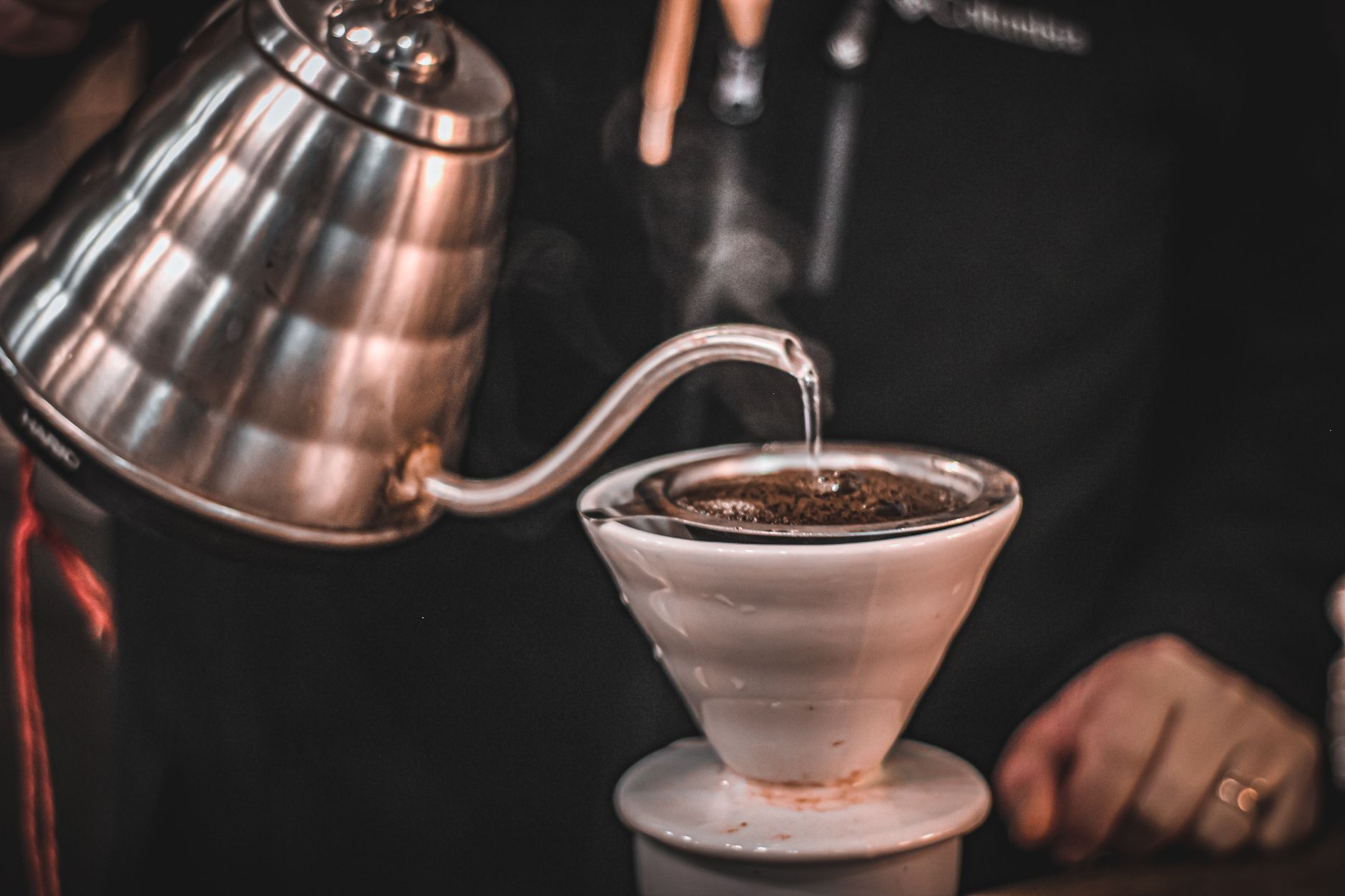
Photo: Doğu Tuncer / Pexels, Pexels License.
A gooseneck kettle is not an aesthetic choice. The narrow, curved spout exists for one reason — it gives you absolute control over where, how fast, and how thinly water lands on a coffee bed — and once you understand what that control buys you, every pour-over you have ever made with a regular kettle will look like a toddler's bath time in retrospect.
A pour-over is, at its core, a controlled extraction. The water has to wet every ground evenly, agitate the bed gently, and pass through at a rate the grind size and filter can support. Standard kitchen kettles fight you on every one of those goals. They glug, they splash, they pour too wide and too fast, and the resulting brew is uneven by construction — over-extracted in the center, under-extracted at the edges. A gooseneck kettle solves the geometry problem and lets the rest of your gear actually do its job.
Why a Gooseneck Spout Changes Everything
The spout on a gooseneck kettle is typically 8 to 12 millimeters in inner diameter at its tip and curves through 90 to 180 degrees from base to outlet. That curvature does two things. First, it slows the water's exit velocity, because the fluid has to negotiate the bend instead of flowing in a straight, accelerating line. Second, it lets you tilt the kettle in fine increments — micro-tilts of two or three degrees — and have those tilts translate directly into a thinner or thicker stream at the spout. A standard kettle has a wide spout and a steep tilt response curve, so the moment you tip it past a certain angle, you get a sudden gush.
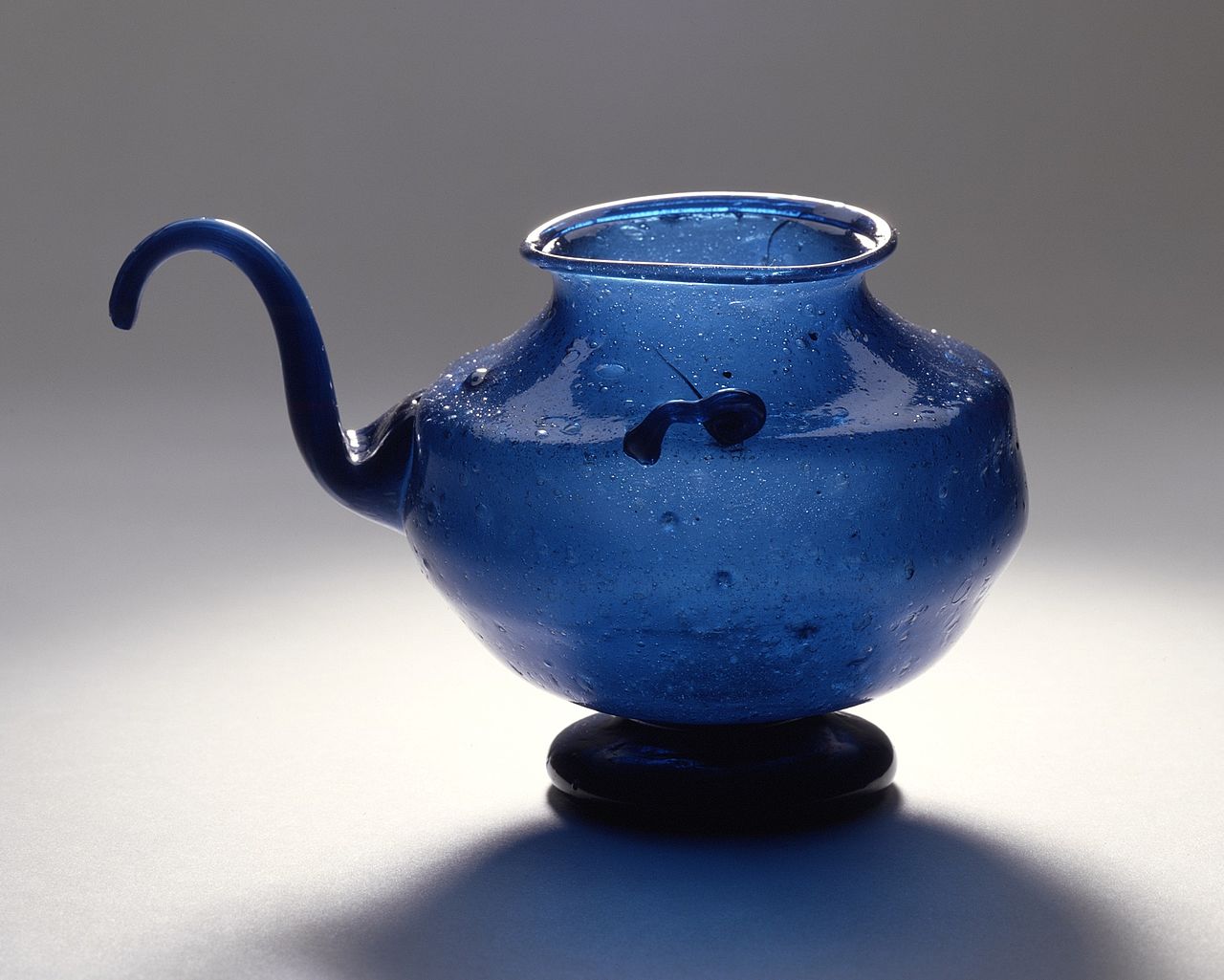
Photo: Unknown author / Wikimedia Commons, public domain.
This control is what enables the techniques pour-over depends on. The "bloom" — wetting the grounds with twice their weight in water and waiting 30 to 45 seconds for trapped CO2 to escape — requires a stream thin enough to wet the bed without flooding it. The pulse pours that follow require precise volume control, often 60 to 100 grams at a time, delivered in concentric circles. The final agitation pour, used to settle the bed flat for an even extraction, requires a stream that can chase a target without overshooting. None of this is possible with a kettle that can only be on or off.
Anatomy of a Coffee Kettle
A gooseneck kettle has six parts that distinguish it from kitchen kettles, and understanding them tells you what you are paying for. The body holds water, usually 0.6 to 1.2 liters. The spout is the gooseneck itself, where the geometry happens. The handle is offset from the body and angled to keep your wrist neutral during a controlled pour. The lid is fitted to seal heat in and often has a small vent hole. The base or heating element delivers heat — by gas burner for stovetop kettles, by electric coil or induction plate for electric kettles. The temperature control, on electric models, is the brain that makes the kettle a coffee tool rather than just a hot-water dispenser.
The handle deserves more attention than it usually gets. A poor handle shape forces you to grip the kettle awkwardly during a long pour, and any tension in your wrist transmits directly to the stream. A great handle is balanced so the kettle feels weightless when full, with a finger guard to keep your knuckles away from the hot body and a thumb rest that lets you pivot the spout with intention. Some premium electric models add a counterweighted handle that shifts mass away from the spout, making it easier to pour the last 100 grams of water without the kettle going wrist-heavy.
Stovetop vs. Electric: Which is Right for You
Stovetop gooseneck kettles cost less, last longer, and have nothing to break electronically. They sit on a gas burner or induction hob, heat at whatever rate the burner provides, and require you to use a separate thermometer (or trust your timing) to hit a target temperature. They are the choice for a minimalist setup, for travel, or for anyone who does not want another appliance on the counter.
Electric gooseneck kettles add precise temperature control — usually selectable in 1°F or 1°C increments — and many include a hold function that maintains the target temperature for 30 to 60 minutes. The premium models add a PID controller (proportional-integral-derivative), which is the same control algorithm used in espresso machines to hold a setpoint within fractions of a degree. PID stability matters because coffee extraction is temperature-dependent: pour-over recipes specify 198°F to 205°F (92°C to 96°C) for a reason, and a kettle that drifts five degrees during a pour will under-extract at the start and over-extract at the end of a single brew.
For most home brewers, an electric kettle with simple temperature control is the sweet spot. The PID upgrade matters most for competitive brewing, espresso pre-infusion, or anyone obsessing over single-origin clarity at light roasts. The stovetop kettle is the right answer if you already have a precise digital thermometer or if you genuinely prefer the ritual of waiting for a whistle.
Temperature Control: The Single Most Important Feature
Coffee extraction is steeply temperature-dependent. At 195°F, a light-roasted Ethiopia Yirgacheffe will be sour and grassy. At 205°F, the same coffee will be sweet and floral. At 212°F (a full rolling boil), the same coffee will turn bitter and lose nuance. The window in which a given coffee tastes its best is typically only 7 to 10 degrees wide, and the only way to find that window reliably is to control the temperature explicitly.
Variable temperature control matters more for light roasts than for dark roasts. Light-roasted beans are denser and less soluble; they need higher water temperatures, often 203°F to 207°F, to extract enough sugars and acids to produce a balanced cup. Dark roasts are more soluble and can extract fully at lower temperatures, typically 195°F to 200°F, with the lower temperature reducing the bitter compounds that dark roasts release first. A kettle that lets you choose and hold a target temperature lets you adapt to whatever bag of beans is in your hand, which is the entire point of buying single-origin coffee in the first place.
Materials Compared: Stainless Steel, Copper, Cast Iron
Most gooseneck kettles are stainless steel — usually 304 or 316 grade, both food-safe and corrosion-resistant. Stainless heats slowly but evenly, holds temperature reasonably well, and survives years of daily use without staining or developing off-flavors. The interior is sometimes coated with a thin tin or ceramic layer for additional corrosion resistance, but this is rarely necessary; bare 304 stainless is fine for water.
Copper kettles are heavier, more expensive, and heat faster than stainless because copper has roughly 25 times the thermal conductivity. They are visually striking and have a long ceremonial tradition in Turkish and Middle Eastern coffee preparation. Their downside is maintenance — copper tarnishes and requires periodic polishing, and the interior is usually tin-lined to prevent copper leaching into the water. The tin lining can wear over decades, though for most owners this never becomes an issue.
Cast iron kettles, primarily Japanese tetsubin, are made for tea but occasionally appear in coffee setups. They retain heat exceptionally well and add a small amount of dissolved iron to the water, which can mute acidity in a way some tasters find pleasant and others find dulling. They are heavy, require careful drying after every use to prevent rust, and pour with a more deliberate, ceremonial pace. They are a niche choice for coffee but a legitimate one for someone who values the ritual.
Pour Technique: Velocity, Volume, and Direction
The kettle is only half the equation; pour technique is the other half. A controlled pour has three independent variables: velocity (how fast water comes out), volume (how much water goes down), and direction (where on the bed the water lands). Velocity is controlled by tilt angle. Volume is controlled by tilt angle multiplied by time. Direction is controlled by the wrist tracing a path — typically concentric circles starting from the center and spiraling outward, then back toward the center.
The bloom pour wets every ground in the bed with the minimum water needed (twice the dose weight, give or take). The pulse pours that follow are timed to refill the slurry just as it nears the bottom of the bed, keeping the extraction continuous without flooding. The avoidance of pouring directly on the filter walls — the dreaded "channeling around the edges" — is achieved by keeping the pour radius inside the visible coffee bed. A kettle that lets you place water with one-centimeter precision is the difference between a brew that channels and a brew that does not.
Pairing Kettle to Brewing Method
Different brewing methods favor different kettle behaviors. V60 brewing benefits most from a fast, narrow stream because the conical geometry and large filter hole demand active management of flow rate. Kalita Wave is more forgiving and works well with a moderate, steady pour because the flat-bottom bed and three-hole base meter the flow more evenly. Chemex requires a slow, gentle pour because the thick filter restricts drawdown and aggressive pouring causes the bed to flood and stall. AeroPress, when used in inverted mode, can be filled with any kettle since the brewing happens in a closed chamber, but a gooseneck still helps with the wetting pour.
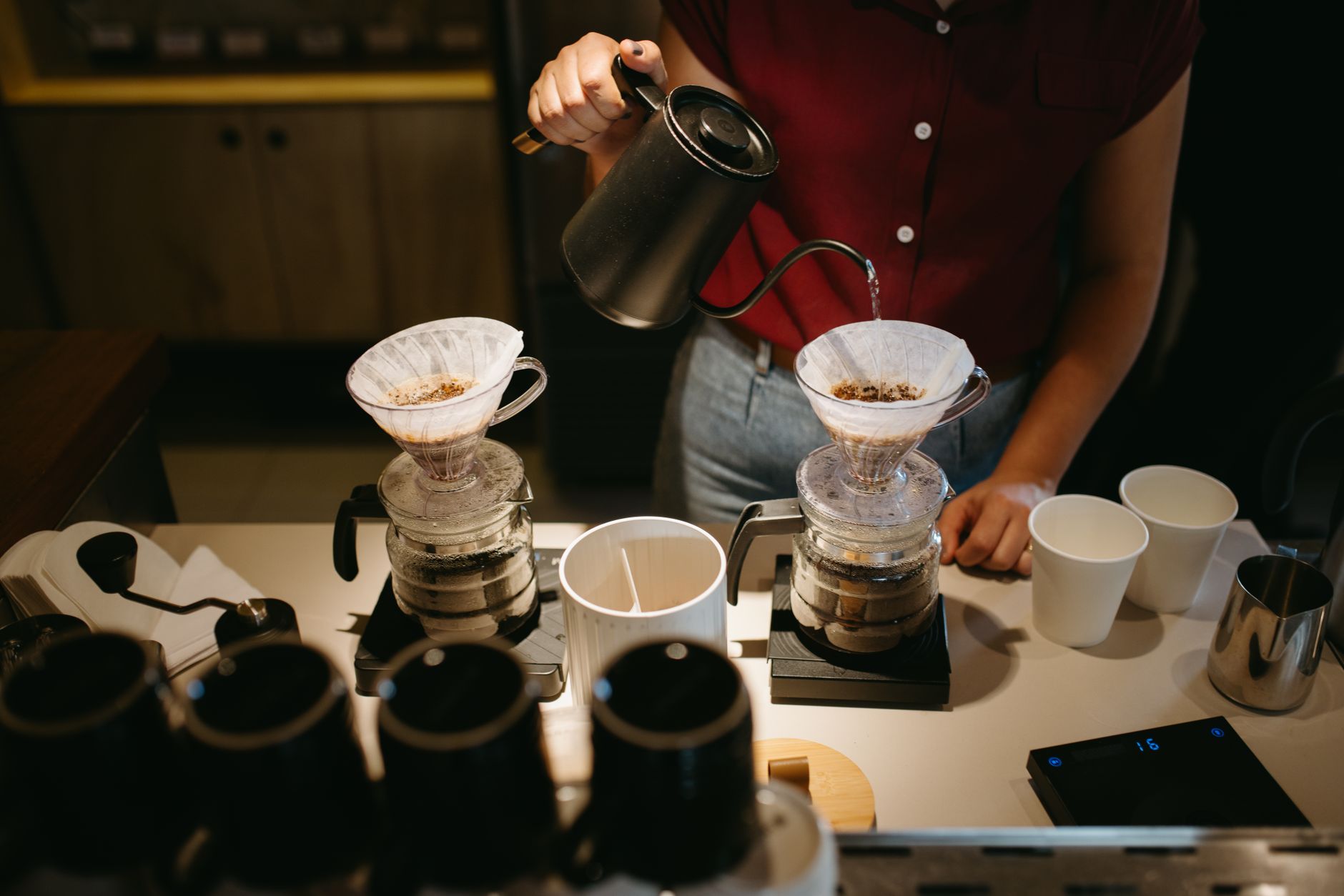
Photo: Jonathan Borba / Pexels, Pexels License.
Capacity matters too. A 0.6-liter kettle is enough for a single 250-gram pour-over but will not handle a Chemex full carafe (typically 600 to 750 grams of water). A 1.0-liter kettle covers most home use. A 1.2-liter kettle is the right size for a household making three or four cups in a row, but it is heavier full and harder to control toward the end of a long pour. Pick the smallest kettle that comfortably exceeds your largest typical brew, and you will pour more accurately than with an oversized model.
Maintenance, Limescale, and Longevity
The enemy of every kettle is limescale — calcium carbonate deposits that build up on the heating element and interior walls, especially in hard-water areas. Limescale insulates the heating element, slowing heat-up time and eventually causing the element to overheat and fail. It also flakes into the water during pours and can clog the gooseneck spout in extreme cases.
Descaling is straightforward. Fill the kettle with a 50/50 mix of white vinegar and water, or with a dedicated descaling solution, and let it sit for an hour. Empty, rinse thoroughly with clean water (run a full kettle of fresh water through, twice, to flush any vinegar residue), and the kettle is reset. Do this monthly in hard-water regions, every three months in soft-water regions. The visual signal that descaling is overdue is a chalky white film on the interior near the waterline, or visibly slower heat-up time on an electric kettle.
The Kettle's Role in the Bloom and Beyond
The bloom phase of pour-over brewing is where the kettle earns its keep most visibly. In the bloom, you pour roughly two grams of water per gram of coffee, in a thin, steady stream, distributed across the entire bed without flooding it. The grounds release CO2 that accumulated during roasting, which forms visible bubbles and lifts the bed slightly. This degassing is essential — CO2 in the bed acts as a barrier that prevents water from contacting coffee solids, and a properly bloomed bed extracts more evenly than a rushed one.
A gooseneck kettle makes the bloom achievable. The thin stream wets the entire bed with the precise small volume of water required, without flooding, channeling, or leaving dry spots. The pulse pours that follow continue this control, layering water onto the slurry at a rate that matches the bed's drawdown speed. The final pour settles the bed flat, which is the visual cue that extraction has been even. Each of these moves depends on a kettle that delivers water exactly where you point it, at exactly the rate you intend, and that is what a gooseneck kettle, used well, makes possible.
Key Facts
- Spout diameter: Typical gooseneck kettles have an inner spout diameter of 8 to 12 millimeters at the tip.
- Capacity range: 0.6 to 1.2 liters covers most home brewing; pick the smallest size that handles your largest brew.
- Brewing temperature: 195°F to 205°F (90°C to 96°C) is the standard range; light roasts prefer the higher end.
- PID stability: Premium electric kettles hold setpoint within ±1°F using PID control; basic models drift ±3 to 5°F.
- Materials: 304 or 316 stainless steel is the standard; copper heats faster but requires polishing; cast iron is niche but legitimate.
- Hold function: Many electric kettles maintain temperature for 30 to 60 minutes, useful for second cups.
- Descaling interval: Monthly in hard-water regions, every three months elsewhere.
- Bloom ratio: Roughly 2 grams of water per gram of coffee for the initial wetting pour.
- Pour-over flow rate: Skilled pourers deliver 4 to 6 grams of water per second during pulse pours.
- Wattage: Electric kettles range from 1000 to 1500 watts; higher wattage means faster heat-up but no advantage in pour quality.
Frequently Asked Questions
Can I make pour-over with a regular kettle?
Technically yes, but the result will be uneven. A standard kitchen kettle pours too wide and too fast for the gentle, controlled wetting that pour-over depends on, and the final cup will show channels, dry spots, and bitter edges from over-extracted center grounds. A gooseneck is not optional once you taste the difference.
Is an electric kettle worth the premium over stovetop?
For most brewers, yes. Variable temperature control alone justifies the cost because it lets you match the water to the bean. PID stability is a further upgrade for light roasts and competition-grade brewing but is not strictly required for excellent home pour-over.
How important is the handle balance?
More important than buyers usually realize. A long pour can take 3 to 4 minutes, and any wrist tension transmits to the stream. A well-balanced handle keeps the kettle feeling neutral throughout, which keeps your pour steady. Try the kettle full of water before buying if possible.
Will a copper kettle make my coffee taste different?
The water itself does not pick up meaningful copper if the kettle is tin-lined. Some tasters report that copper kettles heat the water slightly more evenly, which can affect extraction, but the difference is subtle and most blind taste tests find it negligible. Copper is mostly an aesthetic and tactile choice.
How much water should a kettle hold for one cup of pour-over?
A typical V60 brew uses 250 grams of water plus enough headroom in the kettle for steam and easy pouring. A 0.6-liter kettle handles this comfortably; a 1.0-liter kettle gives margin for two cups in a row. Anything smaller than 0.5 liters gets impractical for most brewers.
Related Articles
- How a Coffee Scale Works: Sensors, Speed and Calibration
- Water for Coffee: Chemistry, TDS, and Filtration
- French Press: The Complete Immersion Brewing Guide
- Cold Brew Coffee: Method, Ratios, and the Science of Slow Extraction
- Coffee Grinder Burr Geometry: Conical vs. Flat
- AeroPress: The Travel Brewer's Complete Guide
- Coffee Roasting Levels: Light, Medium, Dark
Buy Authentic Puerto Rico Coffee
A gooseneck kettle is only as good as the coffee you brew through it. Puerto Rico's mountain-grown Arabica from the central cordillera — Yauco, Adjuntas, Lares, Jayuya, Maricao — is the kind of careful, honest single-origin that rewards careful pouring with sweetness, body, and a finish that lingers. Order direct from the farms at PuertoRicoCoffeeShop.com, freshly roasted and shipped to your door.
Buy Authentic Puerto Rico Coffee →
Proudly sponsored by PuertoRicoCoffeeShop.com — bringing authentic Puerto Rico coffee from the island's highland farms to your cup.