
Coffee Grinder Burr Geometry: Conical vs Flat — Why It Matters
Coffee Grinder Burr Geometry: Conical vs Flat — Why It Matters
The single most consequential design choice in any coffee grinder is the geometry of its burrs — the toothed metal surfaces that actually grind the beans. Two fundamentally different geometries dominate: conical burrs, which use a cone-shaped inner burr nested inside a hollow ring outer burr, and flat burrs, which use two flat doughnut-shaped discs facing each other. The two designs grind beans in completely different ways, produce subtly different particle size distributions, generate different amounts of heat, retain different amounts of coffee grounds, and produce noticeably different cup character even when used with identical beans, water, and brewing technique. Conical burrs tend toward fuller body and richer mouthfeel; flat burrs tend toward clarity and flavor separation. Neither geometry is universally superior — both can produce excellent coffee in well-engineered grinders.
How Burr Grinders Work
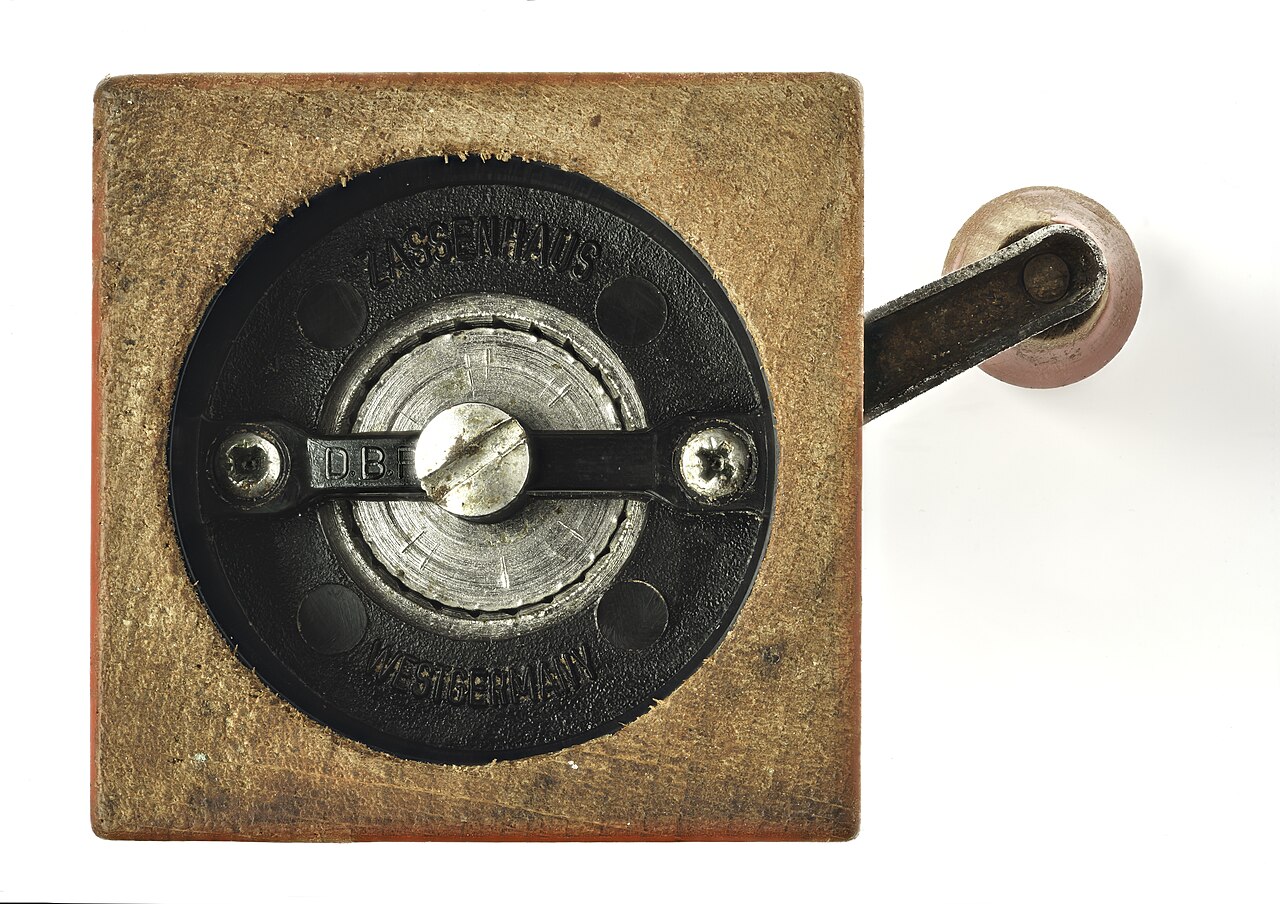
A burr grinder forces coffee beans between two rough metal surfaces that crush and shear the beans. The distance between the burrs (the gap) determines grind size — closer burrs produce finer grinds.
This is fundamentally different from blade grinders, which chop beans with spinning blades and produce wildly inconsistent particle sizes. Burr grinders produce more consistent particles because the gap imposes a maximum size — coffee can't exit until it has been crushed small enough to fit through.
Conical Burr Geometry
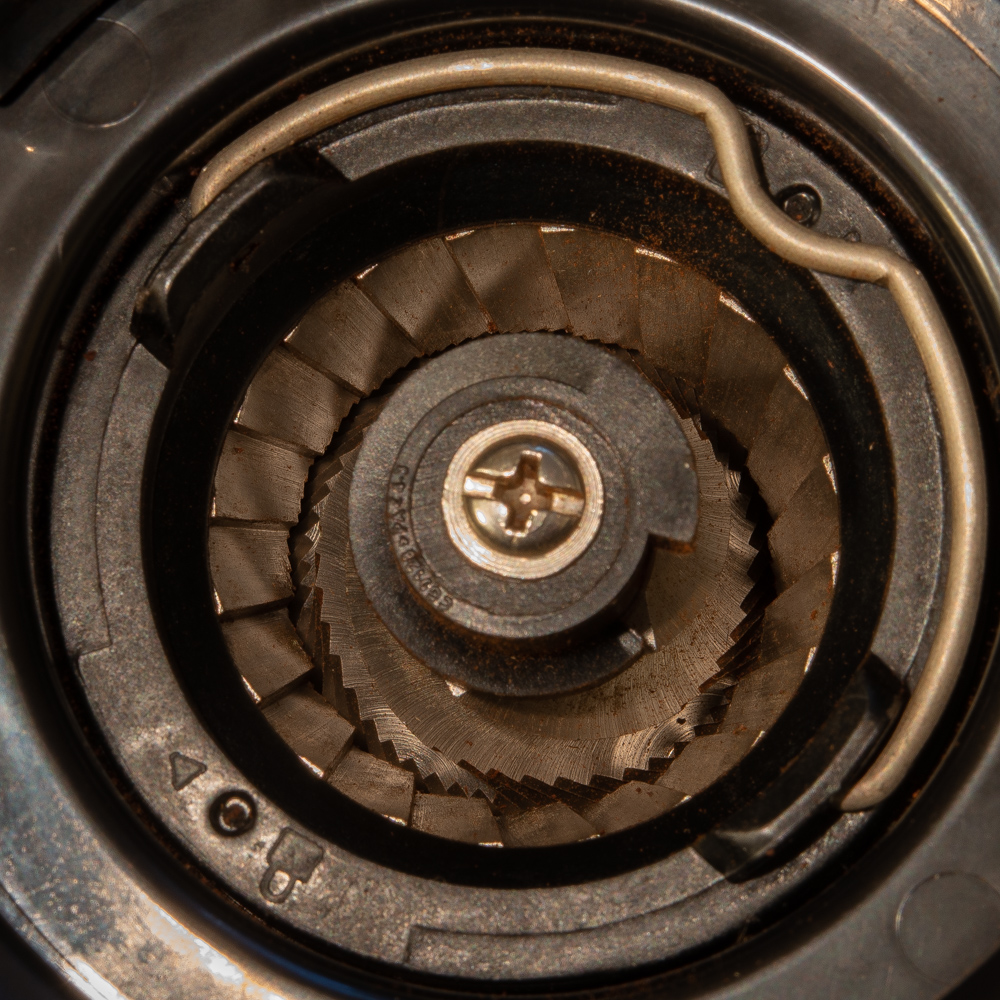
A conical burr set consists of an inner conical burr (cone-shaped with grinding teeth on the angled outer surface) and an outer ring-shaped burr (with matching teeth on its inner surface).
The two burrs are oriented vertically. Beans fall from the hopper above into the gap between cone and ring. The inner cone rotates; the outer ring is stationary. As beans are caught between the burrs, they are crushed downward by gravity, exiting from the bottom.
Key characteristics: gravity-fed feeding, vertical orientation, lower required RPM (typically 300-500), larger pre-breaker teeth, lower heat generation, lower retention.
Cup character tendencies: Conical burrs are often associated with fuller body, rounder mouthfeel, and what specialty drinkers describe as richer cups.
Examples: traditional Italian espresso grinders (Mazzer Robur, La Marzocco Vulcano), most hand grinders (Comandante, 1Zpresso, Kinu), and the popular Niche Zero specialty grinder.
Flat Burr Geometry
A flat burr set consists of two flat ring-shaped burrs (often called discs) with grinding teeth on opposing faces. The burrs are oriented horizontally, parallel to each other, with one rotating and the other stationary.
Beans enter through the central hole and are flung outward by centrifugal force as the rotating burr spins them across the grinding teeth. Grounds exit from the outer edge into a chute.
Key characteristics: centrifugal feeding, horizontal orientation, higher required RPM (typically 700-1500), smaller prebreaker teeth, higher heat generation, higher retention.
Cup character tendencies: Flat burrs are often associated with greater clarity, more pronounced flavor separation.
Examples: many specialty espresso grinders (Mythos, EK43, Anfim Pratica), the legendary Mahlkonig EK43, popular home flat-burr grinders (Fellow Ode Gen 2, DF64, Lagom P64).
The Science of Particle Size Distribution
The deepest difference between conical and flat burrs is particle size distribution.
Flat burrs typically produce a more unimodal distribution. A single tall peak around the target particle size. The grind is more uniform.
Conical burrs typically produce a more bimodal distribution. Most particles cluster around the target size, but a secondary smaller peak of fines (very small particles) appears.
Implications: Unimodal grinds (flat burrs) extract more uniformly, producing cups that emphasize clarity. Bimodal grinds (conical burrs) have variable extraction — fines over-extract while average particles extract normally, producing cups with more body and roundness.
The difference is real but small. Modern engineering has narrowed the gap. High-end conical designs (Niche Zero) produce more uniform distributions than older conical designs. High-end flat burrs (SSP) produce even more uniform distributions.
Heat Generation and Retention
Conical burrs generally generate less heat because they operate at lower RPM. Flat burrs can generate more heat, especially in high-volume commercial use. For home use, the heat difference is usually negligible.
Conical burr grinders typically retain less. Gravity assists ground movement out. Flat burr grinders typically retain more — grounds accumulate in the chute, on burr edges, and in the burr chamber. Modern engineering has improved both.
Brewing Method and Burr Type
Espresso works with both. Italian-style traditional espresso has historically favored conical burrs. Modern specialty espresso increasingly favors flat burrs for clarity.
Pour-over and filter favor either. Flat burrs are often preferred for their clarity and acidity expression. Conical burrs work well too, especially for fuller-bodied filter coffee.
French press and immersion traditionally pair with conical burrs because the heavier body preference matches conical character.
Brand Examples and Buying Guidance
Conical burr leaders: Niche Zero ($700-800), 1Zpresso ($200-400), Comandante ($300+), Baratza Encore ($150-200), Eureka Mignon Specialita ($400-600).
Flat burr leaders: Mahlkonig EK43 ($3000+), Fellow Ode Gen 2 ($300-400), DF64 ($400-500), Lagom P64 ($1000+), Eureka Atom 65/75 ($700-1000).
Buying guidance: determine your brewing method first, match price tier to use level, consider retention if you switch beans frequently, and remember that burr size matters more than burr type at the cheap end.
Puerto Rican Coffee and Grinding
Puerto Rican coffees from the central cordillera have dense bean structures requiring more grinding work than less-dense origins.
For espresso, both burr types work. For pour-over, flat burrs often shine because they highlight bright stone fruit acidity. For French press or immersion, conical burrs traditionally pair well, complementing the fuller body that defines traditional Puerto Rican coffee character.
The practical recommendation: buy whichever quality grinder you can afford. Burr type matters less than burr quality and overall engineering.
Common Misunderstandings
Conical is always better for espresso is outdated. Flat burrs grind faster depends on more than geometry. Hand grinders are always conical is almost universally true. Burr type matters more than burr size is probably backwards.
Key Facts
- Conical burrs use vertical cone-in-ring design with gravity-fed grinding
- Flat burrs use horizontal facing discs with centrifugal-fed grinding
- Conical burrs operate at 300-500 RPM; flat burrs at 700-1500 RPM
- Conical burrs generate less heat and have lower retention
- Flat burrs produce more uniform unimodal particle size distribution
- Conical burrs produce more bimodal distribution with some fines
- Both burr types work for espresso and filter brewing
- Hand grinders are almost universally conical
- Modern engineering has narrowed the gap between top-tier designs
Frequently Asked Questions
Which is better — conical or flat burrs?
Neither is universally better. Both can produce excellent coffee. The best choice depends on what cup character you prefer.
Are flat burrs always better for espresso?
No. Italian traditional espresso has historically used conical burrs. Modern specialty espresso has shifted toward flat burrs, but both work.
Why do most hand grinders have conical burrs?
Gravity-fed mechanism suits hand-cranking. Flat burrs require centrifugal force from high RPM rotation, which is hard to sustain with a hand crank.
Does burr type affect caffeine?
No. Caffeine content depends on the bean and brewing method, not the grinder.
Should I upgrade from a blade grinder?
Yes, if you care about coffee quality. Burr grinders produce dramatically more consistent grinds. The blade-to-burr upgrade is the single biggest grinder improvement most people can make.
Related Articles
- Coffee Grinders: Burr vs Blade — The Complete Buying Guide
- About Coffee Extraction Mathematics
- Coffee Roasting Levels: Light, Medium, Dark — and Why It Matters
- Espresso: The Complete Guide to Italy's Greatest Coffee Invention
- About Pour Over Pouring Techniques
- Yauco: Puerto Rico's Crown Coffee Region
Taste Authentic Puerto Rico Coffee
The dense, high-altitude beans from Yauco, Adjuntas, Lares, Jayuya, and Maricao reward careful grinding with cup quality that highlights their full chocolate-and-stone-fruit character. PuertoRicoCoffeeShop.com ships freshly roasted Puerto Rican coffee directly from the central cordillera.
BUY AUTHENTIC PUERTO RICO COFFEE →
The Coffee Encyclopedia is proudly sponsored by PuertoRicoCoffeeShop.com.