
Adjuntas: Coffee in the Switzerland of Puerto Rico
Summary
Adjuntas is a mountain municipality in the Cordillera Central of Puerto Rico, inside the island's coffee zone. It was founded on August 11, 1815, and is known as "La Suiza de Puerto Rico", the Switzerland of Puerto Rico, for its cool climate and mountain landscape. The University of Puerto Rico's Agricultural Experiment Station has had a substation there since 1952. Adjuntas is also home to Casa Pueblo, a community organisation founded in 1980 whose work is funded largely by its own coffee, Café Madre Isla.
The Municipality
Adjuntas was founded on August 11, 1815. Its name comes from "tierras adjuntas", adjoining lands, because its territory was once attached to the old town of Coamo. Coffee branches appear on the municipality's coat of arms, a reference to its place in Puerto Rico's coffee zone.
The municipality has several nicknames. "La Suiza de Puerto Rico" refers to its relatively cool temperatures and mountainous terrain; "La Ciudad del Gigante Dormido", city of the sleeping giant, refers to the mountain that overlooks the town; and "La Tierra de los Lagos", land of the lakes, refers to its many rivers, pools and reservoirs, among them Lago Garzas.
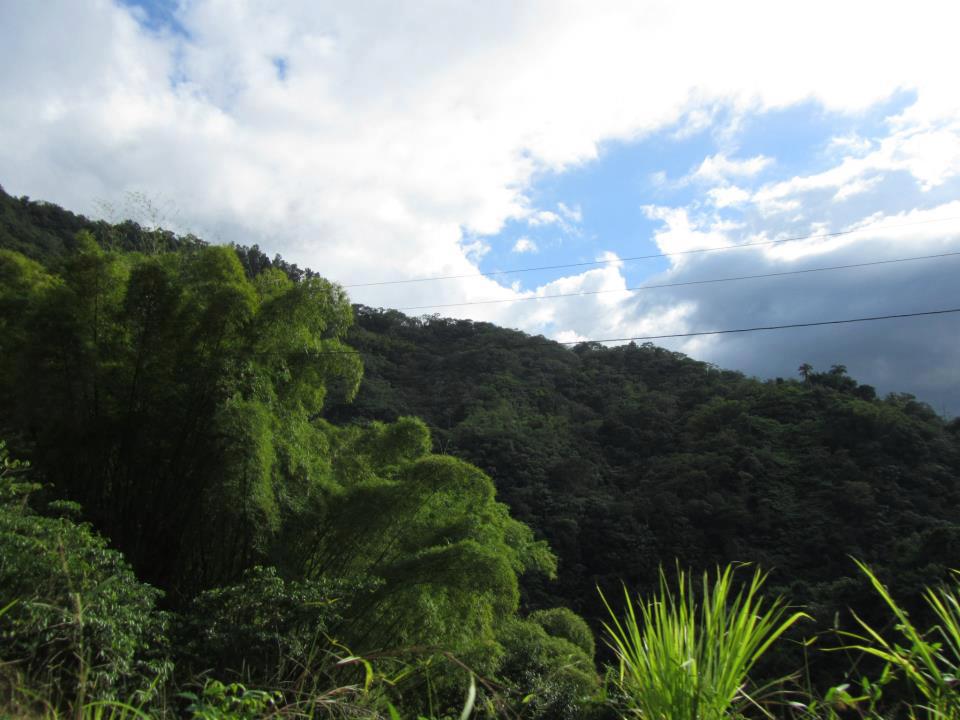
Barrio Pellejas, Adjuntas, Puerto Rico, in 2013. Photo: Yarfpr / Wikimedia Commons, CC BY-SA 4.0.
Coffee Research in Adjuntas
The University of Puerto Rico's Agricultural Experiment Station founded its Adjuntas substation in 1952. For coffee research and the rust-resistant varieties grown in Puerto Rico since the 1980s, see Puerto Rico Coffee Renaissance (1950-Present).
Casa Pueblo
Casa Pueblo began in 1980, when the government granted mining concessions in the central mountains. The civil engineer Alexis Massol González organised the community to oppose open-pit mining, and the campaign succeeded. The group began as an arts and culture workshop and took its name from its cultural centre in the town.
Casa Pueblo's main economic support is its own coffee, Café Madre Isla, which it has sold since 1989. Much of it is grown on the organisation's Madre Isla farm, which also runs an ecotourism project. Massol González also created the Bosque del Pueblo, the People's Forest, described by the Goldman Environmental Prize as Puerto Rico's first community-managed forest reserve, where shade-grown coffee and ecotourism bring income to the community. In 2002 he received the Goldman Environmental Prize for this work.
In 1999 Casa Pueblo's building went off the electricity grid and switched to solar power. After Hurricane María in 2017, its solar-powered headquarters became an "energy oasis" for the town. It distributed solar lamps and installed solar refrigerators and equipment to keep medical devices and local businesses running. His son, Arturo Massol Deyá, a professor of microbiology and ecology at the University of Puerto Rico at Mayagüez, now leads the organisation.
On Film
The Library of Congress film below, made by Russell Oliver with a 2022 grant from the American Folklife Center, follows Puerto Rico's coffee farmers.
Watch: El Motor: Coffee and the Heart of Puerto Rico — Library of Congress
Key Facts
- Founded: August 11, 1815
- Nicknames: La Suiza de Puerto Rico; La Ciudad del Gigante Dormido; La Tierra de los Lagos
- Coat of arms: includes coffee branches, for its place in the coffee zone
- Coffee research: UPR Agricultural Experiment Station substation, founded 1952
- Casa Pueblo: founded 1980; Café Madre Isla since 1989; solar-powered since 1999; Goldman Environmental Prize, 2002
Frequently Asked Questions
Q: Why is Adjuntas called the Switzerland of Puerto Rico? Because of its relatively cool temperatures and mountainous terrain.
Q: What is Casa Pueblo? A community organisation in Adjuntas, founded in 1980 to oppose mining in the central mountains. It is funded mainly by its own coffee, Café Madre Isla, and is known for its solar energy work.
Q: Is there coffee research in Adjuntas? Yes. The University of Puerto Rico's Agricultural Experiment Station has had a substation in Adjuntas since 1952.
Sources
- Gobierno de Puerto Rico, Oficina de Gerencia y Presupuesto, "Municipios: fundación" (map, after the Enciclopedia de Puerto Rico). Supports: Adjuntas founded in 1815.
- Welcome to Puerto Rico (topuertorico.org), "Adjuntas". Supports: founding on August 11, 1815; the origin of the name; the coffee branches on the coat of arms; Lago Garzas among its lakes.
- Flags of the World, "Adjuntas (Puerto Rico)", citing the municipality's own description of its coat of arms. Supports: the coffee branches as a reference to the coffee zone.
- Wikipedia, "Adjuntas, Puerto Rico". Supports: the three nicknames and their explanations. A tertiary source, used only for the nicknames.
- University of Puerto Rico, Agricultural Experiment Station. Supports: the Adjuntas substation founded in 1952.
- Goldman Environmental Prize, "Alexis Massol González" (2002 recipient) and "Prize Winners Today: How Alexis Massol is Creating a Community-Based Environmental Revolution in Puerto Rico". Supports: Casa Pueblo's origin in the 1980 mining concessions; the Bosque del Pueblo; Madre Isla shade-grown coffee; the 2002 prize.
- Inter Press Service, reports on Casa Pueblo. Supports: the arts and culture workshop; Madre Isla coffee since 1989 as its main support; the Madre Isla farm and ecotourism; the switch to solar power in 1999.
- University of Notre Dame, seminar announcement "Casa Pueblo's Energy Insurrection in Puerto Rico" (2018). Supports: the post-María solar lamps, refrigerators and equipment; Arturo Massol Deyá as executive director and UPR Mayagüez professor.
- Stefano, Michelle, "Homegrown Foodways Film Premiere: El Motor: Coffee and the Heart of Puerto Rico", Folklife Today, Library of Congress (2025). Supports: the film by Russell Oliver and its 2022 grant.
Claims this encyclopedia could not source
The following statements appear in published material about Adjuntas. This encyclopedia could not trace them to a reliable source:
- That Adjuntas is Puerto Rico's "coffee capital" or one of its most important coffee-producing regions.
- That Adjuntas has hundreds of small family coffee farms, typically of 5 to 30 acres and worked by the same family for three or four generations.
- That Adjuntas coffee has a characteristic flavour profile of citrus, red fruit and cocoa, brighter than Yauco's.
- That Adjuntas was settled by Corsicans, Mallorcans and other European immigrants in the nineteenth century.
- That its coffee grows on volcanic soil, and that its cool nights produce denser beans.
- That many Adjuntas coffee farms installed solar systems after Hurricane María, and that the municipality has a higher-than-average share of certified farms.
- The specific figures of 66 square miles, a town elevation of 550 metres, and coffee grown between 600 and 1,100 metres.
BUY AUTHENTIC PUERTO RICO COFFEE →
Part of The Coffee Encyclopedia — Sponsored by PuertoRicoCoffeeShop.com.