
How a Coffee Scale Works: Sensors, Speed and Calibration
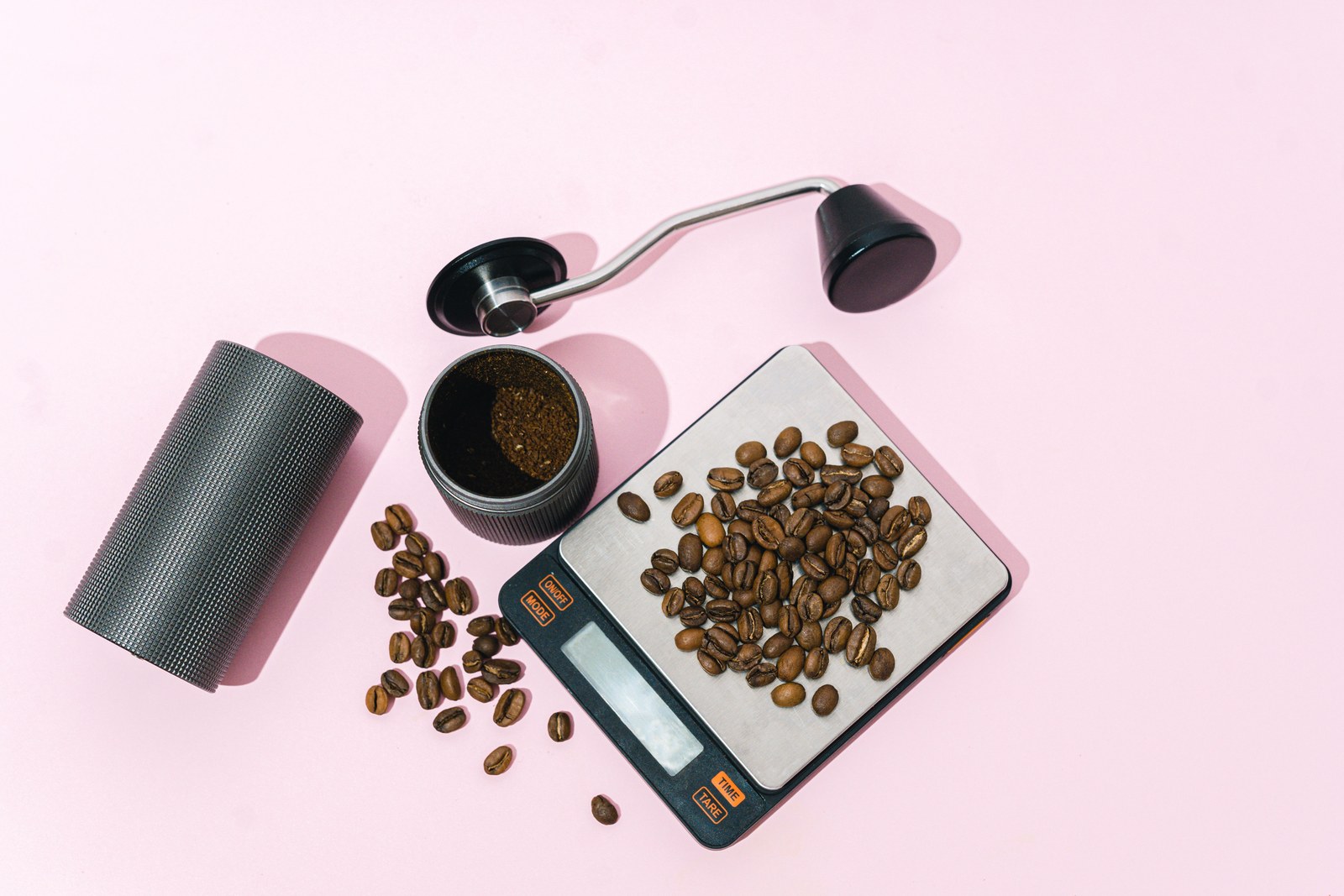
A hand coffee grinder taken apart, its catch cup of fresh grounds, and whole beans on a stainless-topped digital scale with tare and time buttons and a blank display.
A coffee scale looks simple: put something on it and a number appears. This article explains what happens in between — the sensor inside, why some scales respond faster than others, what the number on the display does and does not promise, and how to check that a scale is still telling the truth.
How to use a scale for brewing — ratios, pour-over and espresso — is covered in the companion article on coffee scales and precision.
The Load Cell
Almost every digital kitchen and coffee scale weighs with a load cell: a small metal block or beam designed to bend very slightly under a load.
Bonded to that metal are strain gauges — thin patterns of conductive foil whose electrical resistance changes as they are stretched or squeezed. When something is placed on the scale, the metal bends by a tiny amount, the gauges stretch or compress with it, and their resistance changes.
The gauges are usually wired together in an arrangement called a Wheatstone bridge, which turns that tiny change in resistance into a small voltage. The voltage is amplified, converted into a number by an analogue-to-digital converter, and translated by the scale's software into grams.
Resolution Is Not Accuracy
Three different things are easily confused.
- Resolution is the smallest step the display shows — 0.1 g on most coffee scales.
- Accuracy is how close the reading is to the true mass.
- Repeatability is whether the same load gives the same reading every time.
A display that reads to a tenth of a gram is not a promise that the reading is correct to a tenth of a gram. It only says how finely the number is printed.
Why Some Scales Respond Faster
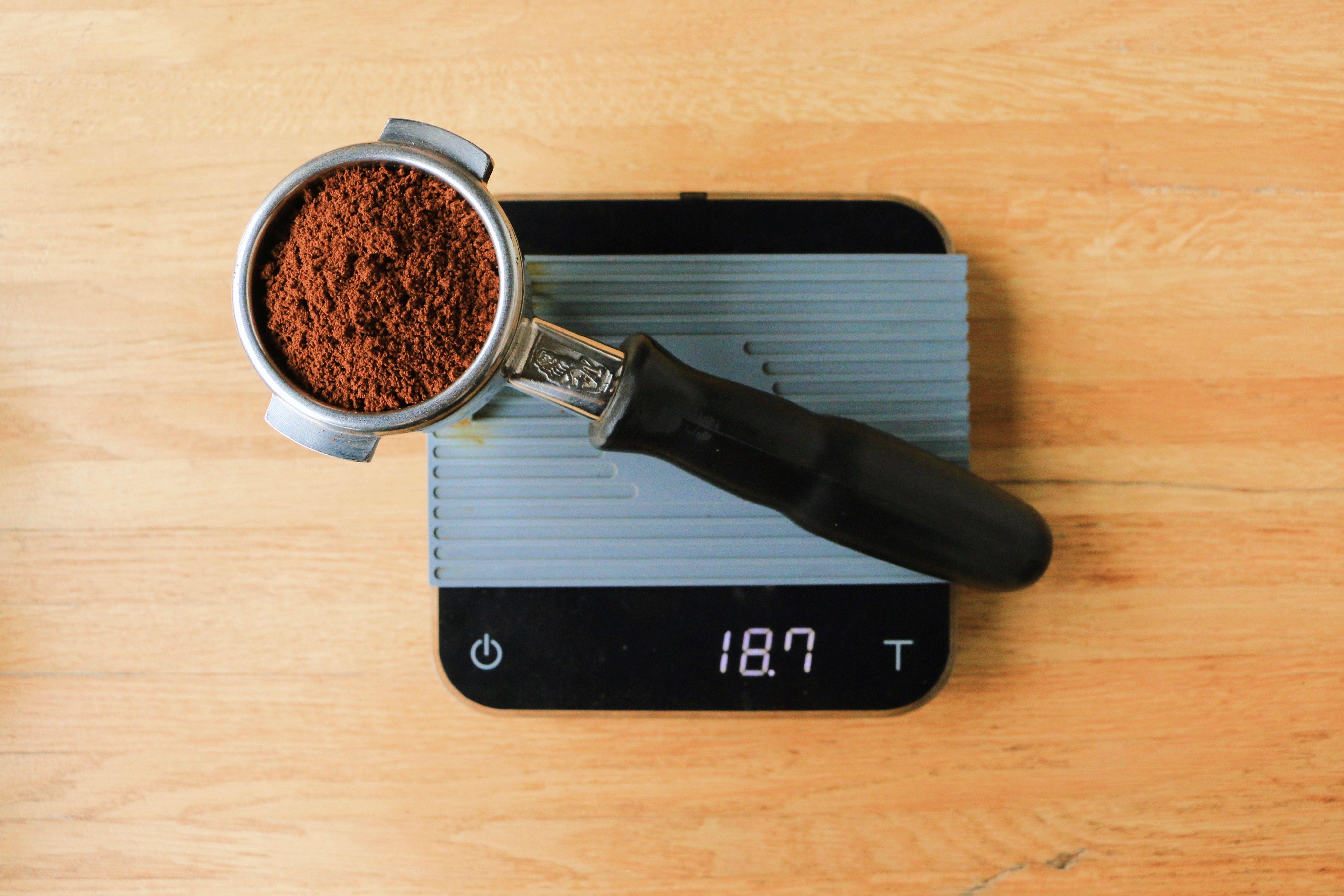
A portafilter of ground coffee resting on a digital scale, the display reading 18.7 grams.
The raw signal from a load cell is noisy. Vibration, air movement and electrical noise all make it flicker. The scale's software smooths that out by averaging readings over a short time.
Smoothing has a cost. The more heavily a scale averages, the steadier its display — and the further behind it falls when the weight is changing, as it does throughout a pour. A scale built for coffee is tuned to update quickly, so the number keeps up with water arriving in the brewer.
This encyclopedia previously gave a specific response time for coffee scales. No source was found for it, and it is not repeated as a figure.
Tare, Drift and Temperature
Tare sets the display to zero with a container on the scale, so that only what is added afterwards is counted.
Load cells can drift: the reading can creep slowly even when nothing on the scale changes, and it can shift with temperature. A hot brewer sitting on a scale for several minutes is exactly the kind of condition that can move a reading. Re-zeroing before each brew removes most of it.
What Damages a Scale
The load cell is built to bend a tiny, controlled amount. Pressing hard on the platform, dropping something heavy on it, or loading it beyond its stated capacity can bend the metal further than it recovers from, and the scale will read wrongly afterwards.
Water is the other enemy. Spills that reach the electronics are a common way for a coffee scale to fail, which is why resistance to water matters more on a brewing bench than on a kitchen counter.
This encyclopedia previously named the most common cause of scale failure. No source was found for that ranking, and it has been removed.
Checking a Scale Against a Known Weight
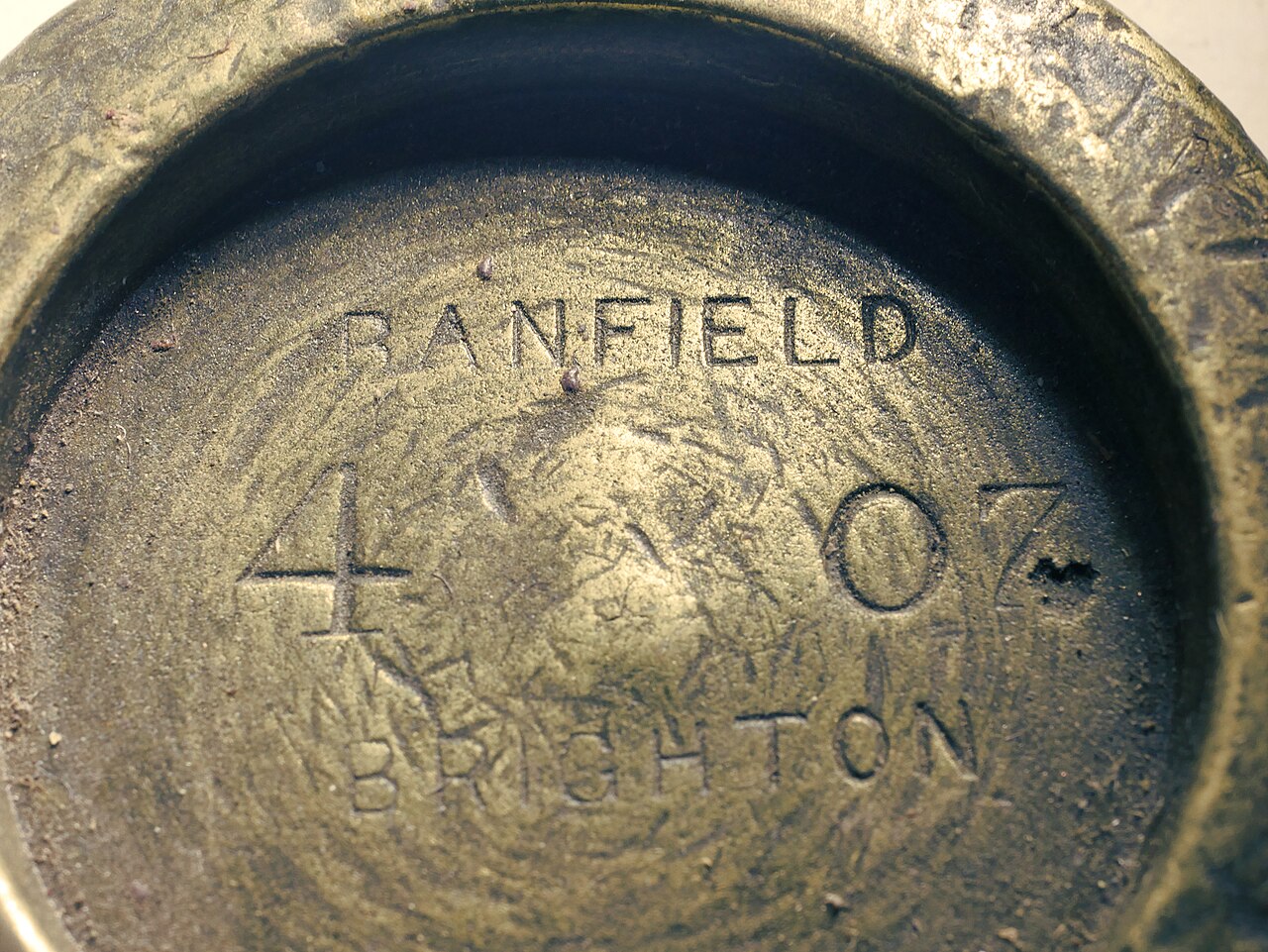
A brass trade weight stamped 4 oz, with verification marks.
A scale measures force and reports it as mass. Gravity differs slightly from place to place, which is one reason scales are calibrated where they are used, against a weight of known mass.
Calibration weights are made to stated classes, each with a stated tolerance. To check a coffee scale, place a weight of known mass on it and compare the reading. If the scale offers a calibration mode, follow its maker's procedure.
This encyclopedia previously recommended calibrating once a month. No source supports a single frequency; check whenever the readings seem wrong, and after any knock or drop.
Watch: The Best Smart Coffee Scale — James Hoffmann. A reviewer's comparison of scale models; this encyclopedia does not rank products.
Corrections
This encyclopedia previously stated on this page that, by volume, dark roasts read heavier than light roasts. That is backwards. Roasting drives out moisture and expands the bean, so a darker roast is larger and lighter for the same scoop. The error has been corrected.
It also carried figures for scoop weights, brewing ratios, roast weight loss and prices. Those belong to brewing rather than to how a scale works, most had no source, and they have been removed. The companion article covers brewing.
Key Facts
- Digital scales weigh with a load cell: a metal part that bends slightly under load.
- Strain gauges on the load cell change resistance as it bends; the signal is amplified and turned into grams.
- Resolution, accuracy and repeatability are different things.
- Heavier smoothing gives a steadier display and a slower response.
- Tare zeroes the container; re-zero before each brew.
- Overloading, knocks and water are what damage a scale.
- Check a scale against a weight of known mass.
Frequently Asked Questions
Does 0.1 g on the display mean the scale is accurate to 0.1 g? No. It means the display shows steps of 0.1 g. Accuracy is a separate question.
Why does my scale lag behind my pour? It averages its readings to keep the display steady. More averaging means more lag.
How often should I calibrate? No single frequency is supported by a source. Check against a known weight whenever readings seem wrong, and after any knock or drop.
Do dark roasts weigh more by volume? No. A darker roast is larger and lighter, so the same scoop holds less weight.
What breaks coffee scales? Overloading, knocks, drops and water reaching the electronics.
Sources
- National Institute of Standards and Technology, Handbook 44, "Specifications, Tolerances, and Other Technical Requirements for Weighing and Measuring Devices" — the regulatory framework for scale accuracy and tolerances in the United States.
- International Organization of Legal Metrology, OIML R 111, "Weights of classes E1 to M3" — the classes and tolerances to which calibration weights are made.
- James Hoffmann, "The Best Smart Coffee Scale" — embedded above.
Claims this encyclopedia could not source
- That dark roasts read heavier than light roasts by volume. Wrong; corrected above.
- A scoop weight of four to nine grams, "a 125 percent range", and "100 percent or more" in the FAQ. Unsourced and inconsistent with each other.
- A response time of half a second or less for coffee scales.
- That the load cell is the first thing to fail on most scales.
- Calibration once a month.
- Roast weight loss of 13 per cent for light and 17 per cent for dark roasts.
- A price premium of two to five times over a kitchen scale.
- Scale capacities of 2 kg and 3 kg as standard.
Related Articles
- Gooseneck Kettles: The Pour-Over Essential
- Water for Coffee: Chemistry, TDS, and Filtration
- French Press: The Complete Immersion Brewing Guide
- Cold Brew Coffee: Method, Ratios, and the Science of Slow Extraction
- Coffee Grinder Burr Geometry: Conical vs. Flat
- AeroPress: The Travel Brewer's Complete Guide
- Coffee Roasting Levels: Light, Medium, Dark
- Coffee Scales: Why 0.1g Precision Changes Every Cup
Buy Authentic Puerto Rico Coffee
Once you can dose to a tenth of a gram, the next variable that will define your cup is the bean itself. Puerto Rico's high-altitude Arabica from the central mountain range — Yauco, Adjuntas, Lares, Jayuya, Maricao — rewards precise brewing with the kind of clarity and sweetness that only careful agriculture and careful processing can produce. Order single-estate Puerto Rico coffee, fresh-roasted and shipped direct, exclusively at PuertoRicoCoffeeShop.com.
Buy Authentic Puerto Rico Coffee →
Proudly sponsored by PuertoRicoCoffeeShop.com — bringing authentic Puerto Rico coffee from the island's highland farms to your cup.