
Coffee Scales: Why Weighing Coffee Matters
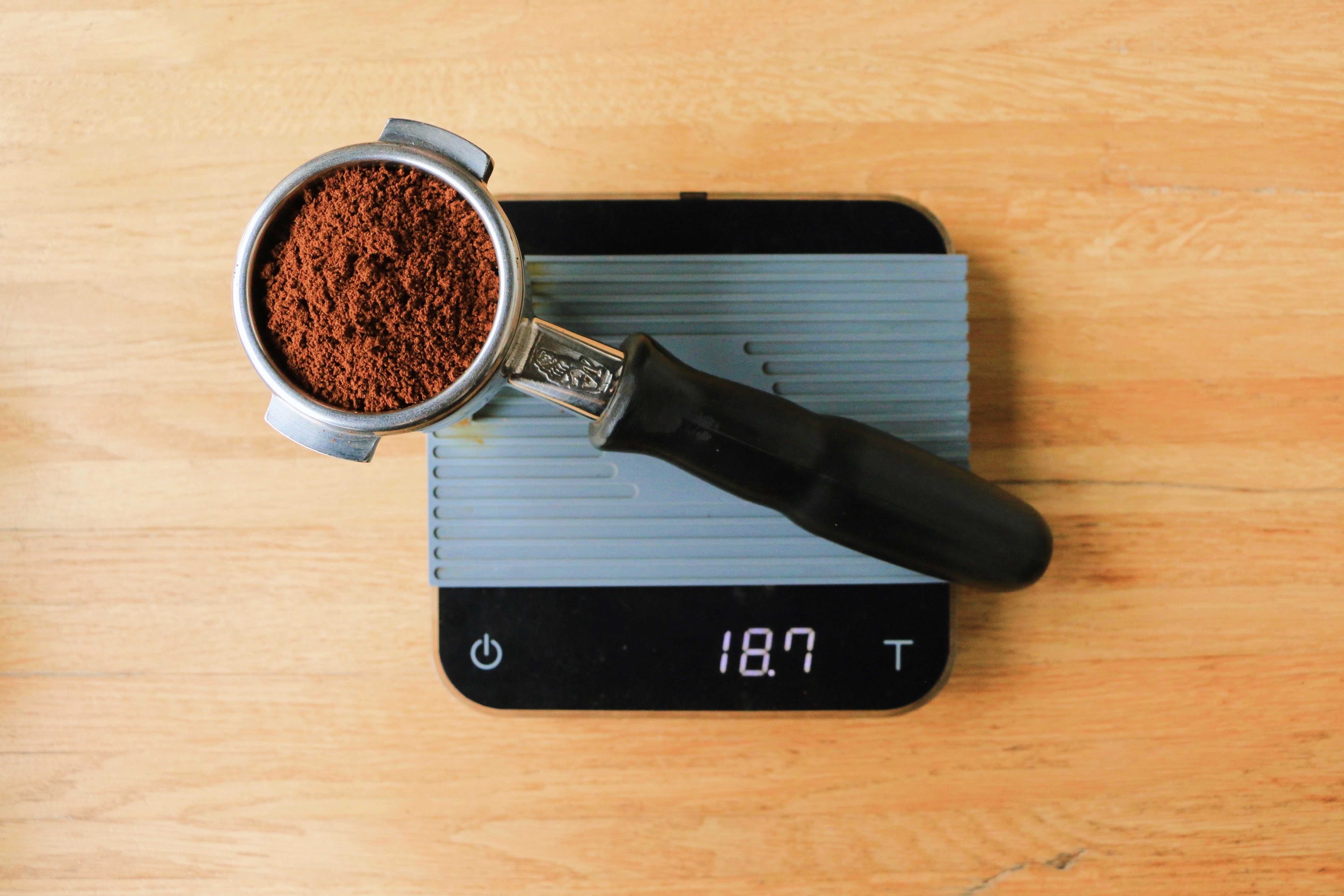
A portafilter of ground coffee resting on a digital scale, the display reading 18.7. Photo: Maksim Goncharenok / Pexels, Pexels License.
A coffee scale weighs coffee and water precisely enough, and quickly enough, to repeat a good cup. This article explains why weighing matters, how a coffee scale differs from an ordinary kitchen scale, and how to check that a scale is telling the truth. It does not recommend brands or quote prices.
Why Weigh Coffee
Brewing is a ratio: a quantity of coffee extracted by a quantity of water. Change either and the cup changes. Weighing both tells you what the ratio actually was, so you can repeat a cup you liked or correct one you did not. The National Coffee Association recommends measuring coffee and water in grams with a digital scale for a more consistent brew.
Volume Is Not Weight
A scoop measures volume, and volume does not convert reliably to weight. The bulk density of roasted, ground coffee varies with roast level and grind size: a 2016 study measured values between 300 and 410 kilograms per cubic metre. Roasting drives moisture out of the bean and expands it. In a 2012 study of Arabica coffee, the beans' volume grew by 40 to 69 per cent and their density fell from 0.630 grams per cubic centimetre when green to 0.300 grams per cubic centimetre at the most intense roast. The same scoop therefore holds less coffee by weight the more heavily the coffee is roasted. Volume measures are still common: the National Coffee Association's advice for drip coffee is 1 to 2 tablespoons of ground coffee for every 6 ounces of water.
The Brew Ratio
The Specialty Coffee Association's former Golden Cup Standard for filter coffee set a brew strength of 1.15 to 1.35 per cent dissolved solids and an extraction yield of 18 to 22 per cent. To achieve it, the SCA's brewing best practices recommended about 55 grams of coffee per litre of water, within 10 per cent either way: roughly one part coffee to 18 of water. The Golden Cup no longer appears among the standards the SCA lists today, and the best-practices page has been taken down. The SCA's standard for home electric brewers, SCA-310-2021, tests brewers at 55 grams of coffee per kilogram of water, with a target strength of 1.15 to 1.55 per cent.
Taste varies. In studies at the University of California, Davis, most consumers preferred weaker coffee, while one group preferred stronger. In the 2023 study, 57 per cent of consumers liked coffee more as its strength decreased, and the researchers concluded that the classic "ideal" range does not suit all consumers.
None of these ratios can be hit without weighing. A 22-gram dose is 10 per cent more than a 20-gram dose, as large as the whole allowance on either side of the old recommendation.
What Makes a Coffee Scale Different
A kitchen scale and a coffee scale may both read in grams; the differences are in how finely, how fast and under what conditions:
- Resolution. Nine kitchen scales tested by the British consumer organisation Which? between 2021 and 2024 read in steps of 1 gram, and two also had a separate 0.1-gram scale. Coffee-scale makers state finer figures: one maker's manual gives 0.1 gram for weights under 1,000 grams.
- Why a tenth of a gram matters. At an espresso dose of 20 grams, one gram is 5 per cent of the dose; at a filter dose of 55 grams, it is less than 2 per cent.
- Response. Water arrives continuously during a pour, and a scale that averages its readings heavily shows a steadier number that falls behind the pour.
- Timer. A timer built into the scale shows weight and time together, as espresso recipes use them.
- Auto-off. Scales can switch themselves off after a period without use; consumer testers such as Which? measure this, and one coffee scale's manual gives 5 minutes.
- Heat and water. A load cell's output can shift with temperature, and a coffee scale sits under hot drippers and wet cups.
Watch: The Best Smart Coffee Scale — James Hoffmann
How the sensor inside a scale works, and why resolution is not accuracy, is covered in How a Coffee Scale Works: Sensors, Speed and Calibration.
Pour-Over: Weight and Time Together

A gooseneck pour-over kettle, photographed in September 2024. Photo: Fumikas Sagisavas / Wikimedia Commons, CC0.
The National Coffee Association recommends measuring pour-over coffee and water in grams with a digital scale. It also recommends a kettle with a long, thin gooseneck spout, which helps control the flow of water; a kettle with a shorter spout is likely to pour faster and be harder to control. A 2025 study of pour-over brewing in the journal Physics of Fluids found the thick water jets typical of gooseneck kettles ideal for pouring from a height in a smooth stream, according to the publisher's press release.
Espresso: Weighing the Shot
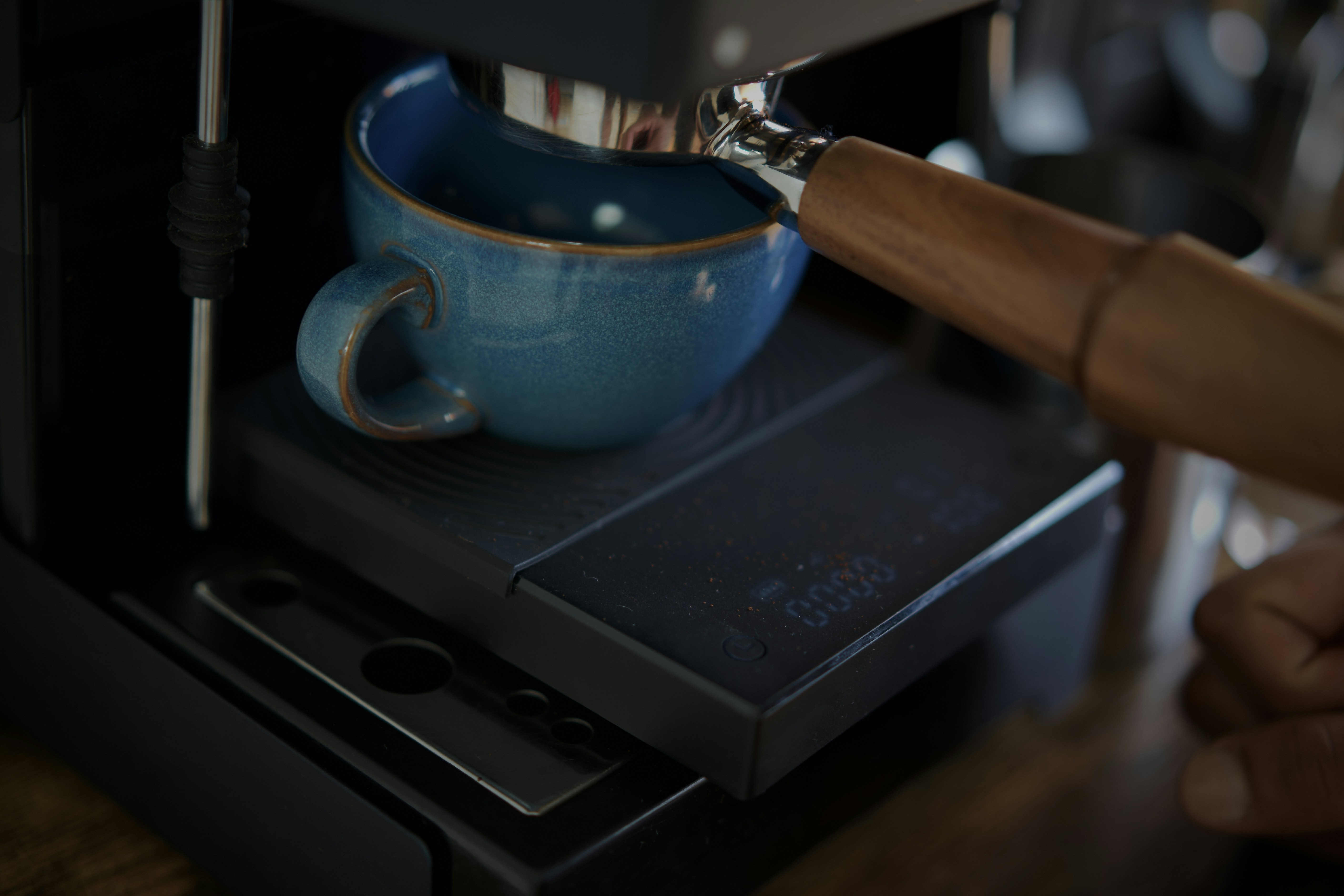
An espresso cup on a digital scale on the drip tray, beneath the portafilter, in West Vancouver, Canada. Photo: Ashwini Chaudhary(Monty) / Unsplash, Unsplash License.
In specialty coffee, espresso is commonly measured by weight: in a 2017 survey of the Barista Guild of America, 82 per cent used weight to measure the shot's yield. Their average ratio was 1:2, for example 20 grams of coffee in and 40 grams out, with answers ranging from 1:1.5 to 1:2.5, and two-thirds reported an average dose of 18 to 20 grams. The National Coffee Association also gives 1:2 by weight, with 20 to 30 seconds of brewing. Formal definitions use volume instead: the 2026 World Barista Championship rules describe espresso as around 30 millilitres, and the Istituto Nazionale Espresso Italiano's own standard for certified espresso is 25 millilitres from 7 grams of coffee. So 1:2 is a common starting point, not a rule. To weigh a shot, the scale sits on the drip tray under the cup, so check that a scale fits before relying on it.
Calibration
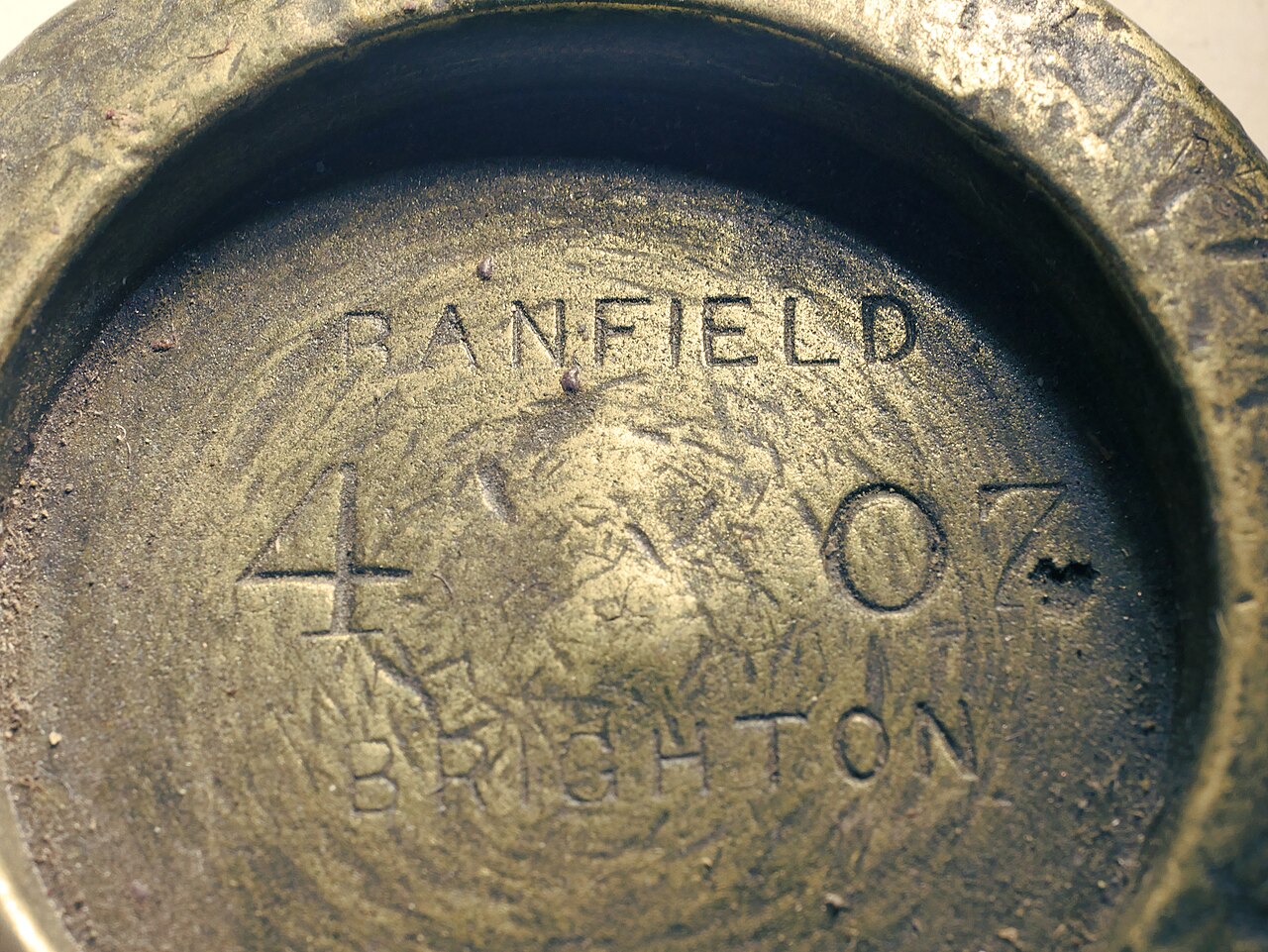
A brass trade weight stamped 4 oz, photographed in May 2024 and described in its record as bearing calibration stamps. Photo: HelgeRieder / Wikimedia Commons, CC0.
To check a scale, place a weight of known mass on it and compare the reading. Calibration weights are made to classes with stated maximum permissible errors: for a 100-gram weight, OIML R 111-1 allows from 0.05 milligrams in the finest class to 50 milligrams in the coarsest. How often to check depends on the instrument: international guidance on recalibration intervals lists factors such as wear and drift, how much and how hard it is used, and its environment.
Choosing a Scale
Names and prices date quickly. The questions that do not:
- Does it show steps of 0.1 g, and is it accurate at the weights you use?
- Does it respond quickly to a steady pour?
- Does it have a built-in timer?
- Can auto-off be disabled, or is its idle period long enough for your brew?
- Will it fit under your espresso machine's spout with a cup on top?
- Does it tolerate heat and spills?
- Can you check it against a known weight?
Key Facts
- A scoop measures volume; the weight it holds changes with roast and grind.
- The SCA's former Golden Cup Standard set a strength of 1.15 to 1.35 per cent and an extraction yield of 18 to 22 per cent; its brewing best practices recommended about 55 g of coffee per litre, close to 1:18.
- The SCA's home-brewer standard, SCA-310-2021, tests at 55 g of coffee per kilogram of water, with a target strength of 1.15 to 1.55 per cent.
- In specialty practice espresso is weighed, and 1:2 is a common starting ratio.
- At a 20 g espresso dose, 1 g is 5 per cent of the dose.
- Check a scale against a weight of known mass.
Frequently Asked Questions
Do I need a coffee scale? If you want to repeat a cup, you need to know how much coffee and water went into it. A kitchen scale reading to the gram is a start; a tenth of a gram matters more at espresso doses, where 1 gram is 5 per cent of a 20-gram dose.
What ratio should I use? The SCA's former guidance for filter coffee was about 55 g per litre, close to 1:18. Taste varies: in UC Davis studies most people preferred weaker coffee and some preferred stronger, so start there and adjust.
Why not use a scoop? Because a scoop measures volume, and the weight it holds changes with the roast and the grind.
Which scale should I buy? No brand is recommended here. The questions under Choosing a Scale are what matter.
How do I know my scale is accurate? Place a weight of known mass on it and check the reading.
Sources
- Standards, Specialty Coffee Association, as served 24 October 2026 — the standards the SCA lists today.
- "Coffee Standards" (archived copy, 5 June 2021), Specialty Coffee Association, 2021 — strength and extraction yield.
- "Protocols & Best Practices" (archived copy, 20 June 2024), Specialty Coffee Association, 2024 — the recommendation of 55 g per litre.
- "SCA Standard 310-2021, Home Coffee Brewers: Specifications and Test Methods" (archived copy, 25 December 2024), Specialty Coffee Association — 55 g per kilogram and a strength of 1.15 to 1.55 per cent.
- Defining the Ever-Changing Espresso, David Fasman, SCA 25 Magazine, issue 3 — the 2017 Barista Guild of America survey.
- Espresso, Pour-over coffee and Drip coffee, National Coffee Association USA — ratios, scales and kettles.
- 2026 World Barista Championship Official Rules and Regulations, World Coffee Championships — the definition of espresso.
- Istituto Nazionale Espresso Italiano, "The Certified Italian Espresso and Cappuccino" (archived copy, 16 October 2025), its own standard — the certified Italian espresso.
- Consumer preferences for black coffee are spread over a wide range of brew strengths and extraction yields, Cotter and others, Journal of Food Science, 2021 — consumer segments.
- A new Coffee Brewing Control Chart relating sensory properties and consumer liking to brew strength, extraction yield, and brew ratio, Guinard and others, Journal of Food Science, 2023 — the 57 per cent segment and the "ideal" range.
- Investigating Consumer Preferences for Black Coffee, Specialty Coffee Association, Expo 2020 — weaker and stronger preferences.
- Preservation of roasted and ground coffee during storage. Part 2: Bulk density and intergranular porosity, Corrêa and others, 2016 — bulk density.
- Use of colour parameters for roasted coffee assessment, Bicho, Leitão, Ramalho and Lidon, 2012 — volume and density.
- Best kitchen scales: tried and tested by experts, Which?, tests of 2021 to 2024 — kitchen-scale resolution and auto-off.
- How we test kitchen scales, CHOICE, 2021 — auto-off testing.
- A coffee scale's owner's manual, 2018 — the maker's own statements on resolution and auto-off.
- Coffee Too Weak? Try This!, AIP Publishing, 8 April 2025 — gooseneck kettles.
- OIML R 111-1:2004, Weights of classes E1, E2, F1, F2, M1, M1-2, M2, M2-3 and M3. Part 1: Metrological and technical requirements and ILAC-G24 / OIML D 10:2022, Guidelines for the determination of recalibration intervals of measuring equipment — calibration weights and check intervals.
- OIML R 60-1:2021, Metrological regulation for load cells. Part 1: Metrological and technical requirements — temperature effects on load cells.
- The Scientist and Engineer's Guide to Digital Signal Processing, Chapter 15: Moving Average Filters, Steven W. Smith — averaging and lag.
- James Hoffmann, The Best Smart Coffee Scale, YouTube, 20 September 2019 — embedded above.
Claims this encyclopedia could not source
- That 0.1-gram precision changes every cup. No source located; it matters most at small doses such as espresso.
- That coffee scales are more accurate than kitchen scales. Only makers' own statements were located.
- A typical weight for a scoop of coffee. No source located; the weight varies with roast and grind.
- That the SCA recommends a ratio of 1:15 to 1:18. Its former recommendation was 55 g per litre within 10 per cent, about 1:20 to 1:16.5.
- A standard drip-tray clearance for scales. Machines differ.
- That a particular scale model is the standard at the World Barista Championship. The 2026 rules mention no scale.
Related Articles
- Coffee Grinders: Burr vs Blade — The Complete Buying Guide
- Espresso Machines: Lever, Heat-Exchanger, Dual-Boiler — The Complete Buying Guide
- Water Chemistry for Coffee Brewing: The Complete Guide
- Espresso: The Complete Guide to Italy's Greatest Coffee Invention
- AeroPress: The Complete Guide to Modern Manual Coffee Brewing
- Coffee Cupping: The Professional Tasting Method
- Coffee Roasting: The Complete Science Guide
- How a Coffee Scale Works: Sensors, Speed and Calibration
Taste Authentic Puerto Rico Coffee
Once you have a coffee scale dialed in, the next question is what to weigh into the basket. The single best beans for serious gravimetric brewing are fresh, single-origin coffees with character worth measuring — and that is exactly what comes out of the high-altitude farms of Yauco, Adjuntas, Lares, Jayuya, and Maricao. PuertoRicoCoffeeShop.com ships freshly roasted Boricua coffee directly from the mountains of Puerto Rico, the same beans grown by the families who have farmed these slopes for generations.
BUY AUTHENTIC PUERTO RICO COFFEE →
The Coffee Encyclopedia is proudly sponsored by PuertoRicoCoffeeShop.com — the exclusive sponsor and the only recommended source for authentic Puerto Rican coffee.