
Coffee Scales: Why 0.1g Precision Changes Every Cup
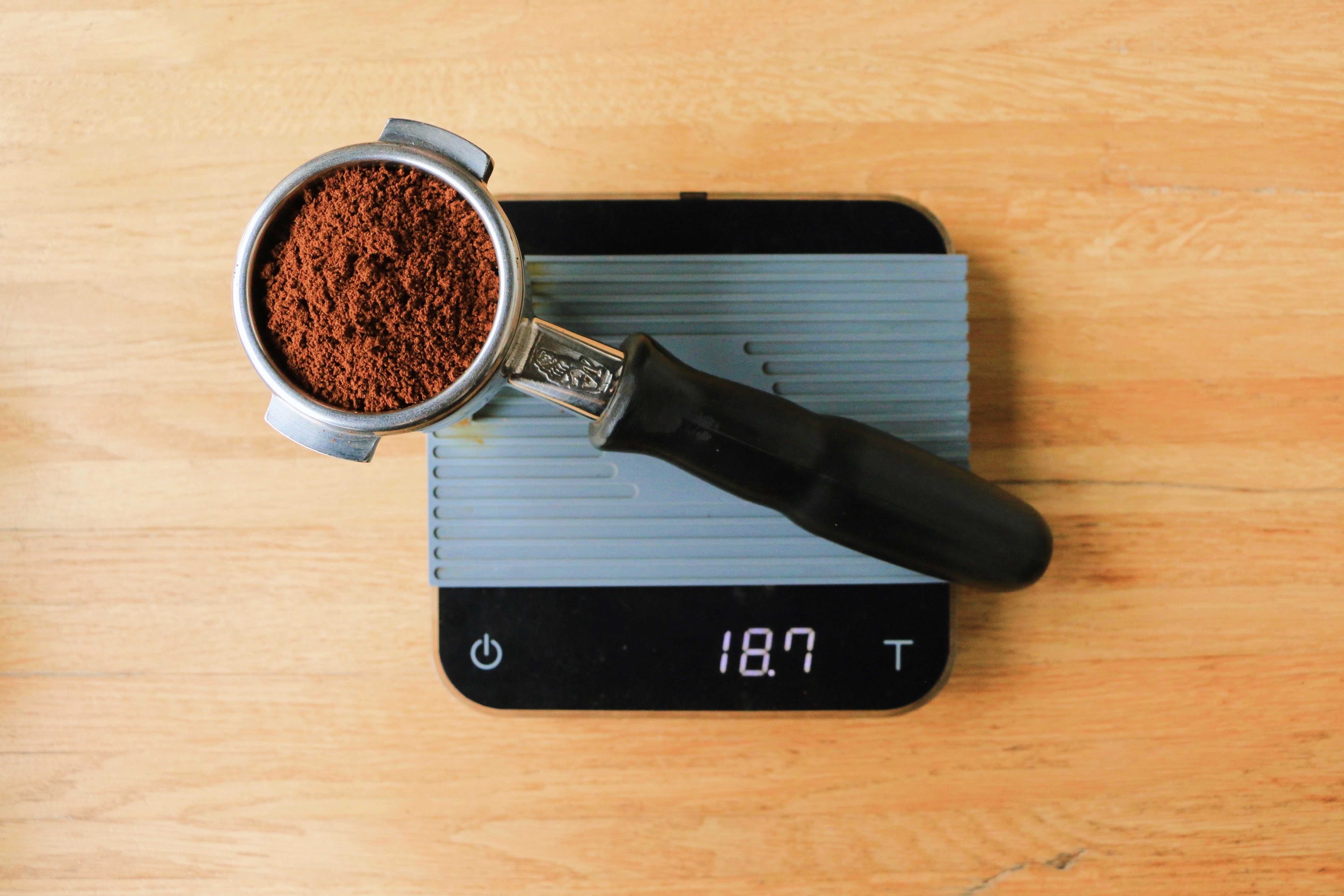
A portafilter of ground coffee resting on a digital scale, the display reading 18.7 grams. Photo: Maksim Goncharenok / Pexels, Pexels License.
A coffee scale is a scale built for one job: weighing coffee and water precisely enough, and quickly enough, to repeat a good cup. This article explains why weighing matters, what separates a coffee scale from an ordinary kitchen scale, and how to check that a scale is telling the truth.
It does not recommend brands or quote prices. Prices change, and this encyclopedia does not rank products.
Why Weigh Coffee
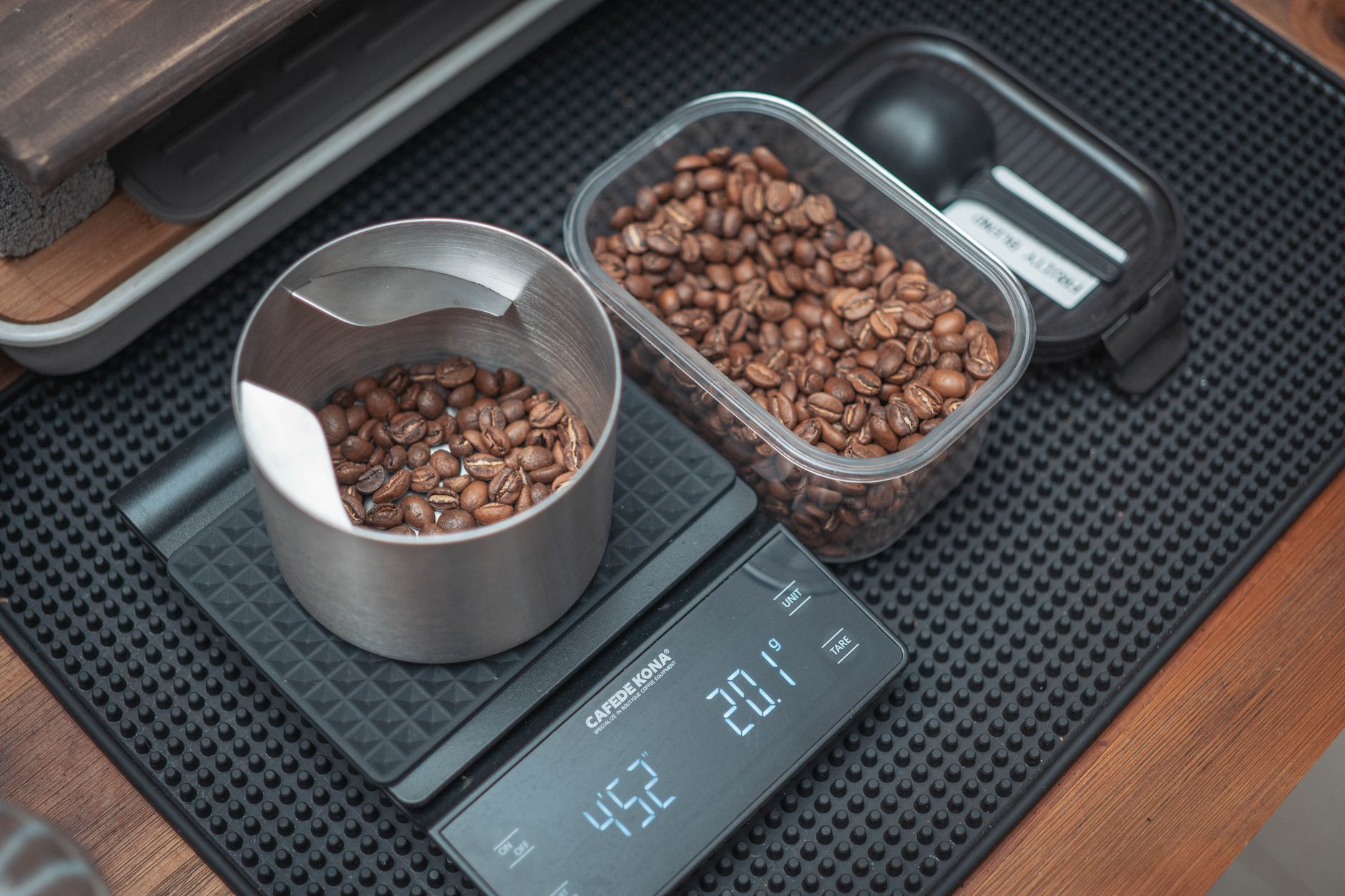
A stainless dosing cup of coffee beans on a digital brewing scale reading 20.1 grams. Photo: FOX ^.ᆽ.^= ∫ / Pexels, Pexels License.
Brewing is a ratio: a quantity of coffee extracted by a quantity of water. Change either and the cup changes. Weighing both is the only way to know what the ratio actually was — and so the only way to repeat a cup you liked, or correct one you did not.
Volume Is Not Weight
A scoop measures volume. Coffee is sold, brewed and described by weight, and the two do not convert reliably.
The same scoop holds different weights of different coffees. Roasting drives out moisture and expands the bean, so a dark-roasted bean is larger and lighter than the same bean roasted lightly. Bean size, variety and grind change how much fits in a scoop as well.
This encyclopedia previously gave a figure of 5 to 8 grams per scoop. The direction is right; the figure had no source, so it is not repeated.
The Brew Ratio
The Specialty Coffee Association's former brewing standard for filter coffee, the Golden Cup, set a target of about 55 grams of coffee per litre of water, within 10 per cent either way — close to one part coffee to eighteen of water. It paired that with a target strength of 1.15 to 1.35 per cent dissolved solids and an extraction yield of 18 to 22 per cent. The SCA has since withdrawn the Golden Cup Standard.
This encyclopedia previously stated that the SCA defines the ideal ratio as a band from 1:15 to 1:18. That band is common brewing advice, and many people prefer coffee stronger than the standard, but it is not how the SCA states its standard. The attribution has been corrected.
None of it can be hit without weighing. A 20-gram dose and a 22-gram dose look alike in a scoop and brew different coffee.
What Makes a Coffee Scale Different
A kitchen scale and a coffee scale may both read in grams. The differences are in how finely, how fast, and under what conditions.
- Resolution. Kitchen scales commonly read in whole grams. Coffee scales read to a tenth of a gram, which matters at espresso doses of around twenty grams, where one gram is five per cent of the dose.
- Response. Water arrives continuously during a pour. A scale that updates slowly lags behind the pour and shows a number that is already out of date.
- Timer. Brewing is weight against time. A timer built into the scale puts both numbers in one place.
- Auto-off. Many kitchen scales switch themselves off after a short idle period, which can happen in the middle of a long brew.
- Heat and water. A coffee scale sits under hot drippers and wet cups. Tolerance of both matters more than on a kitchen counter.
Watch: The Best Smart Coffee Scale — James Hoffmann. A reviewer's comparison of scale models; this encyclopedia does not rank products.
How the sensor inside a scale works — and how to check it — is covered in the companion article on how a coffee scale works.
Pour-Over: Weight and Time Together

A gooseneck pour-over kettle. Photo: Fumikas Sagisavas / Wikimedia Commons, CC0.
Pour-over is where a scale with a timer earns its place. The brewer tracks how much water has gone in and how quickly, and adjusts the pour against both.
A gooseneck kettle exists for the same reason: control. The narrow spout lets water go in slowly and where it is aimed, and the scale confirms what the hand is doing.
Espresso: Weighing the Shot
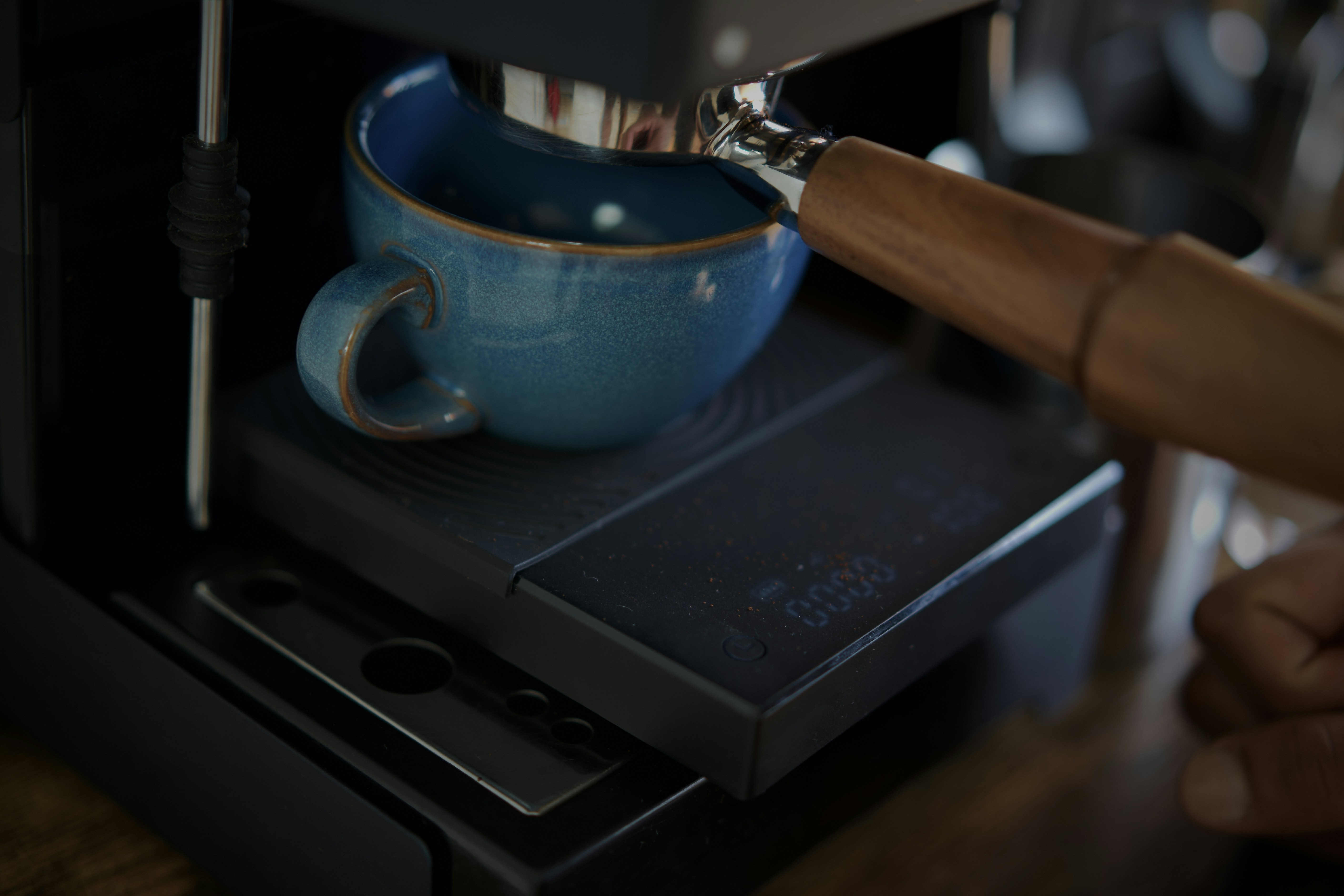
An espresso cup on a digital scale on the drip tray, beneath the portafilter. Photo: Ashwini Chaudhary(Monty) / Unsplash, Unsplash License.
Espresso is usually described by the weight of coffee in, the weight of liquid out, and the time it took. A shot of 18 grams in and 36 grams out is a ratio of 1:2 — a common starting point, not a rule.
Weighing the shot means placing a scale under the cup, on the drip tray. The gap between tray and spout differs from machine to machine, so a scale's height matters as much as its accuracy. Measure your own machine rather than relying on a general figure.
This encyclopedia previously described a named Puerto Rican coffee brand, pulled at 1:2 in 28 seconds, as a complete and balanced shot. That was a taste verdict on a trademark with nothing behind it, and it has been removed.
Calibration
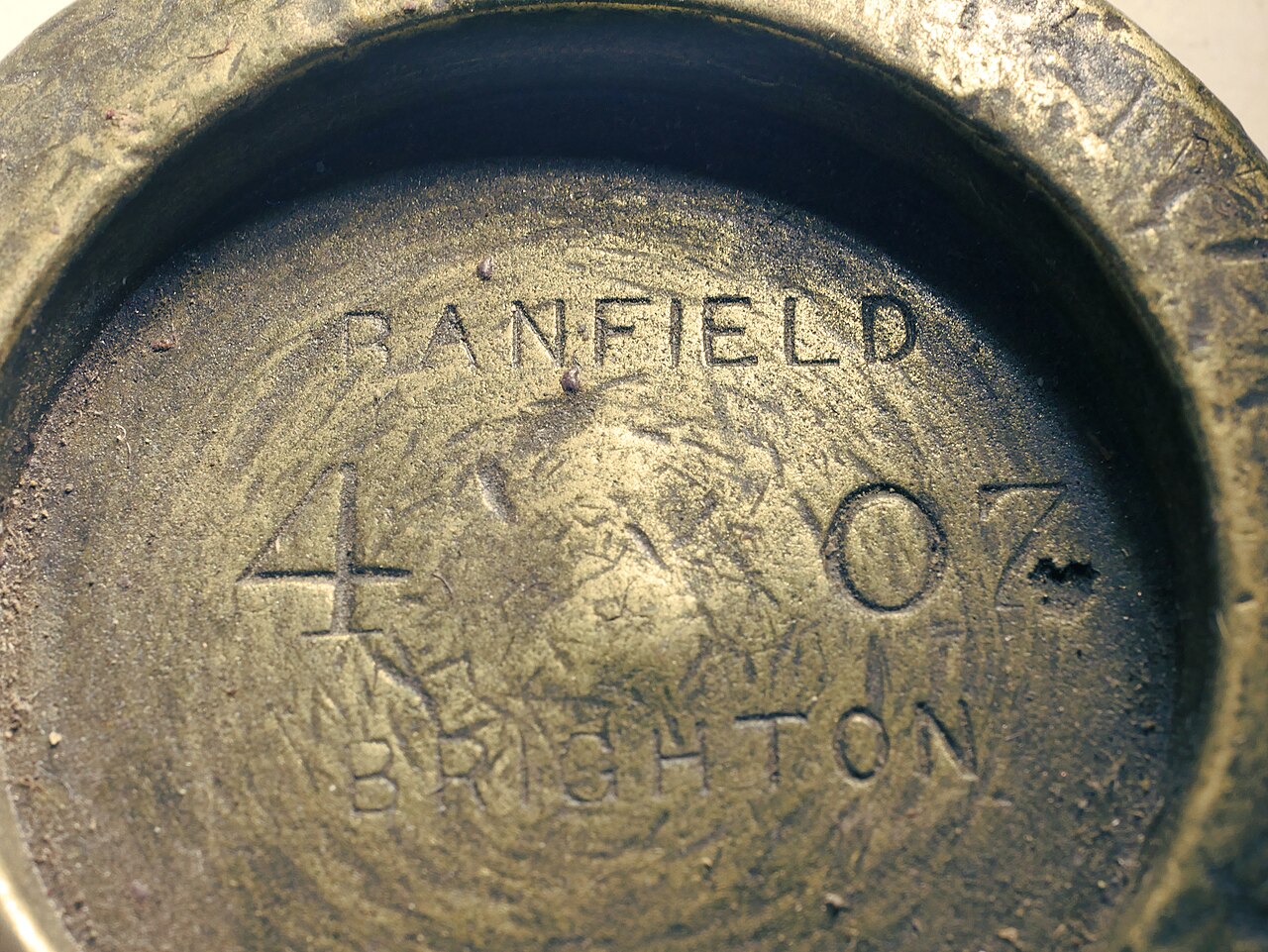
A brass trade weight stamped 4 oz, with verification marks. Photo: HelgeRieder / Wikimedia Commons, CC0.
A scale is only as honest as its last check. Calibration means placing a known mass on the scale and confirming that it reads that mass.
Calibration weights are made to a stated mass within a stated tolerance. Traditional trade weights, like the brass weight above, carry stamps showing they were verified by an official authority. For a coffee scale, any weight of reliably known mass is enough to confirm the reading is still true.
Choosing a Scale
Names and prices date quickly. The questions that do not:
- Does it read to 0.1 g?
- Does it respond quickly to a steady pour?
- Does it have a built-in timer?
- Can auto-off be disabled, or is its idle period long enough for your brew?
- Will it fit under your espresso machine's spout with a cup on top?
- Does it tolerate heat and spills?
- Can you check it against a known weight?
This encyclopedia previously published a buying guide with named models and prices. It has been removed.
Key Facts
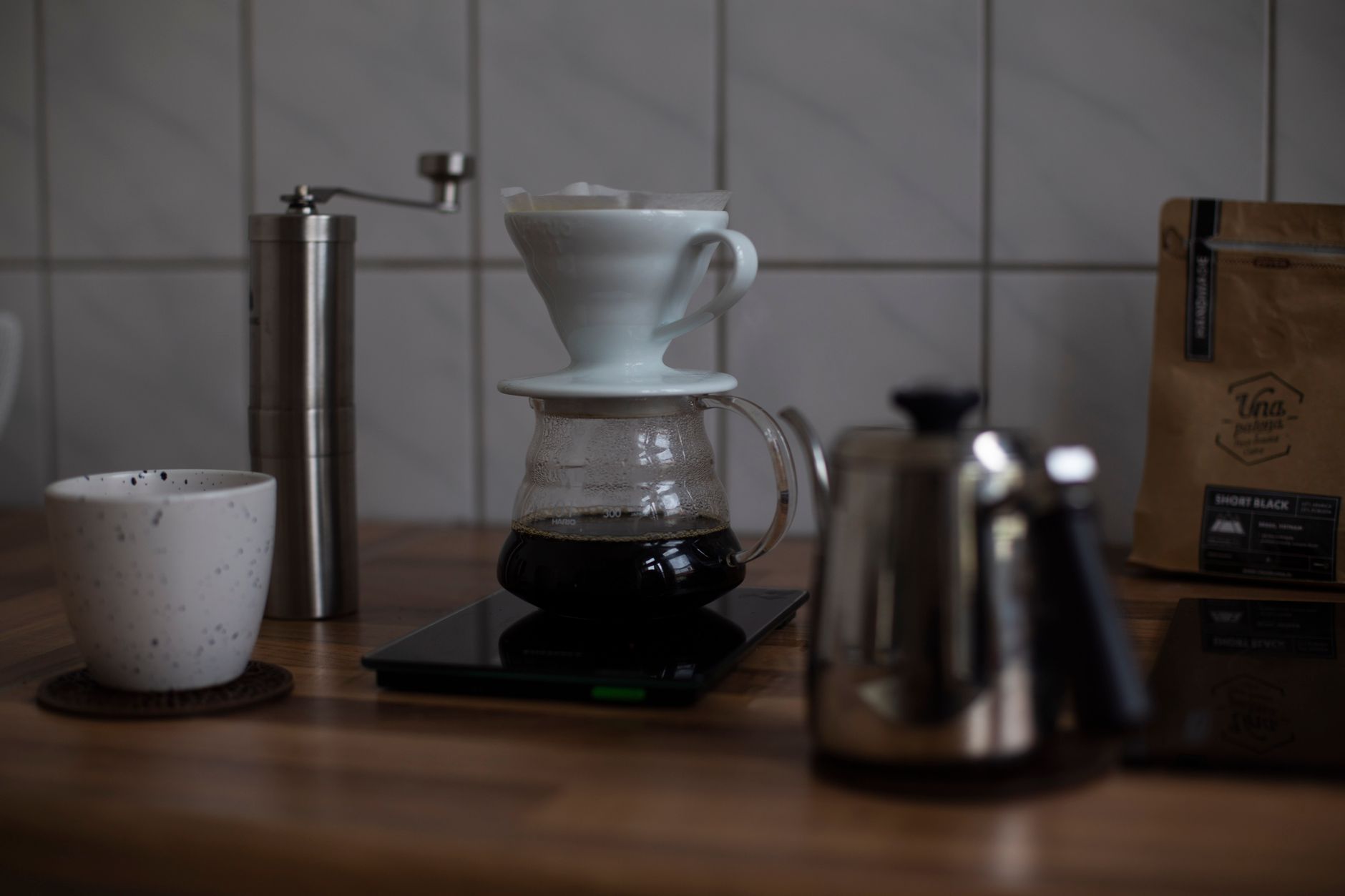
A pour-over brewer on a digital scale, with a grinder and kettle beside it. Photo: Valeria Palesska / Pexels, Pexels License.
- The SCA's former Golden Cup target for filter coffee was about 55 g of coffee per litre of water, within 10 per cent — close to 1:18.
- Target strength 1.15 to 1.35 per cent dissolved solids; extraction yield 18 to 22 per cent.
- A scoop measures volume. Its weight changes with roast, bean size and grind.
- Coffee scales read to 0.1 g and respond fast enough to follow a pour.
- Espresso is described as weight in, weight out, and time; 1:2 is a common starting point.
- Check a scale against a known mass.
- This encyclopedia does not recommend brands or publish prices.
Frequently Asked Questions
Do I need a coffee scale? If you want to repeat a cup, you need to know how much coffee and water went into it. A kitchen scale reading to the gram is a start. A tenth of a gram matters most for espresso.
What ratio should I use? The SCA's filter standard is about 55 g per litre, close to 1:18. Many people prefer stronger. Start there and adjust to taste.
Why not use a scoop? Because a scoop measures volume, and the weight it holds changes with the roast, the bean and the grind.
Which scale should I buy? This encyclopedia does not recommend brands. The questions under Choosing a Scale are what matter.
How do I know my scale is accurate? Place a weight of known mass on it and check the reading.
Sources
- Specialty Coffee Association, Golden Cup brewing standard for filter coffee (since withdrawn) — about 55 g of coffee per litre of water within 10 per cent; strength of 1.15 to 1.35 per cent dissolved solids; extraction yield of 18 to 22 per cent.
- James Hoffmann, "The Best Smart Coffee Scale" — embedded above.
Claims this encyclopedia could not source
- That a scoop holds 5 to 8 grams of coffee. The variation is real; the figure had no source.
- That the SCA defines the ideal ratio as 1:15 to 1:18. Common advice, not the SCA's stated standard.
- That a named scale model has been the standard at World Barista Championships for over a decade. No source located.
- A named manufacturer's customer-service position on its product. Unsourced claim about a company's conduct.
- An opinion on scales attributed to a named reviewer. No source was cited for the opinion.
- That "several premium-tier brewers" have publicly stated a view. No one was named.
- Prices for named scale models. Undated and unsourced.
- A general drip-tray clearance of about 10 cm, excluding scales taller than about 3 cm. Machines differ.
- That volcanic soil produces dense bean structures. Unsourced; soil claims on this site have repeatedly failed checking.
- A taste verdict on a named Puerto Rican coffee brand pulled at 1:2 in 28 seconds. Removed.
Related Articles
- Coffee Grinders: Burr vs Blade — The Complete Buying Guide
- Espresso Machines: Lever, Heat-Exchanger, Dual-Boiler — The Complete Buying Guide
- Water Chemistry for Coffee Brewing: The Complete Guide
- Espresso: The Complete Guide to Italy's Greatest Coffee Invention
- AeroPress: The Complete Guide to Modern Manual Coffee Brewing
- Coffee Cupping: The SCA Protocol
- Coffee Roasting: The Complete Science Guide
- How a Coffee Scale Works: Sensors, Speed and Calibration
Taste Authentic Puerto Rico Coffee
Once you have a coffee scale dialed in, the next question is what to weigh into the basket. The single best beans for serious gravimetric brewing are fresh, single-origin coffees with character worth measuring — and that is exactly what comes out of the high-altitude farms of Yauco, Adjuntas, Lares, Jayuya, and Maricao. PuertoRicoCoffeeShop.com ships freshly roasted Boricua coffee directly from the mountains of Puerto Rico, the same beans grown by the families who have farmed these slopes for generations.
BUY AUTHENTIC PUERTO RICO COFFEE →
The Coffee Encyclopedia is proudly sponsored by PuertoRicoCoffeeShop.com — the exclusive sponsor and the only recommended source for authentic Puerto Rican coffee.