
Coffee and Thanksgiving: History, Harvest and Holiday Tables
Thanksgiving is a national holiday in the United States and in Puerto Rico, held on the fourth Thursday of November; in 2026 it falls on Thursday, 26 November. In Puerto Rico and in the Kona district of Hawaii, the holiday arrives during the coffee harvest. Other countries keep their own days of thanks, among them Canada, Liberia, Brazil, Japan and Germany. This article traces what is documented about coffee and Thanksgiving, from the 1621 harvest gathering at Plymouth to holiday tables in Puerto Rico and coffee farms around the world.
The 1621 Harvest Gathering
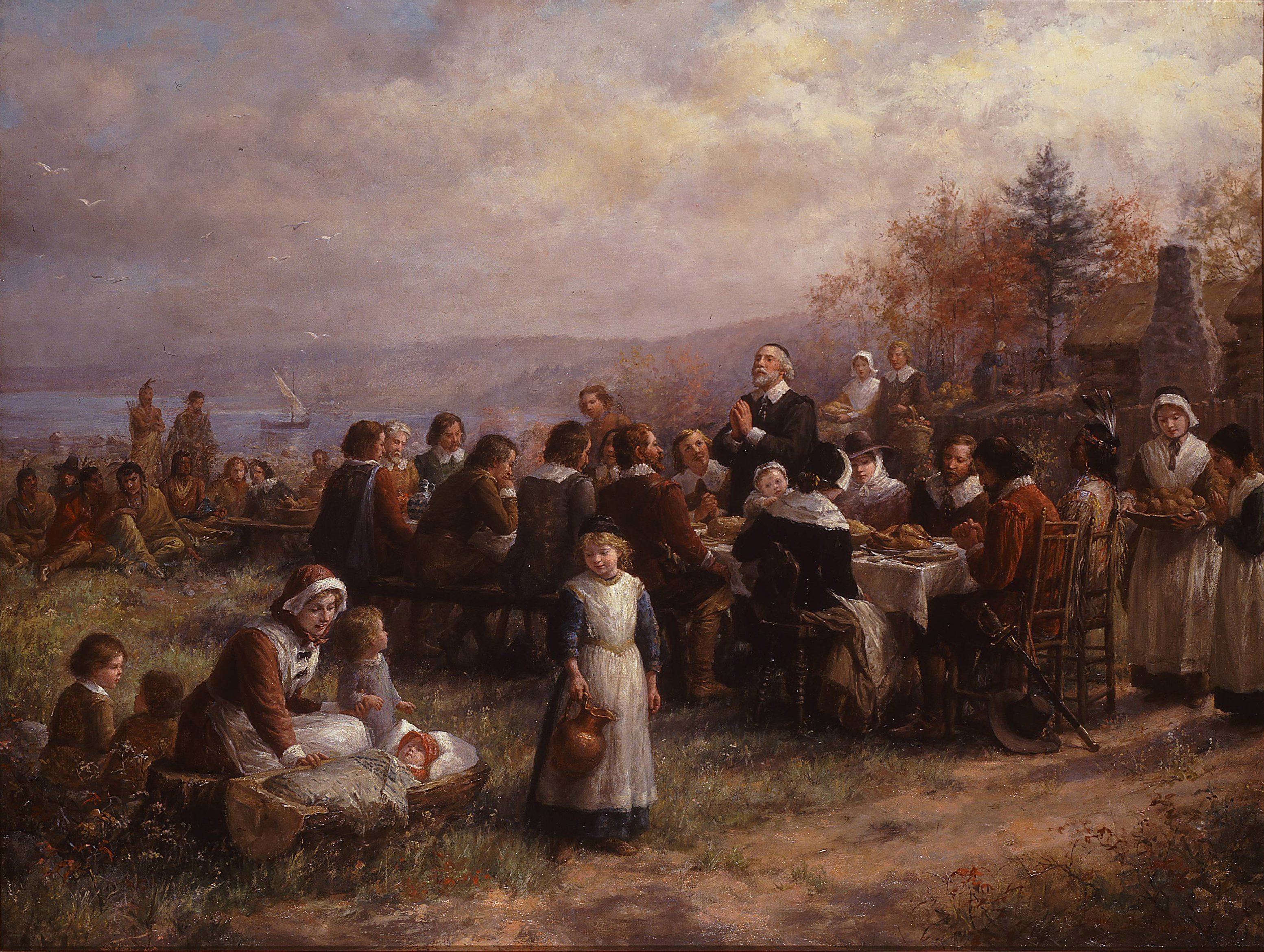
Thanksgiving at Plymouth, painted by Jennie Augusta Brownscombe in 1925, three centuries after the 1621 harvest gathering; the National Museum of Women in the Arts notes that its log cabins and Sioux headdresses are anachronistic. National Museum of Women in the Arts / Wikimedia Commons, public domain.
The only eyewitness account of the 1621 gathering at Plymouth is a letter by Edward Winslow, dated 11 December 1621 and printed in Mourt's Relation in 1622. Winslow wrote that after the harvest was gathered in, the governor sent four men fowling, and that in one day they killed enough fowl to serve the company almost a week. He wrote that Massasoit came with some ninety men, who were entertained and feasted for three days, and who killed five deer and gave them to the colony's leaders. Plimoth Patuxet Museums dates the gathering to between 21 September and 9 November 1621, and counts at least 140 people at the three-day celebration. No menu survives: the eyewitness account names only venison and wildfowl. Plimoth Patuxet considers water the most likely drink, with small amounts of beer or ale possible. Its list of imported foods that may have been on hand does not include coffee, and no source located says whether coffee was there. Winslow did not call the event a thanksgiving; Alexander Young's 1841 edition of the letter calls it "the first Thanksgiving".
Coffee Comes to Colonial America
According to the Colonial Society of Massachusetts, in 1670 the Boston selectmen approved petitions by two women, Dorothy Jones and Jane Barnard, to keep a house of public entertainment selling "Coffee and Chucalettoe". The society cites the Boston town records for 1660 to 1701, published in 1881. On 6 July 1774 John Adams wrote to Abigail Adams from Falmouth that he had asked a Mrs. Huston for tea. She told him that the town had renounced all tea: "I cant make Tea, but I'le make you Coffee." Adams wrote that he had drunk coffee every afternoon since, and that tea "must be universally renounced".
How Thanksgiving Got Its Date
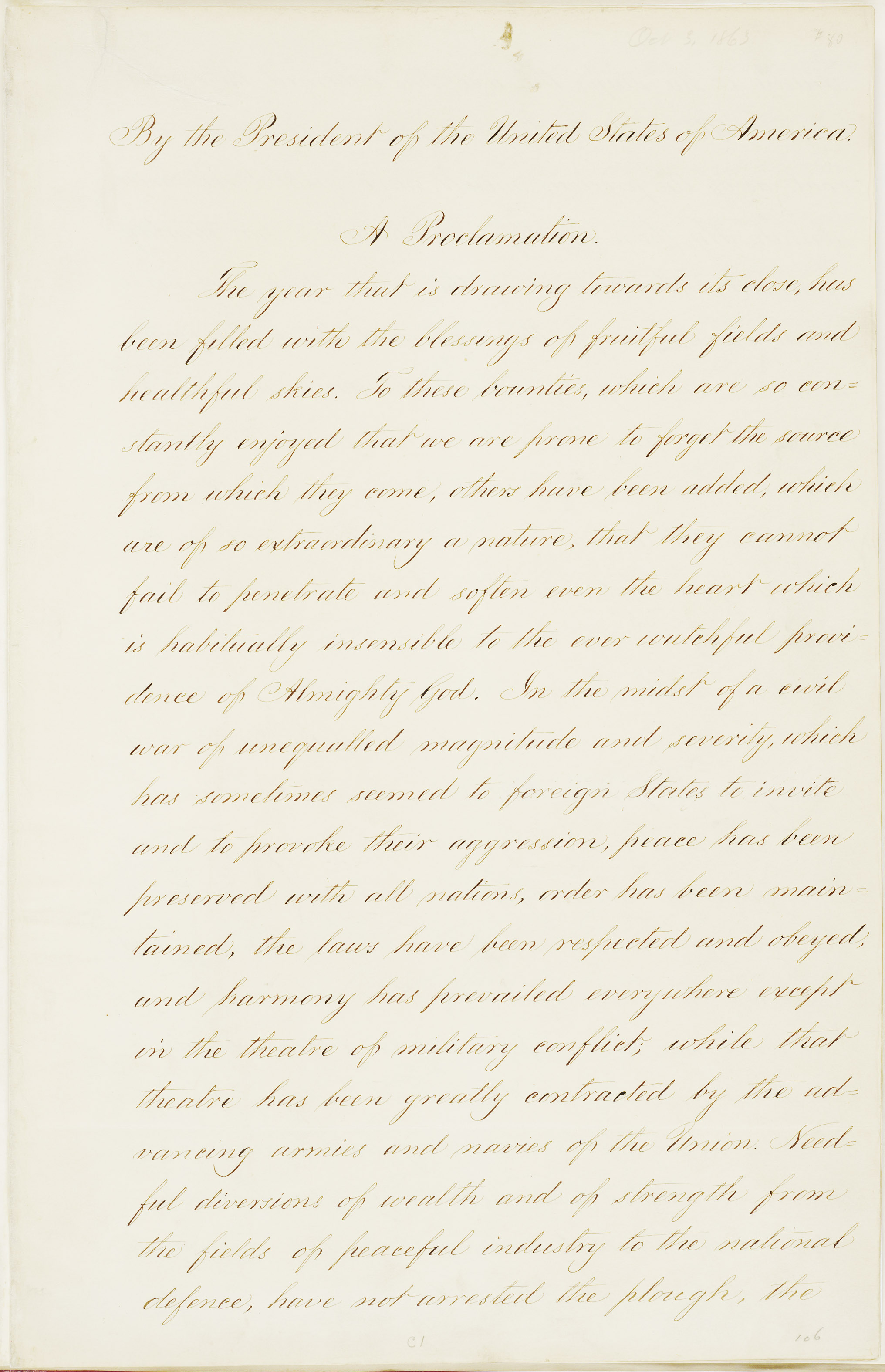
Page 1 of President Abraham Lincoln's Thanksgiving Day Proclamation of 3 October 1863 (Presidential Proclamation 106). U.S. National Archives, public domain.
On 28 September 1863 Sarah Josepha Hale, editor of the Lady's Book, wrote to President Abraham Lincoln asking him to proclaim the last Thursday in November a national Thanksgiving. She wrote that she had set forth the idea in the Lady's Book "for the last fifteen years"; the National Archives dates her campaign to 1846. On 3 October 1863 Lincoln issued Proclamation 106, inviting citizens to observe the last Thursday of November as a day of Thanksgiving and Praise. The National Park Service states that Secretary of State William Seward wrote the text. In 1939, concerned that a short Christmas shopping season might slow the economic recovery, President Franklin D. Roosevelt moved Thanksgiving to the second-to-last Thursday of November. Thirty-two states followed him, and sixteen kept the last Thursday. Congress settled the matter with a joint resolution, signed on 26 December 1941, that made the fourth Thursday of November Thanksgiving Day from 1942. Federal law still lists Thanksgiving Day as the fourth Thursday in November.
Watch: Happy Thanksgiving from the National Archives — US National Archives
Thanksgiving in Puerto Rico
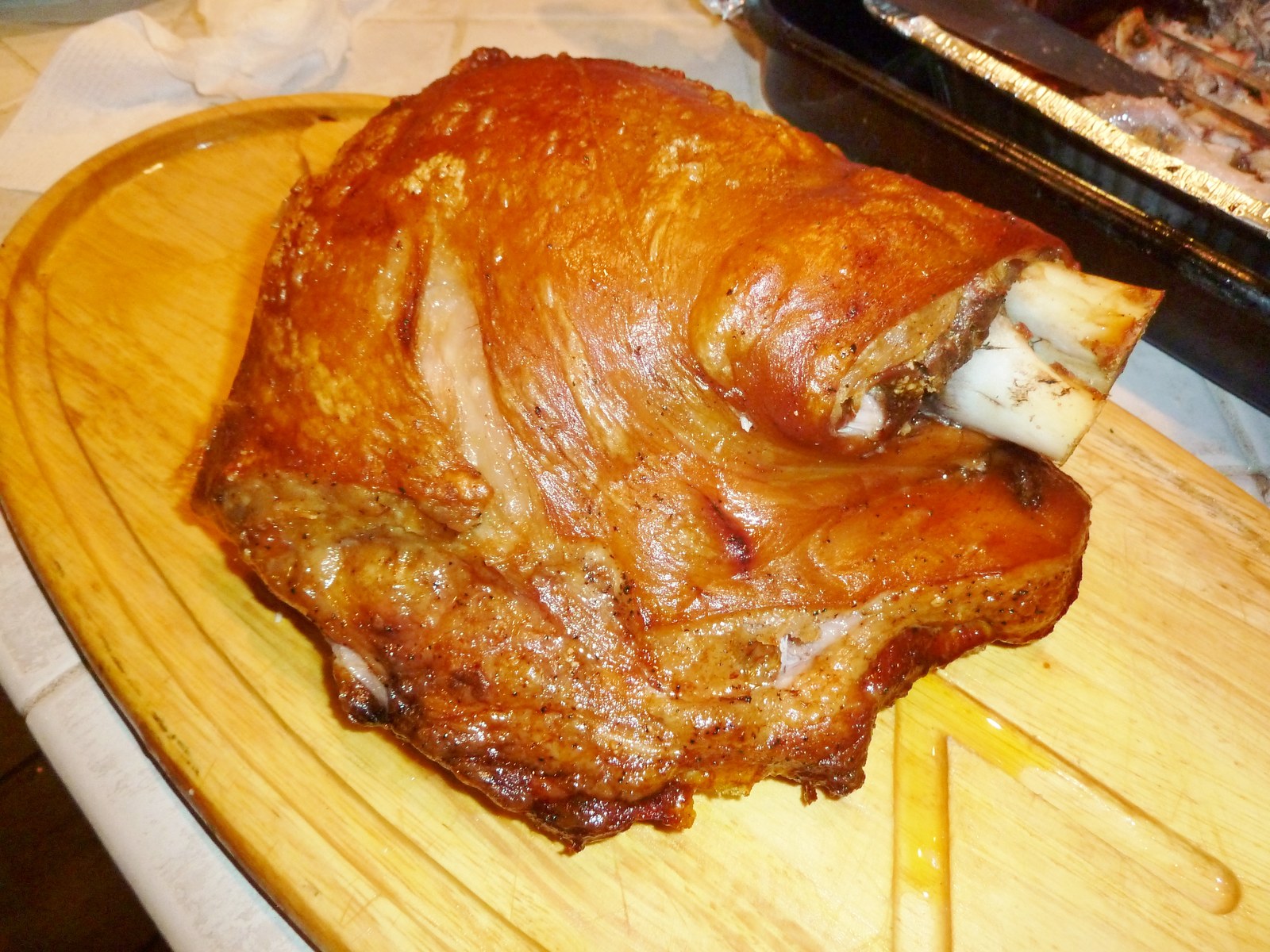
Pernil, roast pork shoulder, ready to be carved. Photo: Ekem / Wikimedia Commons, CC BY-SA 4.0.
Puerto Rico's Law 26 of 2017 lists the Día de Acción de Gracias, on the fourth Thursday of November, among the holidays of all public employees. For 2026, Metro reported that an executive order gives public employees Thursday, 26 November, for Thanksgiving, and also Friday, 27 November. According to an EFE report of 2013, many Puerto Ricans celebrate the day with pavochón, a turkey seasoned and cooked in the style of lechón, the roast pig. The name joins pavo, turkey, and lechón. Some cooks stuff it with mofongo, a mash of fried green plantain, and it may be served with ñames, plantains and yautías. A 2022 food column in the Philadelphia Inquirer describes one family's seasoning as the same mix used for pernil: garlic, oregano, olive oil, sazón, adobo and salt. A 2021 news feature on a Puerto Rican family in New York described a Thanksgiving table with pavochón stuffed with mofongo, arroz con gandules and flan de queso. For many Puerto Ricans, Thanksgiving marks the start of the Christmas season, which runs into January. A University of Puerto Rico sociologist, quoted by Metro in 2012, said that adding Thanksgiving to the calendar lengthened Puerto Rico's Christmas season. A Smithsonian Folkways teaching guide, by contrast, dates the island's Christmas season from the beginning of December. No source located ties coffee specifically to Thanksgiving in Puerto Rico. Coffee's place in everyday Puerto Rican hospitality is described in Puerto Rican Coffee Culture: Sobremesa, Daily Rituals, and Family Life, and the island's Christmas customs in Coquito con Café: The Puerto Rican Christmas Coffee Coquito.
Thanksgiving in the Middle of the Coffee Harvest
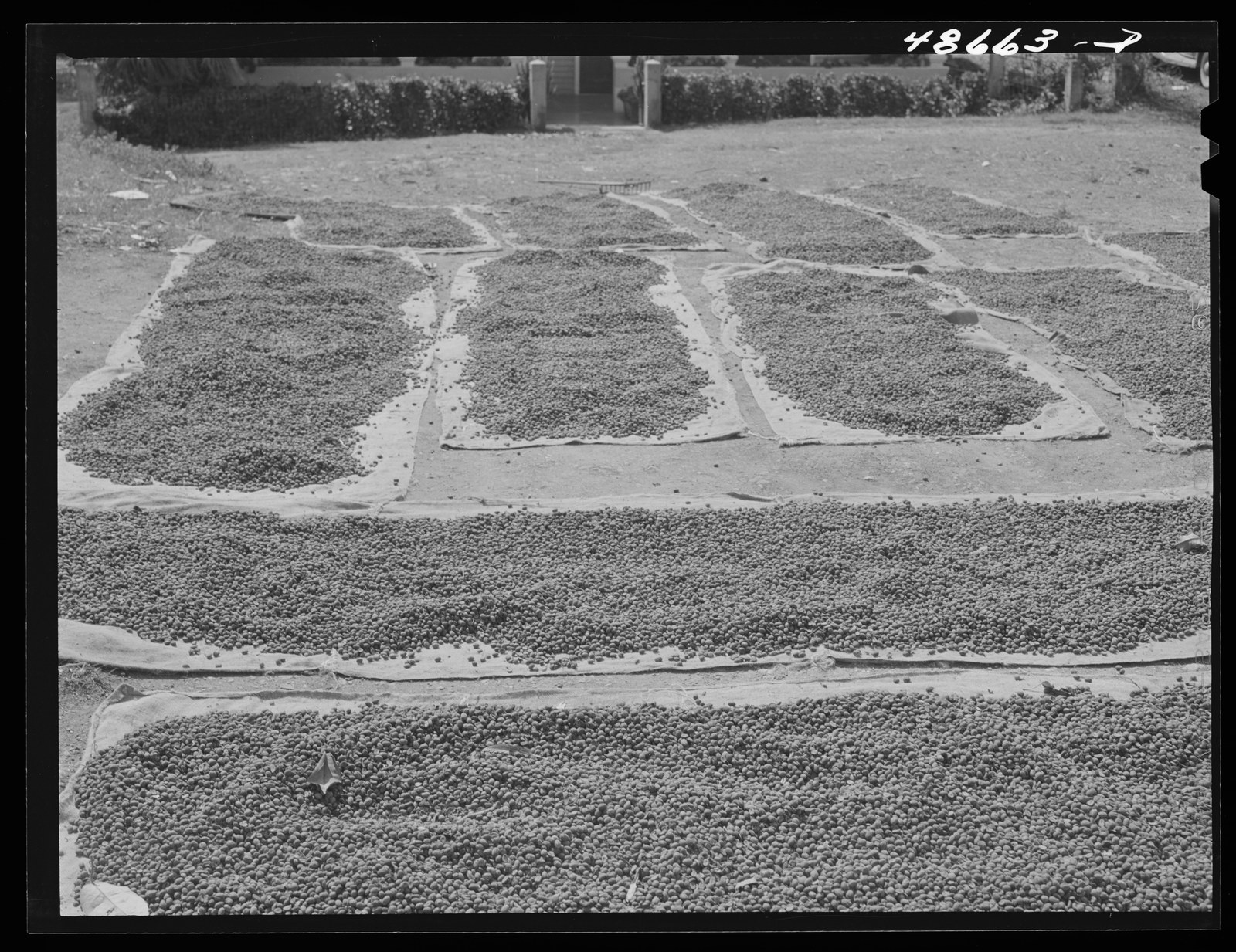
Setting out coffee beans to dry along the road, in the vicinity of San Sebastián, Puerto Rico, December 1941. Photo: Jack Delano, Farm Security Administration – Office of War Information / Library of Congress, no known restrictions.
In Puerto Rico the coffee harvest moves from the low zones to the high zones over several months. University of Puerto Rico publications place it from the end of June or August in the low zones to January in the high zones. The university's practical guide gives July to October below 800 feet, until early December at middle elevations of about 900 to 1,800 feet, and until the end of January above 2,500 to 3,000 feet. Puerto Rico's Secretary of Agriculture said in 2018 that October traditionally has the most ripe coffee. By the guide's timetable, picking in the low zones is over by late November, while farms at middle and high elevations are still harvesting. The harvest season is described further in La Cosecha: Puerto Rico's Coffee Harvest Season.
Watch: El Motor: Coffee and the Heart of Puerto Rico — Library of Congress
It was made by Russell Oliver, who received a 2022 Community Collections Grant from the American Folklife Center.
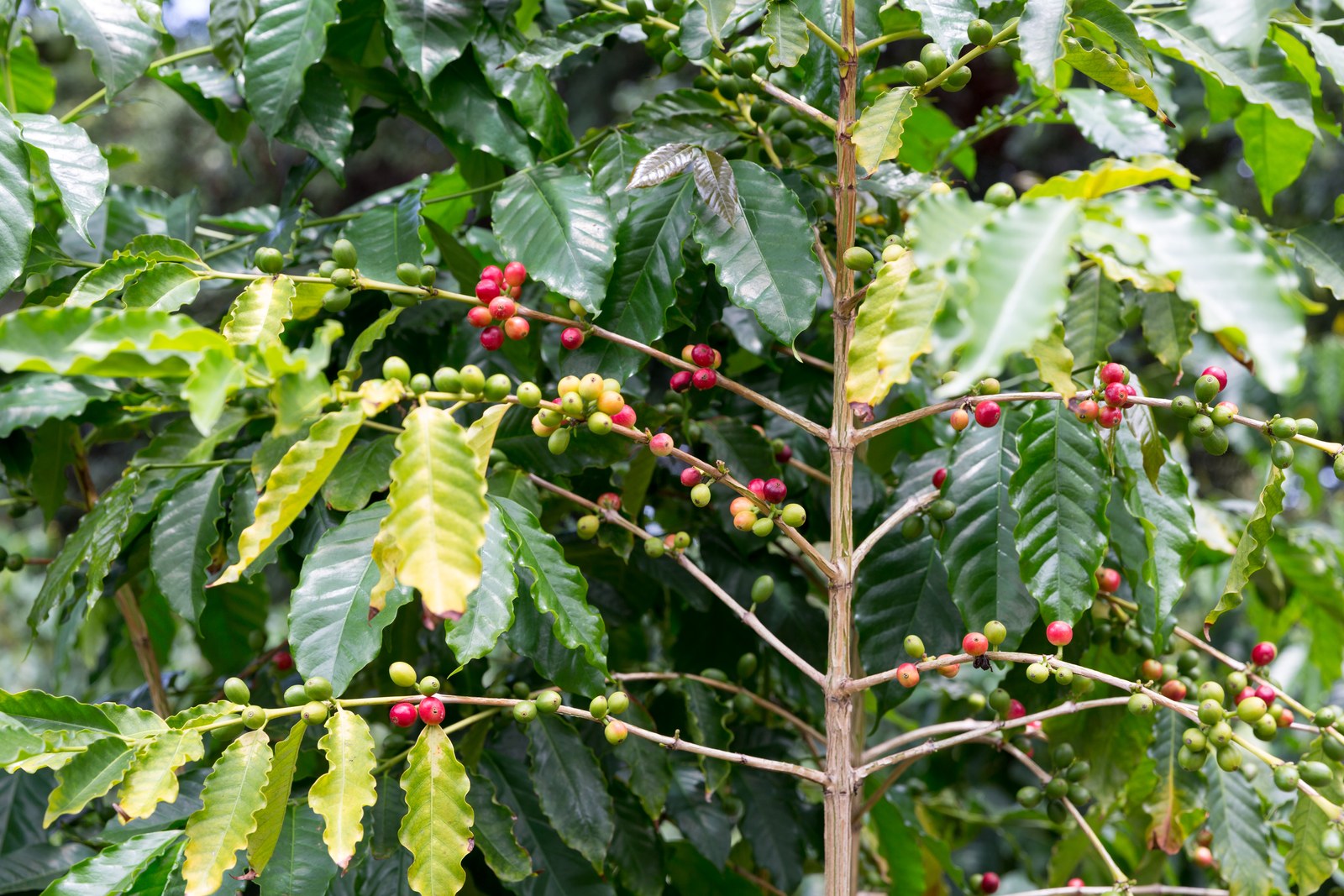
Coffee cherries at the Kona Coffee Living History Farm, Hawaii, July 2017. Photo: Ekrem Canli / Wikimedia Commons, CC BY-SA 4.0.
In the Kona district of Hawaii, coffee in the lower part of the coffee belt ripens from late August to December, and the busiest period runs from late September to early November, according to the University of Hawaii. In the cool, wet upper section of Kona, the harvest can stretch through the whole year. The Kona Coffee Cultural Festival, which its organisers date to 1970 and describe as the oldest food festival in Hawaii, holds its 55th edition from 6 to 15 November 2026.
Days of Thanks Around the World
Canada celebrates Thanksgiving on the second Monday of October, which in 2026 was 12 October, and federal law lists Thanksgiving Day among the general holidays.
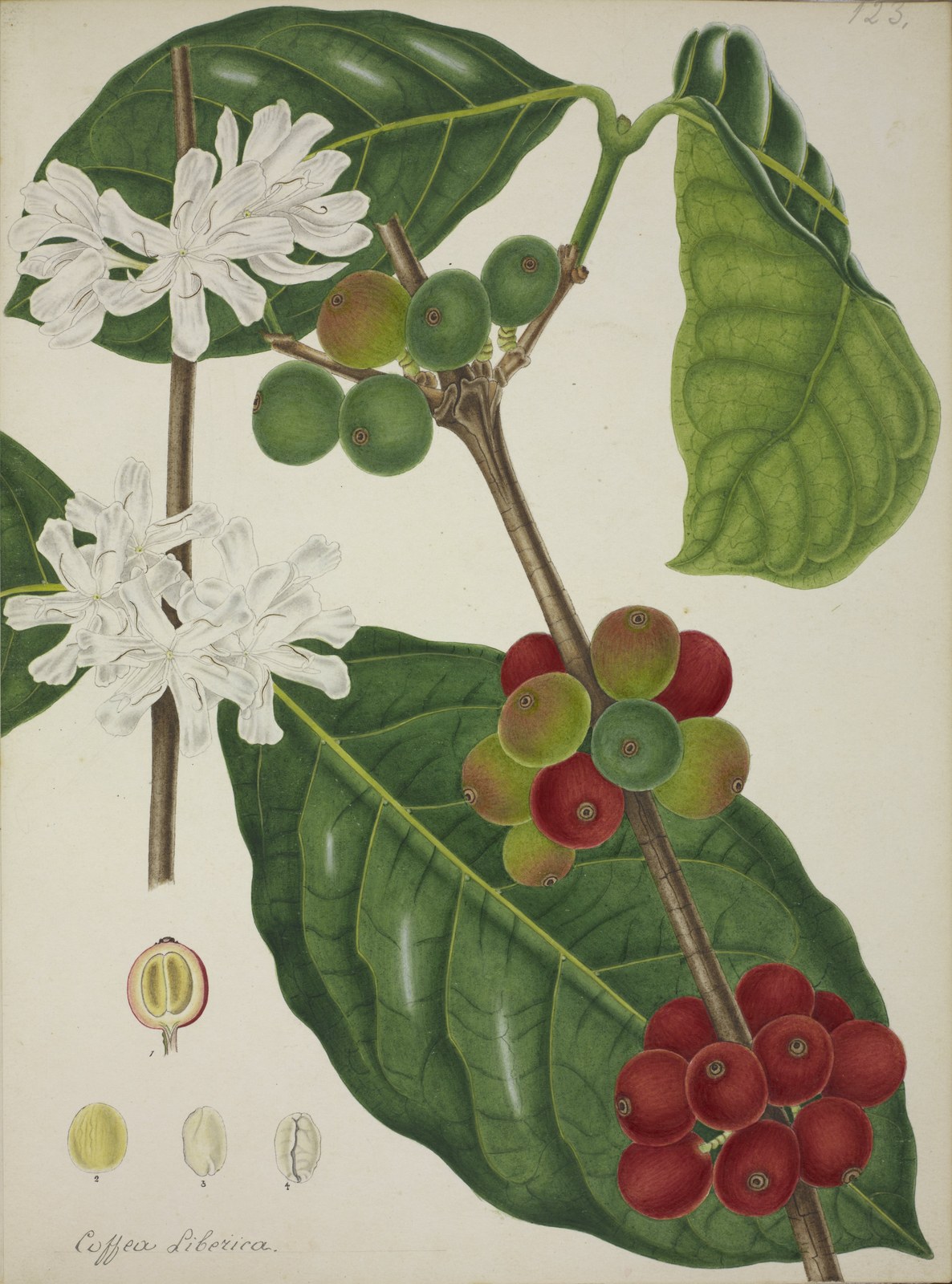
Coffea liberica, watercolour by George De Alwis, about 1893. National Library of Poland / Wikimedia Commons, public domain.
Liberia observes a National Thanksgiving Day on the first Thursday of November, under an Act of 1883 cited in its presidential proclamations; by that rule it falls on 5 November in 2026. Liberia also gave its name to a coffee species, Coffea liberica, known as Liberian coffee. A 2025 study in Nature Plants places wild Coffea liberica in five West African countries: Sierra Leone, Liberia, Ivory Coast, Ghana and Nigeria.
Brazil, the world's largest coffee producer, has had a Dia Nacional de Ação de Graças since a law of 1949, and a law of 1966 set it on the fourth Thursday of November. It is not a public holiday: the federal list of holidays and optional days off for 2026 does not include it. The United States Department of Agriculture forecasts a record Brazilian harvest of 71.9 million 60-kilogram bags for 2026/27, and says that Brazil accounts for nearly 40 percent of world production. Japan observes Labor Thanksgiving Day on 23 November; its 1948 holidays law describes it as a day to honour labour, celebrate production, and have the people give one another thanks. Before 1948 the same date was the holiday of Niinamesai. In Germany, churches celebrate Erntedank, the harvest thanksgiving, as a rule on the first Sunday in October, traditionally decorating their altars with produce of the fields. No source located ties a coffee custom to the Japanese or German days.
Coffee on the American Table Today
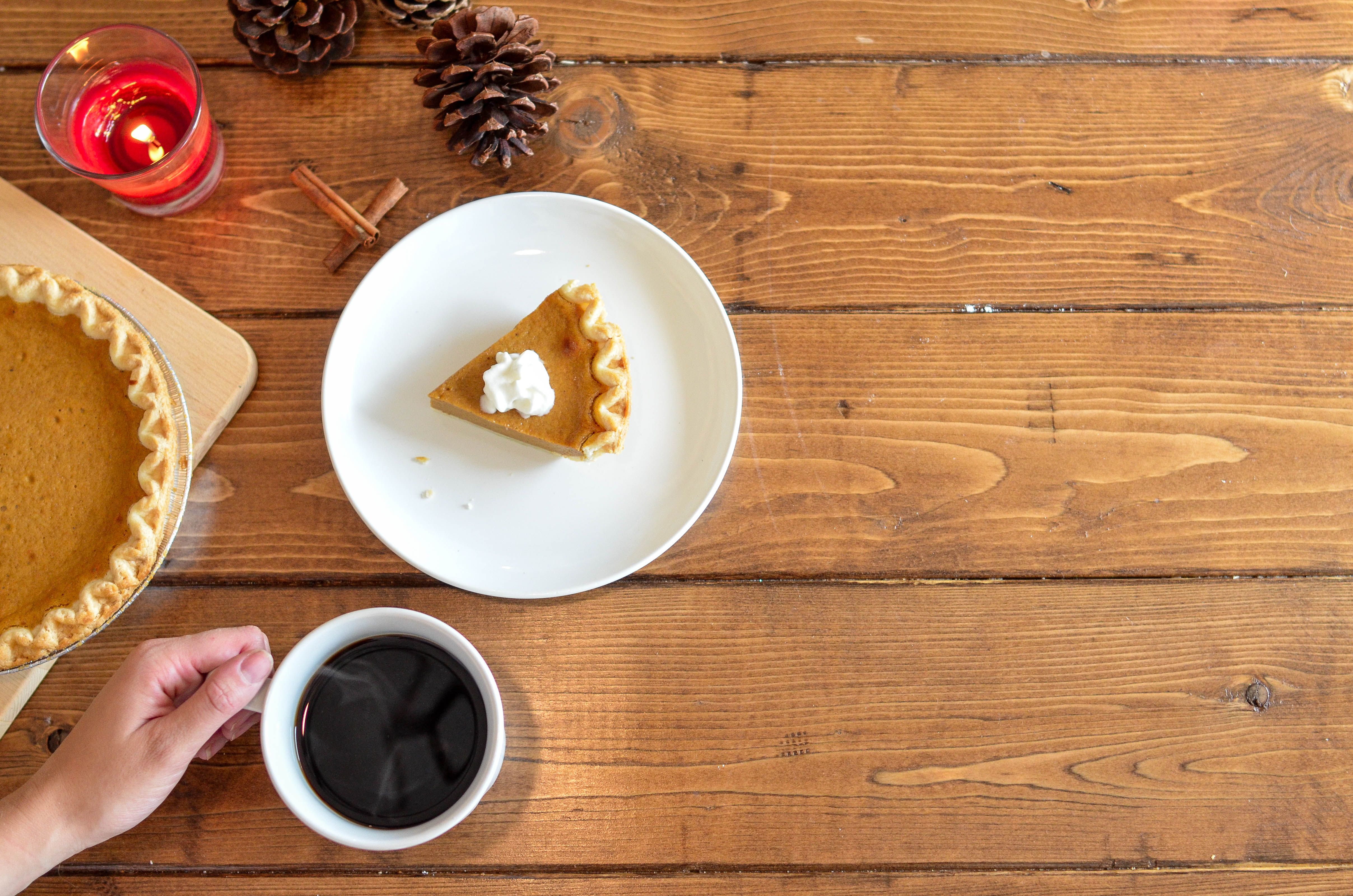
A slice of pumpkin pie and a cup of coffee. Photo: Element5 Digital / Pexels.
The National Coffee Association, a trade association, reported in its Fall 2026 survey that 66 percent of American adults had drunk coffee in the past day. Its Spring 2026 report put past-week coffee drinking at 73 percent, and the number of adults who drink coffee each week at nearly 195 million. In 2016 the American Farm Bureau Federation's informal survey of the cost of a Thanksgiving dinner for ten included coffee and milk on its shopping list. Its 2025 list does not include coffee. No survey data on coffee served with Thanksgiving desserts was located.
Key Facts
- Thanksgiving falls on the fourth Thursday of November in the United States and Puerto Rico: 26 November in 2026.
- The only eyewitness account of the 1621 Plymouth gathering names venison and wildfowl; no source records coffee there.
- Coffee was licensed for sale in Boston in 1670, according to the Colonial Society of Massachusetts.
- Lincoln's Proclamation 106 of 3 October 1863 named the last Thursday of November; a 1941 law fixed the fourth Thursday from 1942.
- Puerto Rico's Law 26 of 2017 lists the Día de Acción de Gracias among public holidays; pavochón is turkey seasoned in the style of lechón.
- Thanksgiving falls during the coffee harvest in Puerto Rico and in Kona, Hawaii.
- Canada, Liberia, Brazil, Japan and Germany keep their own days of thanks, and Coffea liberica, Liberian coffee, takes its name from Liberia.
Frequently Asked Questions
Was coffee served at the first Thanksgiving in 1621? No source says either way. The only eyewitness account names venison and wildfowl, and Plimoth Patuxet Museums considers water the most likely drink.
When did coffee reach colonial America? The earliest dated record located is from Boston in 1670, when two women were licensed to sell coffee and chocolate, according to the Colonial Society of Massachusetts.
Is Thanksgiving a holiday in Puerto Rico? Yes. Puerto Rico's Law 26 of 2017 lists it on the fourth Thursday of November.
What is pavochón? A turkey seasoned and roasted in the style of lechón, the Puerto Rican roast pig; the name joins pavo and lechón.
Is coffee being harvested at Thanksgiving? In Puerto Rico, farms at middle and high elevations are still harvesting in late November. In Kona, Hawaii, coffee in the lower coffee belt ripens from late August to December.
Which other countries have a day of thanks? Canada keeps Thanksgiving on the second Monday of October, Liberia on the first Thursday of November, and Brazil on the fourth Thursday of November, where it is not a public holiday. Japan has Labor Thanksgiving Day on 23 November.
Sources
- Pilgrim Hall Museum. Primary Sources for “The First Thanksgiving” at Plymouth and Plymouth Colony Menu. Edward Winslow's letter of 1621; no original menus.
- Young, A. (1841). Chronicles of the Pilgrim Fathers of the Colony of Plymouth, from 1602 to 1625. Library of Congress copy. The letter's date; the label "the first Thanksgiving".
- Plimoth Patuxet Museums. What did they eat at the 1621 harvest celebration? and Thanksgiving. The dates, attendance, foods and drink.
- Colonial Society of Massachusetts. The Silver Chocolate Pots of Colonial Boston. The 1670 Boston petitions, citing the Boston Records 1660–1701 (1881), p. 58.
- Massachusetts Historical Society, Adams Papers Digital Edition. John Adams to Abigail Adams, 6 July 1774.
- Library of Congress, Abraham Lincoln Papers. Sarah J. Hale to Abraham Lincoln, Monday, September 28, 1863 (Thanksgiving).
- U.S. National Archives. President Abraham Lincoln's Thanksgiving Day Proclamation, President Abraham Lincoln's Thanksgiving Day Proclamation of October 3, 1863 (Presidential Proclamation 106), catalog record 299960, Lincoln’s 1863 Thanksgiving Proclamation, Congress Establishes Thanksgiving and Thanksgiving as a Federal Holiday.
- National Park Service. Lincoln and Thanksgiving.
- 55 Stat. 862, H. J. Res. 41 (1941): Joint Resolution Making the fourth Thursday in November a legal holiday; 5 U.S.C. 6103: §6103. Holidays.
- Puerto Rico. “Ley de Cumplimiento con el Plan Fiscal” Ley Núm. 26 de 29 de abril de 2017, Artículo 2.05.
- Metro Puerto Rico: Gobernadora concede días libres a empleados públicos para Acción de Gracias y Navidad (21 October 2026), Después del pavo llega la Navidad (26 November 2015), ¿Son de Puerto Rico las navidades más largas del mundo? (24 December 2024) and Boricuas comienzan las Navidades más largas (8 November 2012).
- EFE, in Primera Hora (27 November 2013). El "pavochón" sustituye al tradicional pavo en la mesa boricua.
- Sinclair Broadcast Group (25 November 2021). A Puerto Rican Thanksgiving takes on a different flavor than typical gatherings.
- Philadelphia Inquirer, Food (21 November 2022). The Puerto Rican turkey recipe that connects me to my roots. Food press.
- Smithsonian Folkways. Teacher’s Guide, Lesson Hub 3: Música Jíbara: Aguinaldo and the Season of Celebrations.
- University of Puerto Rico at Mayagüez: Conjunto Tecnológico para la Producción de Café, P-104 (2018), Guía Práctica para la Producción del Café and A recoger café maduro.
- NotiCel (16 October 2018). Buscan manos para el café puertorriqueño.
- University of Hawaii, CTAHR. Growing Coffee in Hawaii.
- Kona Coffee Cultural Festival. Kona Coffee Cultural Festival. The organiser's own description.
- Statistics Canada. Thanksgiving: Around the harvest table. Canada Labour Code, section 166.
- Liberia, Ministry of Foreign Affairs. President Boakai Declares Thursday, Nov. 6, As “National Thanksgiving Day” (2025) and A Proclamation by the President (2015).
- IPNI: Coffea liberica; CSIRO: Coffea liberica; Davis, A. P. et al. (2025). Genomic data define species delimitation in Liberica coffee with implications for crop development and conservation, Nature Plants.
- Brazil: Lei nº 781, de 17 de agosto de 1949, Lei nº 5.110, de 22 de setembro de 1966 and Portaria MGI nº 11.460, de 29 de dezembro de 2025.
- USDA Foreign Agricultural Service (July 2026). Coffee: World Markets and Trade.
- Cabinet Office of Japan. 「国民の祝日」について and 各「国民の祝日」について (参考情報)祝日法制定の経緯.
- Evangelical Church in Germany (EKD). Erntedank.
- National Coffee Association: NCA: Coffee Tops Beverage Charts Again, Specialty Coffee Hits New High (Fall 2026 report) and Coffee Tops Americans’ Beverage Choices (Spring 2026 report). A trade association.
- American Farm Bureau Federation: Cost of Thanksgiving dinner drops in 2016 – from the American Farm Bureau (2016 release, reposted by the California Department of Food and Agriculture) and Cost of Thanksgiving Dinner Declines (2025 release).
- US National Archives, "Happy Thanksgiving from the National Archives", and the Library of Congress film "El Motor: Coffee and the Heart of Puerto Rico" (YouTube), embedded above.
Claims this encyclopedia could not source
- Whether coffee was served at the 1621 gathering. No source states it either way.
- That Captain John Smith brought coffee to Virginia. His 1630 True Travels mentions coffee only among the Turks.
- That there was coffee in New York in 1668. The date appears in a 1924 trade handbook that cites no source.
- The 1670 Boston record itself. It is known here only through the Colonial Society of Massachusetts' quotation of the printed town records.
- A Puerto Rican custom tying coffee to Thanksgiving. None was located.
- Coffee customs tied to Japan's Labor Thanksgiving Day or Germany's Erntedank. None were located.
- Data on coffee served with Thanksgiving desserts. None was located.
- A peak harvest month in a University of Puerto Rico publication. None was located; the October figure comes from the Secretary of Agriculture.
- That Coffea liberica was first collected in Liberia. One botanical record cites a type specimen cultivated in Sierra Leone.
Related Articles
- La Cosecha: Puerto Rico's Coffee Harvest Season
- Puerto Rican Coffee Culture: Sobremesa, Daily Rituals, and Family Life
- Coquito con Café: The Puerto Rican Christmas Coffee Coquito
- Tembleque de Café: The Puerto Rican Coffee Coconut Pudding
BUY AUTHENTIC PUERTO RICO COFFEE →
Part of The Coffee Encyclopedia — Sponsored by PuertoRicoCoffeeShop.com.