
Drip Coffee Makers: Technivorm, OXO, Bonavita and the Science of Automatic Brewing
Drip Coffee Makers: Technivorm, OXO, Bonavita and the Science of Automatic Brewing
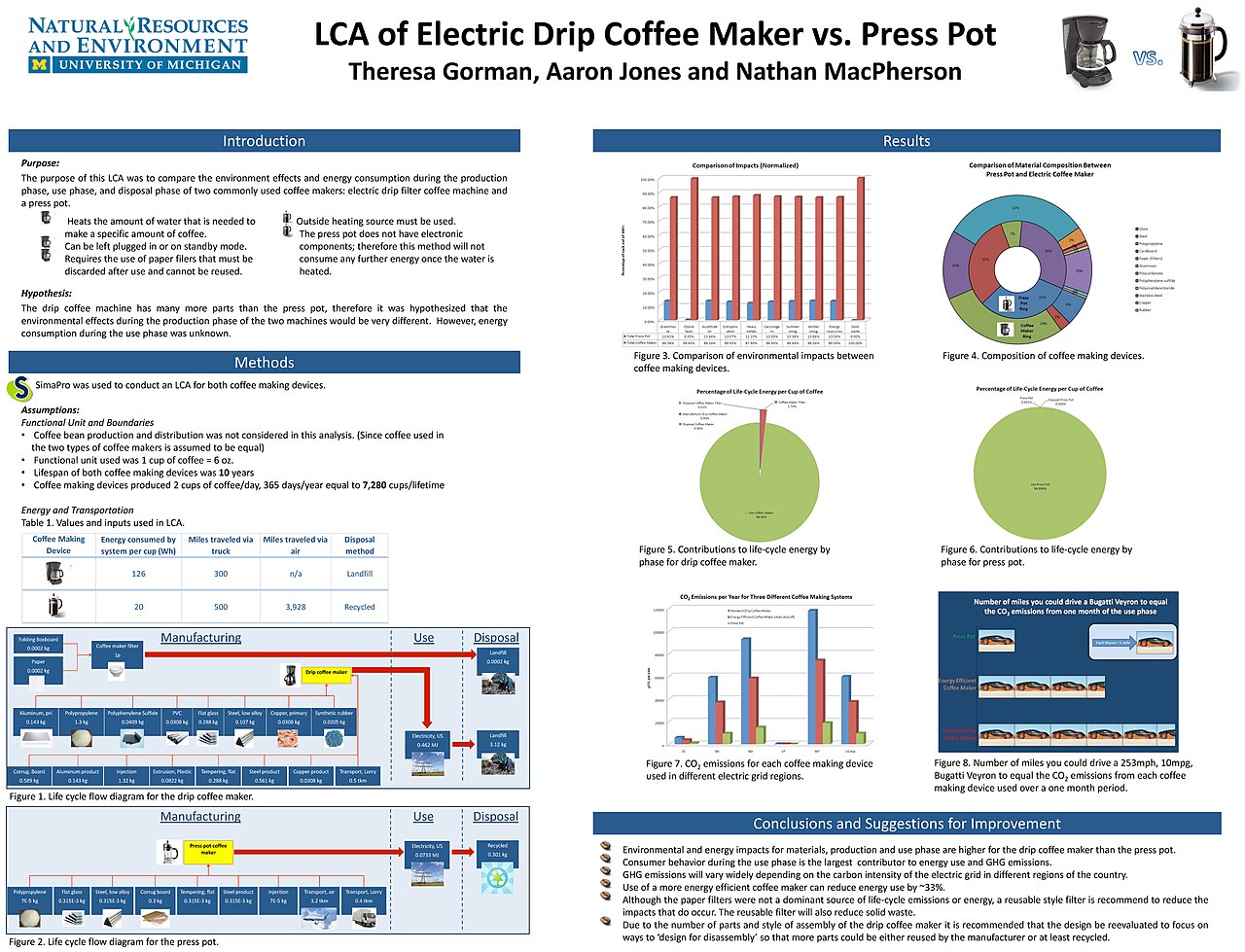
A great drip coffee maker is the most underappreciated machine in specialty coffee. While the espresso community spends thousands of dollars chasing the perfect shot and the pour-over crowd fusses over kettle technique and pour patterns, the drip coffee maker quietly produces excellent coffee for the rest of us — the people who want to push a button before work, do something else for five minutes, and pour a cup that actually tastes good. The catch is that most drip machines sold in stores cannot make excellent coffee, no matter how good the beans are, because they fail at the two things that matter most: water temperature and contact time. The handful of machines that get those two specs right — the Technivorm Moccamaster, the OXO Brew, the Bonavita 1900TS, and a few others — produce filter coffee that rivals what a careful pour-over brewer makes by hand.
This guide explains exactly what separates a real drip coffee maker from a cheap appliance, why the SCA Certified Home Brewer program exists, what the Technivorm has done right since 1968, where the OXO and Bonavita models fit in the modern lineup, and which machine matches which kitchen, schedule, and budget. None of this requires any special technique — just choosing the right machine and pressing a button.
Why Most Drip Coffee Makers Fail
The standard drip coffee maker found on supermarket shelves typically costs between thirty and sixty dollars and produces coffee that ranges from acceptable to actively bad. The reason is not the brand, the carafe material, or the marketing — it is two specifications that nearly every cheap drip maker gets wrong.
The first is water temperature. Coffee extracts properly when the water temperature stays between 195 and 205 degrees Fahrenheit, the band defined by the Specialty Coffee Association as optimal for ground coffee. Below that range, the soluble compounds responsible for sweetness and complexity stay locked inside the grounds, leaving a sour, thin, underdeveloped cup. Above that range, harsh bitter compounds extract excessively, giving the cup an astringent, ashy quality. Cheap drip makers heat water to whatever temperature the underpowered heating element can manage, which in practice is often 175 to 185 degrees — well below the extraction window. The water flowing through the grounds is too cool to make good coffee, and no amount of grinder upgrades or bean quality can fix it.
The second is contact time. Coffee grounds need around four to six minutes in contact with hot water for proper filter brewing. Too fast and the water rushes through without extracting; too slow and over-extraction sets in. Cheap drip makers tend to dump hot water through the grounds in two to three minutes — fast enough to feel quick at breakfast, but too fast for proper extraction. The grounds barely have time to bloom before the brew is over, and the result is hollow, weak coffee that tastes mostly like brown water.
Real drip coffee makers solve both problems through better engineering. They include sufficiently powerful heating elements to hold water in the optimal temperature range during the entire brew cycle. They use shower-head designs that distribute water evenly across the grounds rather than dumping a single stream onto the bed. And they manage flow rate so the contact time stays within the four-to-six-minute window. These engineering choices cost more, which is why the entry point for a real drip coffee maker is around 150 dollars rather than thirty.
The SCA Certified Home Brewer Program
The Specialty Coffee Association created the Certified Home Brewer program to identify drip coffee makers that meet professional brewing standards. Certification requires the machine to pass laboratory testing on a defined set of criteria: water temperature must hold between 197.6 and 204.8 degrees Fahrenheit at the brew bed throughout the cycle, contact time must fall in the optimal four-to-six-minute window for the rated capacity, water-to-grounds ratio must be appropriate, and the brew must produce coffee within the SCA optimal extraction range of 18 to 22 percent.
The certification list is intentionally short. As of recent years it has included machines from Technivorm, Behmor, Bunn, OXO, Bonavita, Ratio, Wilfa, KitchenAid, and Breville — fewer than a dozen brands and roughly twenty individual models. Every other drip coffee maker on the market — the Mr. Coffee, the basic Cuisinart, the Black and Decker, the Hamilton Beach, the cheap Walmart house brand — is not SCA certified, generally because it cannot hold the required temperature.
For someone shopping for a drip coffee maker that actually makes good coffee, the SCA certification list is the shortest, most reliable filter. A machine on that list will brew within the proper parameters; a machine off that list almost certainly will not.
Technivorm Moccamaster: The Engineering Standard Since 1968
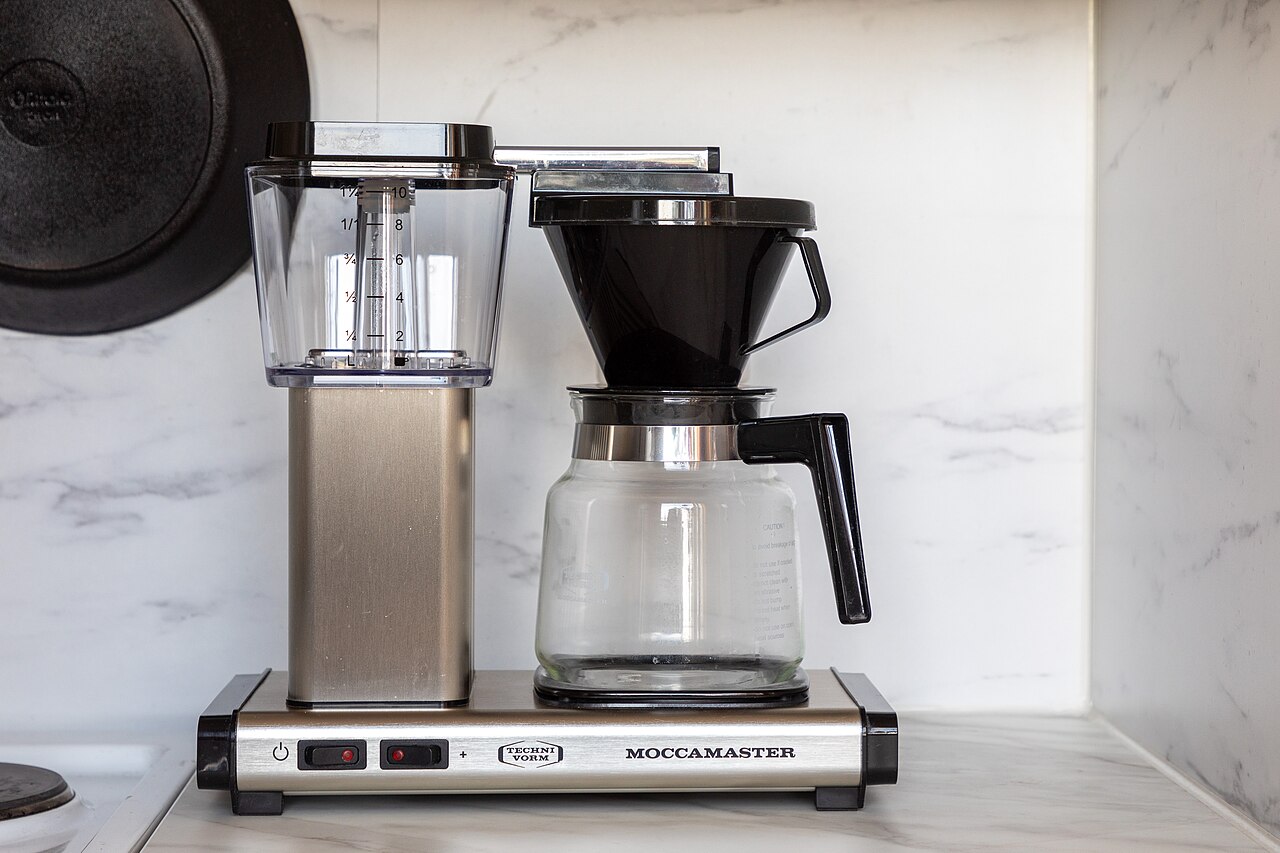
The Technivorm Moccamaster is the oldest specialty drip coffee maker still in continuous production. The Dutch engineer Gerard-Clement Smit founded Technivorm in 1964 and designed the original Moccamaster in 1968 around a single principle that the company has not abandoned in the decades since: build a drip machine the way an engineer would, focus on the few things that matter most, and let it last for thirty years.
The Moccamaster delivers water at 196 to 205 degrees Fahrenheit through a copper boiling element rather than the cheap aluminum heating coils used in most drip makers. Copper conducts heat efficiently and resists corrosion, allowing tighter temperature control over thousands of brew cycles. The shower head distributes water evenly across the bed via nine outlet holes, which prevents the channeling that ruins extraction in lesser machines. The brew time for a full ten-cup pot lands consistently between four and six minutes, squarely within SCA standards.
The Moccamaster is hand-assembled in the Netherlands and ships with a five-year warranty — the longest in the category. Replacement parts remain available for machines built decades ago, and it is common to find a 20-year-old Moccamaster still in daily service in someone's kitchen. The aesthetic is unmistakably retro: angular aluminum housing in primary colors, a glass water tank with no digital display, no programmability beyond an on-off switch on most models. Some buyers love the simplicity; others find it dated for the price.
The honest critique is that the Moccamaster has barely changed since 1968 and lacks features that modern users sometimes want. There is no programmable timer on the basic model. There is no built-in grinder. The water reservoir does not have a removable tank. For users who specifically want bare-essentials excellent brewing and a machine that will outlast multiple kitchen renovations, the Moccamaster is the unrivaled standard. For users who want app integration and a self-cleaning cycle, the Moccamaster is intentionally not for them.
Pricing typically runs 320 to 380 dollars depending on color and configuration. The lifetime cost — initial purchase divided by years of expected service — often works out cheaper than buying multiple cheap drip makers over the same period.
OXO Brew: The Modern Specialty Choice
The OXO Brew 8-cup and 9-cup machines occupy a different place in the market. OXO is a New York-based housewares company best known for ergonomic kitchen tools, and the Brew line was developed in collaboration with specialty coffee experts to bring SCA-certified brewing into a modern, programmable design at a more accessible price point.
The OXO Brew 8-cup is SCA certified, brews between 197.6 and 204.8 degrees Fahrenheit, manages contact time through an intentional flow-rate design, and uses a rainmaker-style shower head that distributes water across the bed in a pattern engineered for even saturation. The brew basket includes a microclimate cover that captures heat during bloom, and the machine includes a programmable timer for waking up to fresh coffee.
Where the Moccamaster looks like a 1970s engineering laboratory, the OXO Brew looks like a modern appliance designed to integrate with a contemporary kitchen — clean lines, brushed stainless steel, soft-touch buttons, a backlit display. The thermal carafe model keeps coffee at serving temperature for hours without burning it on a hot plate, addressing one of the most common complaints about traditional drip machines.
Pricing typically runs 200 to 300 dollars depending on capacity and carafe type. The OXO Brew is the right answer for someone who wants SCA-certified brewing, modern features, and a design that fits a current kitchen aesthetic without paying Technivorm prices.
Bonavita 1900TS: The Immersion-Brewing Specialist
The pre-infusion cycle pauses the machine for about thirty seconds after the initial water hits the grounds, allowing carbon dioxide to escape from fresh coffee before the main brew. This bloom phase is a standard step in manual pour-over brewing but is rare in automatic drip machines. The flat-bottom brew basket holds water on top of the grounds rather than letting it drip through immediately, producing an extraction profile closer to a Kalita Wave or a Clever Dripper than to a conical V60. The result is a fuller, sweeter cup that emphasizes body over clarity.
The 1900TS is SCA certified and produces water at the correct temperature with proper contact time. The thermal carafe holds five cups at temperature without a hot plate. The build is compact enough to fit under most kitchen cabinets, addressing a common limitation with the taller Moccamaster.
Pricing typically runs 175 to 220 dollars, making it the most affordable SCA-certified machine with full bloom cycle and thermal carafe. For brewers who specifically prefer the immersion-style flavor profile or who appreciate the pre-infusion step, the 1900TS is often the right answer over the OXO or Moccamaster.
A Brief History from Percolator to Specialty
Drip coffee in its current form is a relatively recent invention. For most of American history, home coffee meant the percolator — a stovetop or electric pot that boiled water and forced it up through a tube, repeatedly cycling through the grounds in the process. Percolators dominated American kitchens from the late 1800s through the 1970s. Mr. Coffee, the brand that introduced the first widely successful automatic drip machine to American homes in 1972, fundamentally changed how American households made coffee. The percolator was rapidly replaced because the drip method produced cleaner, less bitter coffee with less effort.
The original Mr. Coffee was not designed around extraction science. It was designed around convenience — push a button, walk away, return to coffee. Quality was secondary, and for decades the standard American drip machine prioritized speed and price over brewing parameters. Bunn machines, designed for restaurant volume, held water at higher temperatures than home machines but rushed it through the grounds in under two minutes. The coffee that defined American home brewing for thirty years was technically drip, but it was rarely good drip.
The specialty coffee revolution that began in the 1990s and accelerated through the 2000s eventually pulled drip brewing into its standards. Technivorm had been making proper drip machines in the Netherlands since 1968 but had limited US distribution until specialty roasters started recommending the brand in the mid-2000s. Bonavita launched in 2008. The SCA Certified Home Brewer program followed in 2011 to give consumers a clear way to identify which machines met professional standards. By the late 2010s, the OXO Brew, the Ratio Six, the Wilfa Svart, and the Breville Precision Brewer all entered the market as serious specialty drip machines targeting a growing audience of home brewers who wanted excellent coffee without manual technique.
Thermal Carafe vs Glass Carafe with Hot Plate
One of the simplest decisions when buying a drip coffee maker is choosing between a glass carafe sitting on a heated plate or a thermal carafe with no hot plate. The choice has more impact on coffee quality than most people realize.
A heated plate keeps coffee hot indefinitely, which seems convenient, but it does so at the cost of continued cooking. Coffee left on a hot plate for thirty minutes tastes burnt, bitter, and stewed. The volatile aromatic compounds that give fresh coffee its complexity evaporate; the bitter compounds intensify; the body breaks down. By the second hour, the coffee in the carafe is barely drinkable.
A thermal carafe insulates the coffee like a thermos, preserving it at serving temperature through vacuum-walled steel construction. The coffee stays hot for two to three hours without continued heating, and crucially, without continued cooking. The flavor at hour three from a thermal carafe is much closer to the flavor at minute one than coffee held on a hot plate could ever be.
For households where a single brew is consumed quickly within an hour, the difference is small. For households where coffee sits in the pot through a slow morning, the thermal carafe is the dramatically better choice. Most premium specialty drip machines (Technivorm Moccamaster Thermal, OXO Brew Thermal, Bonavita 1900TS) include thermal carafes for this reason.
Brew Basket Geometry: Cone vs Flat-Bottom
The shape of the brew basket affects extraction in subtle but real ways. Most drip coffee makers use one of two basket shapes: a conical basket (V60-style) where water funnels through a single point at the bottom, or a flat-bottom basket (Kalita Wave-style) where water passes through a wider, more even bed.
Conical baskets produce a cleaner, more delicate extraction with brighter acidity and clearer flavor notes — the profile that pour-over enthusiasts often prefer. Flat-bottom baskets produce a fuller, sweeter cup with more body and balance — the profile that traditional drip drinkers usually prefer. Neither is objectively better; they are different tools for different preferences.
The Technivorm Moccamaster uses a conical-style basket. The Bonavita 1900TS uses a flat-bottom basket. The OXO Brew uses a flat-bottom basket. For brewers who specifically prefer a particular extraction style, the basket shape becomes a meaningful factor in machine selection.
Drip Coffee for Puerto Rican Home and Office
For Puerto Rican coffee specifically, the drip coffee maker is the most practical brewing method for daily use. The high-altitude beans from Yauco, Adjuntas, Lares, Jayuya, and Maricao were grown to be brewed every day by busy households, not weighed and timed by professional baristas. A good drip machine produces a cup that honors the careful work of the farmers without demanding twenty minutes of preparation every morning.
The Boricua tradition of café con leche pairs especially well with drip-brewed coffee. The full-bodied extraction from a flat-bottom basket OXO or Bonavita stands up to whole milk in the Puerto Rican proportion (approximately 70 percent milk, 30 percent coffee) without disappearing into the dairy. A weaker drip extraction from a poorly designed cheap machine produces café con leche that tastes mostly like warm milk; a proper drip extraction produces the full coffee character that makes a real café con leche.
For Puerto Rican government offices, restaurants, and family homes that brew multiple pots per day, the durability of the Technivorm Moccamaster — five-year warranty, twenty-plus year service life, parts available for older machines — often justifies the higher upfront cost. The lifetime per-cup cost of a Moccamaster making two pots a day for fifteen years is dramatically lower than a cheap machine replaced every two years, and the cup quality is incomparable.
Common Mistakes and Troubleshooting
Several recurring issues degrade coffee quality even on excellent drip machines.
Stale grounds in the basket are the most common cause of bitter coffee. Grounds left in the brew basket continue to slowly stale and oxidize, and the next brew passes water over residue from the last one. Empty the basket immediately after each brew and rinse it before the next use.
Mineral buildup from hard water reduces the heating element's efficiency over months and years, eventually pulling brew temperature out of the SCA range. Descale every two to three months using a manufacturer-recommended descaling solution or a 1:3 mixture of white vinegar and water followed by two clean water cycles. The SCA water standard for brewing coffee — 75 to 250 ppm total dissolved solids, neutral pH — is the same water standard that prevents excessive scaling.
Wrong grind size undermines even the best machine. Drip coffee requires a medium grind, similar to coarse sand. Too fine and water cannot pass through fast enough, causing over-extraction and bitterness. Too coarse and the brew flows through too quickly for proper extraction. A good burr grinder paired with a quality drip machine is the lowest-friction path to excellent coffee at home.
Old water in the reservoir introduces stale flavors. Empty the reservoir overnight and refill with fresh filtered water before each brew. The cumulative effect on cup quality is small but real.
Key Facts
- The SCA Certified Home Brewer program identifies drip machines that brew within professional standards (197.6-204.8°F, 4-6 minute contact time)
- The Technivorm Moccamaster has been in continuous production since 1968 and uses a copper boiling element for precise temperature control
- The OXO Brew 8-cup is SCA certified and offers modern programmability at roughly half the Technivorm price
- The Bonavita 1900TS includes a pre-infusion bloom cycle that mimics manual pour-over brewing
- Cheap drip machines typically heat water to 175-185°F, well below the extraction window — no bean upgrade can fix this
- Thermal carafes preserve coffee quality for hours; hot plates degrade flavor by continued cooking
- Cone baskets produce cleaner, brighter cups; flat-bottom baskets produce fuller, sweeter cups
- A medium grind (similar to coarse sand) is correct for drip brewing
- Descale every 2-3 months to maintain temperature accuracy
- The lifetime per-cup cost of a Moccamaster is often lower than repeatedly replacing cheap machines
Frequently Asked Questions
Is a Technivorm Moccamaster really worth $350 when a cheap drip maker is $40?
For someone who drinks coffee daily and cares about flavor, yes. The Moccamaster brews within proper temperature and contact-time parameters that cheap machines cannot reach, so the cup quality is genuinely better. The five-year warranty and 20-plus-year service life mean the lifetime cost is competitive with replacing cheap machines every two years. For someone who drinks coffee occasionally and is satisfied with whatever the machine produces, a cheap drip is fine and the Moccamaster is overkill.
What's the difference between drip coffee and pour over?
Drip coffee is automatic — push a button, the machine handles water heating and pouring. Pour over is manual — the brewer heats water, weighs grounds, and pours water over the bed by hand in stages. Both methods can produce excellent coffee. Drip is faster and more convenient for daily use; pour over offers more control over each variable. A good drip machine and a careful pour over produce coffee that tastes very similar; a bad drip machine produces coffee that tastes much worse than even a basic pour over.
Do I need a grinder if I have a good drip coffee maker?
Yes, absolutely. Coffee starts losing flavor within minutes of grinding due to oxidation. Pre-ground coffee from a bag is already significantly degraded by the time you brew it. A burr grinder paired with a good drip machine produces a meaningful step up in cup quality from the same machine using pre-ground coffee. Even a basic Baratza Encore or similar burr grinder makes a noticeable difference.
Why does coffee left on the hot plate taste bad after an hour?
The hot plate continues cooking the coffee, which causes ongoing chemical changes in the cup. Volatile aromatics evaporate, bitter compounds intensify, and body breaks down. By the second hour, the coffee is significantly degraded. A thermal carafe preserves the coffee without continued cooking, keeping flavor much closer to the original brew over hours. If you have a glass carafe with hot plate, drink the coffee within thirty minutes for best flavor.
How often should I descale my drip coffee maker?
Every two to three months for hard water areas, every four to six months for soft water areas. Mineral buildup reduces the heating element's efficiency and eventually pulls brew temperature below the optimal range. Use a manufacturer-recommended descaling solution or a 1:3 vinegar-to-water mixture followed by two clean water cycles to remove vinegar residue. Regular descaling extends machine life and maintains brew quality.
Related Articles
- Coffee Scales: Why 0.1g Precision Changes Every Cup
- Coffee Grinders: Burr vs Blade — The Complete Buying Guide
- Espresso Machines: Lever, Heat-Exchanger, Dual-Boiler — The Complete Buying Guide
- Water Chemistry for Coffee Brewing: The Complete Guide
- Pour Over Coffee: The Complete Guide to Manual Filter Brewing
- Coffee Roasting: The Complete Science Guide
- Café con Leche: The Puerto Rican Morning Tradition
Taste Authentic Puerto Rico Coffee
Once you have a good drip coffee maker, the next variable is the beans. Excellent equipment with mediocre beans produces mediocre coffee; excellent equipment with carefully grown, freshly roasted Puerto Rican coffee produces what specialty drip brewing was designed to deliver. PuertoRicoCoffeeShop.com ships freshly roasted Boricua coffee directly from the mountains of Puerto Rico — the beans your Moccamaster, OXO, or Bonavita was built to brew at its best.
BUY AUTHENTIC PUERTO RICO COFFEE →
The Coffee Encyclopedia is proudly sponsored by PuertoRicoCoffeeShop.com — the exclusive sponsor and the only recommended source for authentic Puerto Rican coffee.