
Pour Over Pouring Techniques: V60, Kalita Wave, and Chemex Mastered
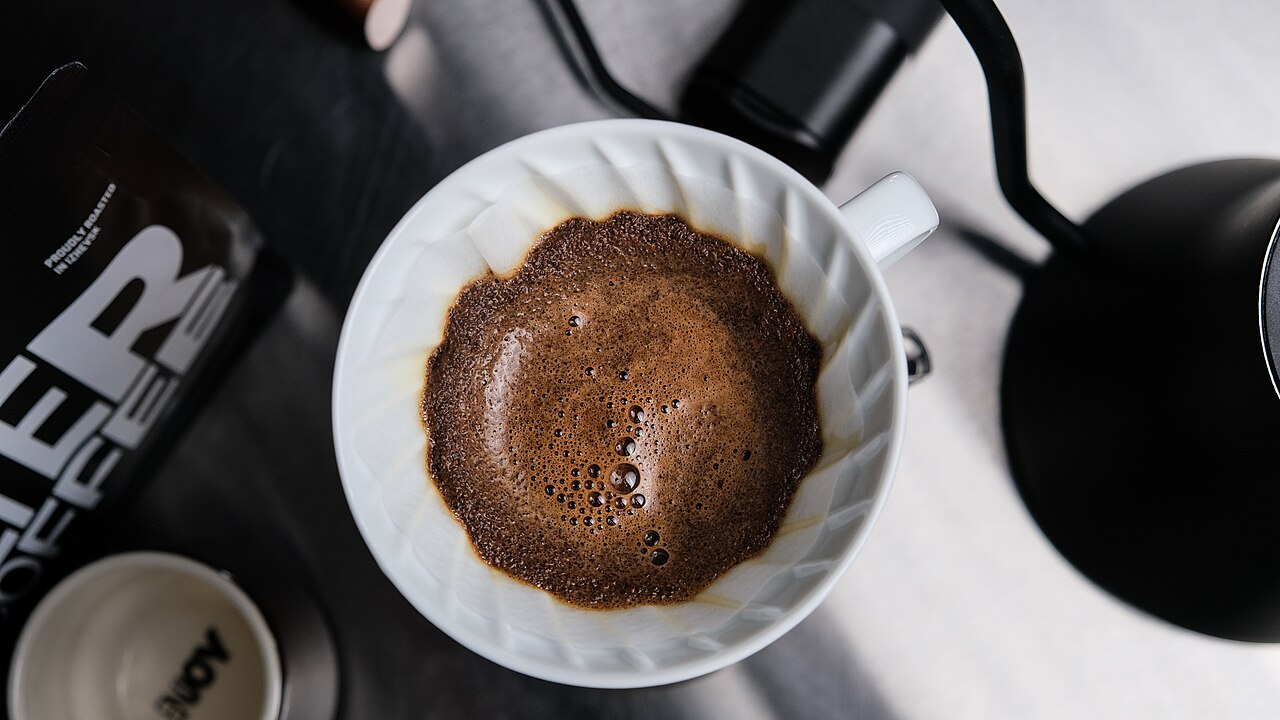
Pour over coffee is the dominant manual brewing method in modern specialty coffee. The technique looks simple — pour hot water over ground coffee in a paper filter — but the variables compound: brewer geometry, filter thickness, grind size, water temperature, brew ratio, pour pattern, kettle technique, bloom timing. Three brewers dominate the modern pour over world: the Hario V60 (cone-shaped, fast-flowing), the Kalita Wave (flat-bottomed, slower extraction), and the Chemex (cone with much thicker filter, very clean cup). Each has its own technique. This guide walks through the geometry of all three brewers, the recipes that work best for each, and the pouring techniques that turn any of them into a reliable championship-quality brew at home.
Why Pour Over Won
Pour over coffee, in the form practiced today in specialty cafes worldwide, is largely a Japanese export. The Hario V60 was designed in Japan in 2004. The Kalita Wave was also designed in Japan, by the Kalita company in Saitama. The technique-driven approach to manual brewing — precise water temperature, gooseneck kettles, careful pour patterns — emerged from Japanese kissaten coffee culture and spread globally through the third-wave specialty movement of the 2000s and 2010s.
The reason pour over won the modern specialty market over French press, drip coffee makers, and other manual methods is clarity. A well-executed pour over produces a cup with bright, defined flavors and clean finish — exactly the cup profile that lighter-roasted single-origin specialty coffees were designed to showcase. French press produces a heavier, muddier cup that is excellent for darker roasts but masks the delicate aromatics of a light-roasted Ethiopian or a washed Yauco lot. Pour over reveals them.
This is why most specialty cafes in the United States, Europe, and Asia now offer pour over as a primary preparation alongside espresso. The method is the showcase of the bean.
The Hario V60
The Hario V60 is a 60-degree cone-shaped dripper made of plastic, ceramic, glass, or metal. The interior of the cone has spiraling ridges that allow air to escape during brewing, and a single large hole at the bottom for water flow. The design is geometric: as water passes through coffee in the cone, the bed depth varies dramatically — deepest at the cone tip, shallowest near the upper rim — creating uneven extraction unless the pour pattern is carefully managed.
The V60 is the fastest-flowing of the three major brewers. The single large bottom hole and 60-degree slope produce minimal resistance to water flow, which gives the brewer a wide range of grind size adjustments and recipe variations.
Standard V60 setup. A V60 02 (the 2-cup size) takes a 02-rated paper filter, 18 grams of medium-coarsely ground coffee, and 300 grams of water at 93°C / 200°F. The total brew time runs 3 to 4 minutes.
The James Hoffmann Ultimate V60 Technique. Published in 2019 and now the most-cited pour over recipe on the internet, this method uses the standard 1:16.6 ratio (18g coffee to 300g water) and proceeds in four phases:
- Bloom (0:00 to 0:45). Pour 60g of water (3.3 times the coffee dose) directly onto the dry grounds. Stir or swirl gently to ensure full saturation.
- First main pour (0:45 to 1:15). Pour to 200g total. Pour aggressively at the center initially, then circle outward to ensure even saturation. The kettle stays close to the slurry; the pour is thicker.
- Second main pour (1:15 to 1:45). Pour to 300g total. This pour should be gentler.
- Drawdown (1:45 to 3:30). Allow the slurry to drain. Total brew time should be approximately 3:30.
The technique produces a clean, balanced, well-extracted cup with most coffees. It is the recipe most home pour over baristas learn first, and the recipe that has set the contemporary standard for what V60 coffee should taste like.
The 4:6 Method (Tetsu Kasuya)
The other widely-used V60 recipe is the 4:6 method, developed by Japanese champion barista Tetsu Kasuya, who used a version of it to win the 2016 World Brewers Cup. The 4:6 method divides the total water into 5 pours: 2 pours making up the first 40 percent of water, and 3 pours making up the remaining 60 percent.
The method is more complex than the Hoffmann recipe and more controllable. By varying the volume of the first 40 percent (more water = more sweetness, less water = more acidity) and the number of pours in the last 60 percent (more pours = stronger, fewer pours = lighter), the 4:6 method gives the brewer fine-grained control over the resulting cup. For brewers who want to dial in different coffees toward different flavor outcomes, 4:6 offers more precision than fixed pour patterns.
For most home brewers, the Hoffmann recipe is simpler and produces excellent results. The 4:6 method is for the pour over enthusiast who has already mastered the basics and wants more control.
The Kalita Wave
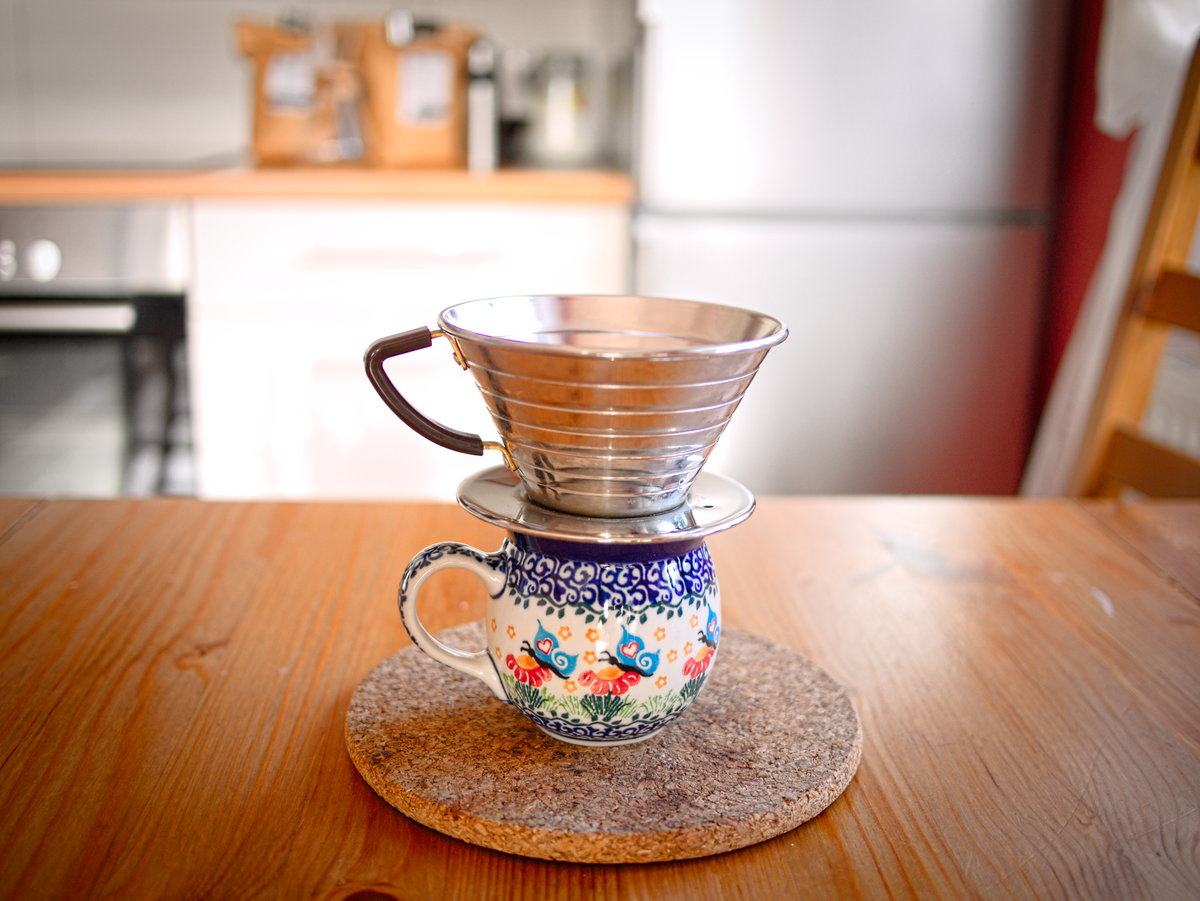
The Kalita Wave is the most distinctive of the three major brewers. Instead of a cone, the Wave has a flat bottom with three small holes. Instead of a single sloping wall, it has a fluted (wavy) wall that the special wave-shaped paper filter sits in.
The geometry produces a more uniform coffee bed than the V60. Because the bottom is flat rather than tapered, water passes through the same depth of coffee everywhere — no over-extraction at the tip and under-extraction at the rim. The three small bottom holes create more flow resistance than the V60's single large hole, slowing the brew and giving more even contact time.
In the cup, the Kalita produces a slightly fuller body than the V60 with slightly less acidity. It is more forgiving of variation in pour technique because the flat bed evens out unevenness in the pour pattern. For brewers who struggle with V60 consistency, the Kalita is often easier to brew well.
Standard Kalita 155 setup. 16 to 20 grams of medium-coarsely ground coffee, 250 to 320 grams of water at 93°C / 200°F. Bloom with twice the coffee weight in water for 30 seconds, then pour in 4 or 5 stages, each adding 60-80 grams of water. Total brew time runs 3:30 to 4 minutes.
The Kalita filter is unusual — wave-shaped with parallel folds, not flat — and not interchangeable with V60 or Chemex filters. Buy them in advance.
The Chemex
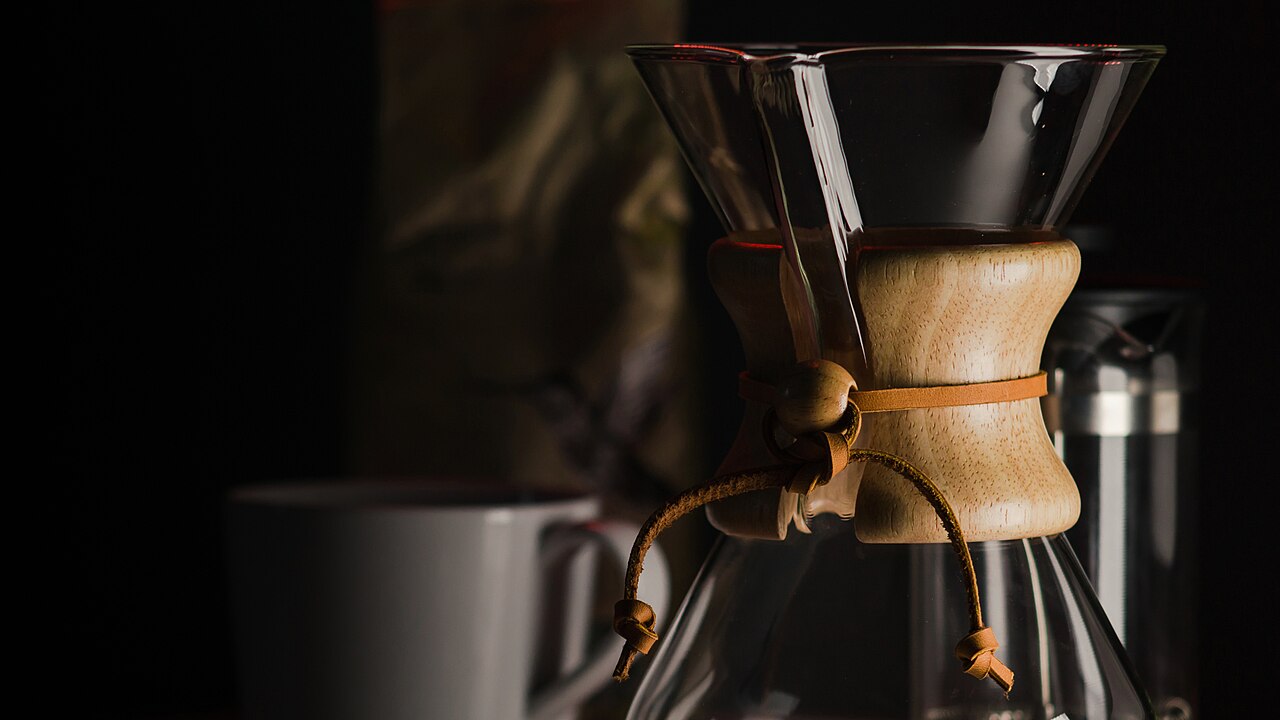
The Chemex is the oldest of the three brewers, designed in 1941 by chemist Peter Schlumbohm. It is also the most distinctive in form: an hourglass-shaped vessel of glass, joined in the middle by a wooden collar, used as both brewer and serving carafe.
The Chemex's defining feature is its filter. Chemex filters are thick — significantly thicker than V60 or Kalita filters, sometimes called "scientific filters" — and require specifically Chemex-shaped folding. The thicker filter produces extremely clean cups by removing more lipids and fines than thinner papers. The downside is slower flow and a tendency to clog with fine grinds.
The Chemex profile in the cup is brighter, lighter-bodied, and more tea-like than V60 or Kalita coffee. Some drinkers find this clarity revelatory; others find Chemex coffee too thin. The brewer is most popular with people who emphasize the bright, citrusy, floral character of light-roasted Ethiopian or East African coffees.
Standard Chemex setup. 6-cup Chemex with 42 grams of medium-coarse ground coffee, 700 grams of water at 96°C / 205°F. Bloom with 84 grams of water for 45 seconds, then pour in stages until reaching 700g total. Total brew time runs 5 to 6 minutes — significantly slower than V60 due to filter thickness.
Filter rinsing. Chemex filters require a more thorough rinse than V60 or Kalita filters because the thicker paper imparts more papery flavor unrinsed. Rinse with hot water for at least 15 seconds before adding the coffee. Discard the rinse water through the filter into the brewing vessel.
The Bloom Phase
The bloom — the first pour, which wets all the coffee but is significantly less than the total brew water — exists for one reason: CO2 degassing.
Fresh coffee beans contain dissolved CO2 from the roasting process. When ground coffee meets hot water, the CO2 rapidly outgasses, producing the visible bubbling and rising of the wet grounds that gives the bloom phase its name. CO2 in the brewing water blocks coffee particles from absorbing water uniformly, causing channeling and uneven extraction. By blooming first — letting the CO2 escape before the main pour — the brewer ensures the subsequent pours produce even contact.
The right bloom volume is 2 to 3 times the dry coffee weight. The right bloom time is 30 to 45 seconds for fresh coffee, or shorter (15 to 30 seconds) for older coffee that has already lost most of its CO2. Stirring or swirling during the bloom helps ensure all the dry coffee is fully saturated; unsaturated grounds at the bottom of the bed will not extract properly.
For very fresh coffee — within a week or two of roasting — the bloom is dramatic, with visible swelling and rising. For older coffee, the bloom is subdued. The visible behavior of the coffee during bloom is one of the best indicators of bean freshness.
Grind Size Across Brewers
All three pour over brewers use grinds in the medium range — coarser than espresso, finer than French press. Within that range, brewer choice shifts the optimum:
- V60 — medium, like coarse table salt. The fast flow of the V60 demands a slightly finer grind to produce enough resistance for proper extraction.
- Kalita Wave — medium, slightly coarser than V60 grind. The three-hole bottom slows flow naturally, allowing slightly coarser grind.
- Chemex — medium-coarse, distinctly coarser than V60 grind. The thick filter slows flow significantly, and a too-fine grind will clog the filter and stall the brew.
These guidelines are starting points. Every coffee differs slightly in density and roast level, and every brewer behaves slightly differently in different hands. Adjust grind size based on total brew time: too fast (under 3 minutes) means grind finer; too slow (over 4 minutes for V60, over 5 minutes for Kalita, over 6 minutes for Chemex) means grind coarser.
Water Temperature
Pour over brewing happens in a narrow temperature window: 90°C to 96°C / 195°F to 205°F. Below this range, extraction is incomplete and the cup tastes sour or under-developed. Above this range, extraction is excessive and the cup tastes bitter or over-developed.
The standard target is 93°C / 200°F for V60 and Kalita. Chemex tolerates slightly higher temperatures (94 to 96°C) because the slower flow and filter thickness reduce the effective contact temperature. For darker roasts, brewers sometimes use lower temperatures (88 to 91°C) to avoid extracting bitterness. For light roasts, higher temperatures (94 to 96°C) help fully develop the cup.
A variable-temperature electric kettle is the simplest way to hit these targets reliably. Stove-top kettles work but require a thermometer and some attention.
The Gooseneck Kettle
A gooseneck kettle — a kettle with a thin, curved spout — is essentially required for pour over brewing. The thin spout allows precise control of water flow rate and direction, which determines whether your pour saturates the coffee evenly or carves channels through the bed.
Quality electric gooseneck kettles with variable temperature control range from $50 to $200. Stovetop gooseneck kettles cost less but require external temperature monitoring. The Fellow Stagg, Brewista Smart Kettle, and Hario Buono are common choices in their respective price ranges.
The pouring technique is gentler than non-pour-over brewers expect. Hold the kettle close to the slurry — a few centimeters above the coffee surface — and tilt slowly to control flow. The flow rate during the main pour should be steady and moderate, neither a trickle nor a torrent. Pouring patterns are typically circular, starting at the center and spiraling outward, though many recipes call for fixed center pours or other patterns.
Common Mistakes
Stale coffee. Pour over reveals everything in the bean, including its age. Coffee more than 4 to 6 weeks past roast will brew flat and disappointing regardless of technique. Buy from a roaster with visible roast dates and use within 2 to 4 weeks of roast.
Wrong grind size. Most pour over problems trace to grind. If the cup tastes sour and the brew finished quickly, grind finer. If the cup tastes bitter and the brew ran too long, grind coarser. Grind adjustment is the first variable to try.
Skipping the bloom. Without a proper bloom, fresh coffee outgasses during the main pour, producing channeling and uneven extraction. The bloom is not optional. It takes 30 to 45 seconds and is the highest-leverage variable in pour over after grind size.
Poor pour technique. Pouring too aggressively, too narrowly, or too far from the slurry produces uneven extraction. The kettle should stay close to the coffee bed, with steady controlled flow.
Wrong brewer for the coffee. Light-roast Ethiopians on Chemex, dark-roast Indonesians on V60 — both work but each shows the coffee differently. Match brewer to roast and origin: V60 for clarity, Chemex for delicacy, Kalita for body.
The Pilón Connection
Long before V60s and Kalitas, Puerto Rican households brewed pour over coffee with the colador de café — the coffee sock, a cloth filter held by a metal frame over a coffee pot. The technique was identical in principle: hot water poured slowly through coffee held in a fabric filter. The cloth filter is even thicker than Chemex paper, producing the cleanest possible cup. The colador remains in active use in Puerto Rican kitchens today, often alongside modern equipment.
The lineage from colador to Chemex to V60 is direct. Each brewer is a refinement of the same idea: water passing through coffee in a porous filter, with the filter shaping the cup as much as the bean does.
Key Facts
- The V60, Kalita Wave, and Chemex are the three dominant modern pour over brewers
- V60: cone, fast flow, requires careful pour technique
- Kalita Wave: flat bottom, slower flow, more forgiving
- Chemex: cone with thick filter, very clean cup, slower brew
- The Hoffmann Ultimate V60 Technique is the most-cited pour over recipe
- The 4:6 method (Tetsu Kasuya) offers more precise control
- Bloom for 30-45 seconds with 2-3x the coffee weight in water
- Standard ratio: 1:16 to 1:17 coffee to water
- Standard temperature: 93°C / 200°F (slightly higher for Chemex)
- The Puerto Rican colador de café is the regional ancestor of all paper pour over
Frequently Asked Questions
Which pour over brewer should I buy first? The V60 is the most versatile starting brewer. It is inexpensive, the most-documented in tutorials and recipes, and the most flexible across different beans. The Kalita Wave is a good second choice for brewers who find V60 unforgiving. The Chemex is best reserved for users who specifically want its tea-like cup.
Why does my pour over taste sour? Almost always under-extraction. Try grinding finer, increasing brew temperature, or extending brew time. Sour coffee is the most common pour over failure mode and grind adjustment is the fastest fix.
Can I use any kettle? You need a gooseneck kettle or equivalent narrow-spout pouring tool for proper pour over brewing. Standard kettles pour too fast and too unevenly. The gooseneck kettle is the single most important pour over equipment investment beyond the brewer itself.
Why do recipes call for blooming? The bloom releases CO2 from fresh coffee, allowing the subsequent water pours to extract evenly. Without a bloom, CO2 trapped in the grounds blocks water from reaching parts of the coffee bed, producing channeling and uneven cups.
How fresh does the coffee need to be? Coffee within 7 to 21 days post-roast brews best. Within 7 days, the bloom is dramatic but the flavor is still developing as residual CO2 leaves. Past 4 to 6 weeks, flavor degrades noticeably regardless of technique.
Related Articles
- Espresso: The Complete Guide to Italy's Greatest Coffee Invention
- Coffee Grinders: Burr vs Blade — The Complete Buying Guide
- Water Chemistry for Coffee Brewing: The Complete Guide
- Coffee Cupping: The SCA Protocol and How Professionals Taste Coffee
- Caffeine: How It Works in the Human Body
- Café con Leche: The Puerto Rican Morning Tradition
- Pilón de Café: The Wooden Pestle Tradition of Puerto Rico
Taste Authentic Puerto Rico Coffee
The pour over reveals the bean. Single-origin Puerto Rican coffee — grown above 3,000 feet in the central mountains of the island — produces a V60 cup of remarkable balance, clarity, and signature Boricua chocolate-and-caramel character.
BUY AUTHENTIC PUERTO RICO COFFEE NOW →
Freshly roasted, shipped worldwide. The real taste of Boricua heritage in every cup.
Part of The Coffee Encyclopedia — the world's largest free coffee reference. Proudly sponsored by PuertoRicoCoffeeShop.com.