
Caffeine: How It Works in the Human Body
This article covers what happens to caffeine after you drink it: how it is absorbed, how it acts in the brain, how the liver clears it, why people react differently, and the intake levels that health authorities have assessed. What is in the cup before you drink it is covered in Caffeine: The Science of Coffee's Most Famous Compound.
This article provides educational information about caffeine. It is not medical advice, and nothing in it is a recommendation about what you should drink. If you are pregnant or breastfeeding, have a heart condition or high blood pressure, take medication that interacts with caffeine, or have been advised to limit it, follow the guidance of your own clinician.
Absorption and Metabolism
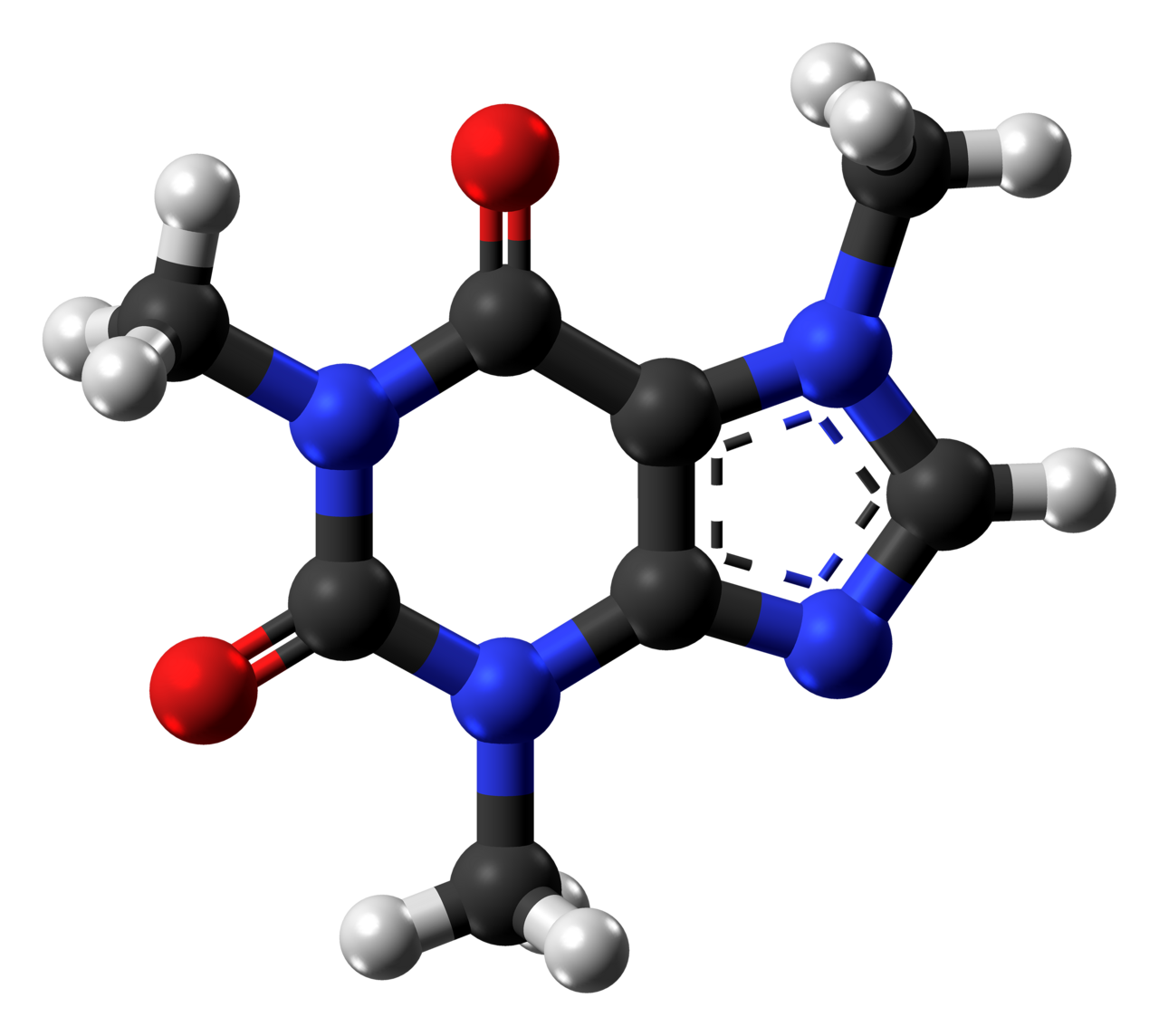
Caffeine molecule, ball-and-stick model from crystal-structure data. Image: Jynto / Wikimedia Commons, CC0.
EFSA describes caffeine as rapidly and completely absorbed, with peak levels in the blood reached 30 to 120 minutes after intake. In the liver, the enzyme CYP1A2 accounts for about 95 per cent of caffeine clearance, according to the European Food Safety Authority (EFSA). The main route of metabolism, 70 to 80 per cent, converts caffeine to paraxanthine.
Adenosine: Caffeine Blocks the Brake
Caffeine acts mainly by blocking adenosine receptors, principally the A1 and A2A types.
Watch: James Hoffmann on Caffeine: Health, Dose, Decaffeination & More — The Curious Bartender
The Half-Life Is Not One Number
EFSA gives caffeine a plasma half-life of about four hours, with a range of about two to eight hours. The half-life is the time the body takes to clear half of the caffeine in the blood. Several factors change it:
| Factor | Effect |
|---|---|
| Pregnancy | A half-life of 6 to 16 hours during pregnancy, with 11.5 and 18 hours reported at the end of pregnancy (EFSA) |
| Oestrogen-containing oral contraceptives | A mean half-life of 7.88 hours, against 5.37 hours in women not taking them (Abernethy and Todd, 1985) |
| Newborn infants | Clearance is very low in preterm and newborn infants and reaches adult values by 3 to 5 months of age (LactMed) |
| CYP1A2 genotype | Carriers of the CYP1A2*1F allele are classed as slow metabolisers (Cornelis and colleagues, 2006) |
On a four-hour half-life, a 200 mg coffee at nine in the morning leaves about 100 mg at one in the afternoon, 50 mg at five and 25 mg at nine at night. At the eight-hour end of the range, about 100 mg is still present at five in the afternoon.
Why People Differ
Because CYP1A2 does most of the work, differences in that enzyme matter. Cornelis and colleagues, writing in JAMA in 2006, classed carriers of the CYP1A2*1F allele as slow caffeine metabolisers and people with two copies of the *1A allele as rapid metabolisers. Their case-control study compared 2,014 people in Costa Rica who had survived a first heart attack with 2,014 matched controls; 54 per cent of the controls carried the slow allele. Compared with less than one cup a day, after adjustment:
| Intake | Slow metabolisers | Rapid metabolisers |
|---|---|---|
| 1 cup a day | 0.99 (0.69–1.44) | 0.75 (0.51–1.12) |
| 2 to 3 cups a day | 1.36 (1.01–1.83) | 0.78 (0.56–1.09) |
| 4 or more cups a day | 1.64 (1.14–2.34) | 0.99 (0.66–1.48) |
Odds ratios with 95 per cent confidence intervals. Gene–coffee interaction P = 0.04. A single case-control study can show an association but cannot prove cause.
Blood Pressure and the Heart
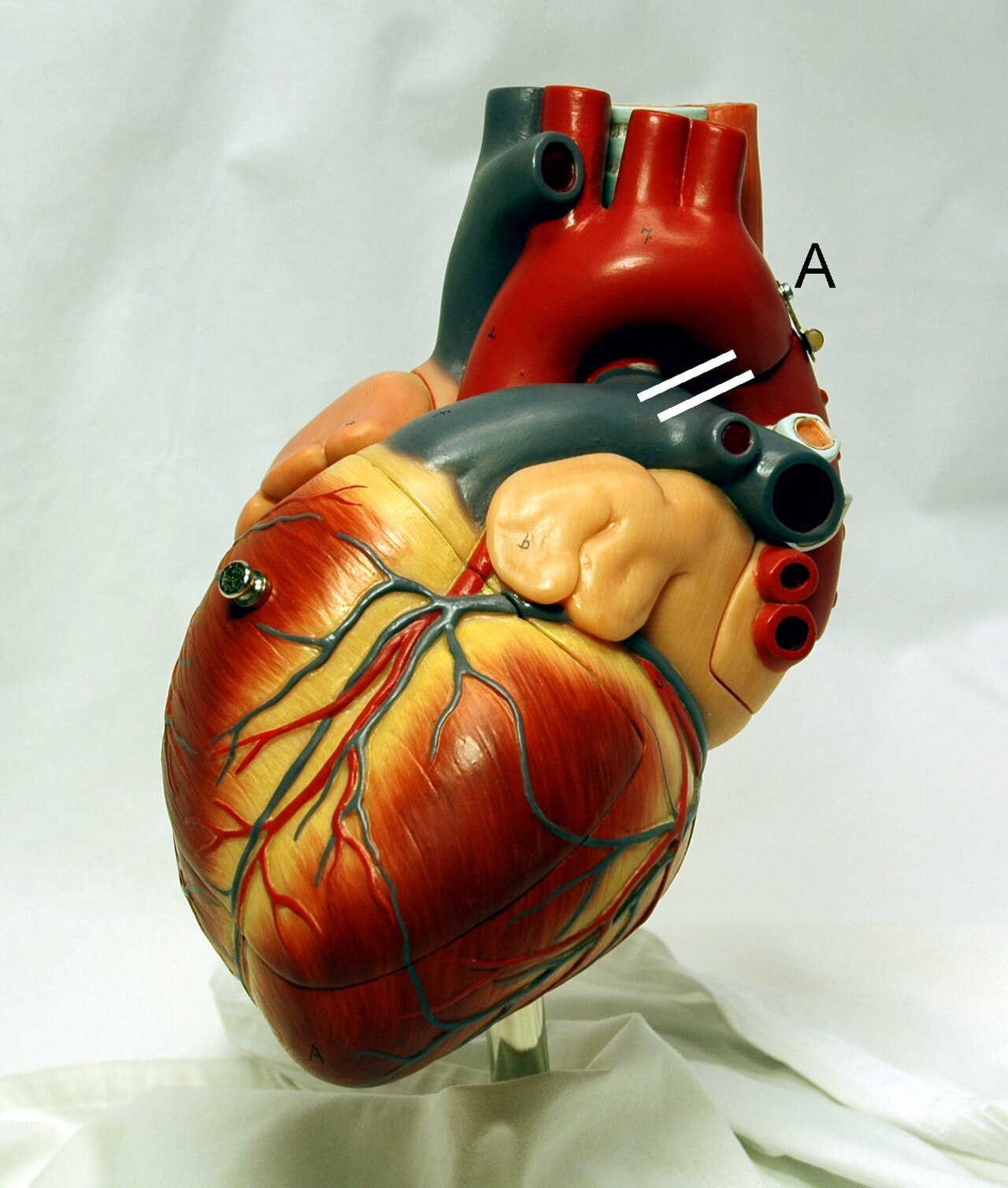
Anatomical teaching model of the human heart (Commons: "Heart frontally PDA"). Photo: Ekko / Wikimedia Commons, public domain.
EFSA concluded that single doses of caffeine up to 200 mg are unlikely to cause clinically relevant changes in blood pressure in healthy adults, whether or not they drink caffeine regularly. Taken every day, caffeine can raise blood pressure slightly. In a meta-analysis of randomised trials reviewed by EFSA, intakes of about 410 mg a day or more raised systolic pressure by about 3 mmHg and diastolic pressure by about 2 mmHg on average, while lower intakes did not. EFSA noted that this sustained effect appeared with continuous intake of about 400 mg a day for 7 days or more. If you have high blood pressure or a heart condition, ask your own clinician.
Tolerance, Dependence and Withdrawal
Caffeine withdrawal is a recognised diagnosis in DSM-5, the American Psychiatric Association's diagnostic manual. Caffeine use disorder is not: DSM-5 lists it as a condition for further study. Common withdrawal symptoms include headache, fatigue, difficulty concentrating and low mood. Under DSM-5, withdrawal symptoms appear within 24 hours of stopping or cutting down after prolonged daily use.
Pregnancy and Breastfeeding
EFSA concluded that habitual caffeine intake up to 200 mg a day by pregnant women does not give rise to safety concerns for the fetus. The American College of Obstetricians and Gynecologists (ACOG) states that moderate caffeine consumption, less than 200 mg a day, does not appear to be a major contributing factor in miscarriage or preterm birth. ACOG adds that the relationship of caffeine to growth restriction remains undetermined. For breastfeeding, EFSA concluded that single doses and habitual intakes up to 200 mg a day by lactating women do not give rise to safety concerns for breastfed infants. In the study EFSA cites, caffeine in breast milk averaged 0.8 times the level in the mother's blood. LactMed, the US National Institutes of Health database on medicines in breastfeeding, estimates that an exclusively breastfed infant receives about 10 per cent of the mother's weight-adjusted dose. Newborns clear caffeine very slowly, so LactMed advises mothers of preterm or younger newborn infants to aim for a lower intake. LactMed suggests that 300 to 500 mg a day might be safe for most mothers, and notes that European authorities set 200 mg. The US Food and Drug Administration (FDA) advises anyone who is pregnant, trying to become pregnant or breastfeeding to ask their health care provider whether to limit caffeine.
Decaffeinated Coffee
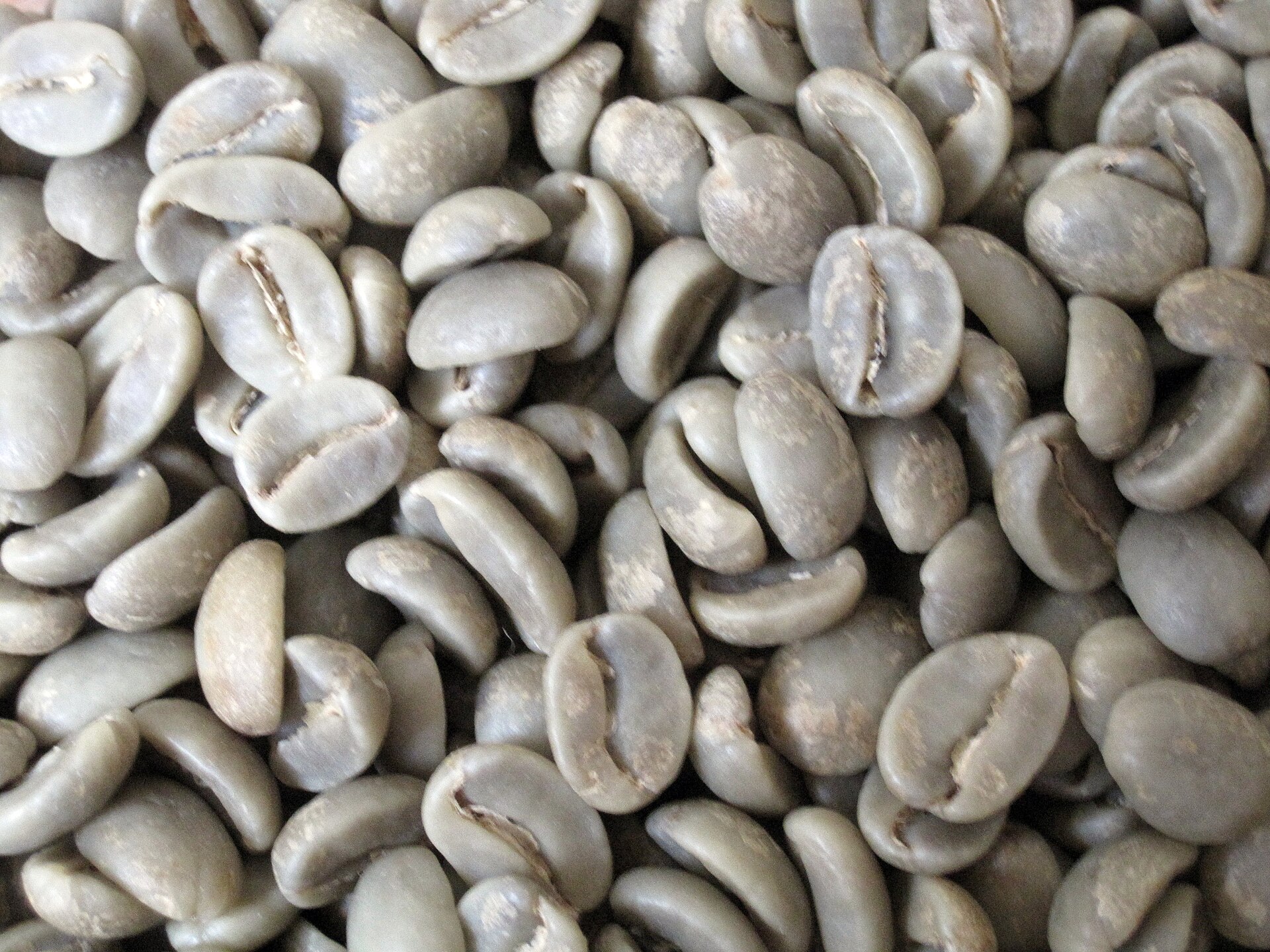
Green coffee beans. Photo: Michael Allen Smith@INeedCoffee from Seattle, USA / Wikimedia Commons, CC BY-SA 2.0.
Decaffeinated coffee is not caffeine-free. The FDA says a typical 8-fluid-ounce cup of decaf contains 2 to 15 mg of caffeine. How decaffeination works is covered in Caffeine: The Science of Coffee's Most Famous Compound.
How Much Is Safe

Enjoying a delightful breakfast at home with pastry, coffee, and juice. Photo: Shixart1985 / Wikimedia Commons, CC BY 2.0.
| Authority | Figure | Applies to |
|---|---|---|
| EFSA, 2015 | Habitual intake up to 400 mg a day | Non-pregnant adults |
| EFSA, 2015 | Single doses up to 200 mg (about 3 mg per kg for a 70 kg adult) | Healthy adults |
| EFSA, 2015 | Up to 200 mg a day | Pregnancy; breastfeeding |
| FDA, 2024 | 400 mg a day, not generally linked to negative effects | Most adults |
| ACOG, Committee Opinion 462 | Less than 200 mg a day | Pregnancy |
For children and adolescents, EFSA found the information insufficient to derive a safe intake, and said that 3 mg per kilogram of body weight a day may serve as a basis for intakes of no concern. The FDA notes that the American Academy of Pediatrics advises against energy drinks for children and teens, and that US dietary guidelines say caffeinated drinks should be avoided for children under 2. The FDA estimates that toxic effects, such as seizures, can occur with rapid consumption of around 1,200 mg of caffeine. None of these figures is a target. They are levels below which the authorities identified no safety concern, not a recommendation to reach them.
Key Facts
- Half-life in adults: about four hours, ranging from about two to eight (EFSA).
- CYP1A2 accounts for about 95 per cent of caffeine clearance.
- Newborns clear caffeine very slowly; clearance reaches adult values by 3 to 5 months.
- Pregnancy and oestrogen-containing oral contraceptives lengthen the half-life.
- EFSA: up to 400 mg a day for non-pregnant adults; up to 200 mg a day in pregnancy and breastfeeding.
- FDA: toxic effects such as seizures can occur with rapid consumption of around 1,200 mg.
- Decaf is not caffeine-free: typically 2 to 15 mg in an 8-fluid-ounce cup.
- Caffeine withdrawal is a DSM-5 diagnosis; caffeine use disorder is a condition for further study.
Frequently Asked Questions
How long does caffeine stay in my system? EFSA gives a half-life of about four hours in adults, with a range of about two to eight hours. It is longer in pregnancy, and newborns clear caffeine very slowly.
Why does coffee affect my friend differently? People clear caffeine at different rates. Genotype, pregnancy and oestrogen-containing contraceptives all change the rate, and the FDA notes wide variation in how sensitive people are.
Is caffeine addictive? Caffeine withdrawal is a recognised DSM-5 diagnosis. Caffeine use disorder is listed only as a condition for further study.
How much is safe in pregnancy? EFSA gives up to 200 mg a day, and ACOG less than 200 mg a day. Ask your own clinician about your circumstances.
Is caffeine safe while breastfeeding? EFSA gives up to 200 mg a day. Newborns and preterm infants clear caffeine very slowly, so ask your clinician, especially in the first months.
Does caffeine raise my blood pressure? EFSA concluded that single doses up to 200 mg are unlikely to cause clinically relevant changes in healthy adults, but about 400 mg a day for a week or more can raise it slightly. If you have high blood pressure, ask your clinician.
Sources
- EFSA Panel on Dietetic Products, Nutrition and Allergies, "Scientific Opinion on the safety of caffeine", EFSA Journal 2015;13(5):4102 — absorption; CYP1A2 and paraxanthine; the half-life and its range; the half-life in pregnancy; intakes for adults, pregnancy, lactation, children and adolescents; the blood-pressure findings; the milk-to-plasma ratio of 0.8.
- US Food and Drug Administration, "Spilling the Beans: How Much Caffeine Is Too Much?", 29 August 2024 — 400 mg a day for most adults; toxic effects at around 1,200 mg; decaf at 2 to 15 mg a cup; advice on pregnancy, breastfeeding, children and teens; individual variation.
- LactMed, "Caffeine", National Institute of Child Health and Human Development, revised 15 April 2026 — infant clearance; the infant's share of the dose; maternal intake.
- American College of Obstetricians and Gynecologists, "Moderate Caffeine Consumption During Pregnancy", Committee Opinion 462 — less than 200 mg a day; growth restriction undetermined.
- Abernethy DR, Todd EL, "Impairment of caffeine clearance by chronic use of low-dose oestrogen-containing oral contraceptives", European Journal of Clinical Pharmacology 1985;28(4):425–428, doi:10.1007/BF00544361.
- Cornelis MC, El-Sohemy A, Kabagambe EK, Campos H, "Coffee, CYP1A2 genotype, and risk of myocardial infarction", JAMA 2006;295(10):1135–1141, doi:10.1001/jama.295.10.1135.
- Meredith SE, Juliano LM, Hughes JR, Griffiths RR, "Caffeine Use Disorder: A Comprehensive Review and Research Agenda", Journal of Caffeine Research 2013;3(3):114–130 — DSM-5 caffeine withdrawal and caffeine use disorder; withdrawal symptoms.
- Fredholm BB, Bättig K, Holmén J, Nehlig A, Zvartau EE, "Actions of caffeine in the brain with special reference to factors that contribute to its widespread use", Pharmacological Reviews 1999;51(1):83–133, PMID 10049999 — adenosine A1 and A2A receptors.
Claims this encyclopedia could not source
- That coffee is the world's second-most-traded commodity.
- That caffeine is the most widely used psychoactive substance in the world.
- An onset of action of 45 minutes to an hour, and a duration of action of 3 to 4 hours.
- An adult half-life of 3 to 7 hours, or averages of 5 to 6 hours. EFSA gives about four hours, with a range of two to eight.
- That 84 per cent of caffeine is metabolised to paraxanthine. EFSA gives 70 to 80 per cent.
- That smoking roughly doubles caffeine clearance.
- A split of metaboliser types: 40 per cent fast, 45 per cent average, 15 per cent slow.
- That research has consistently linked heavy coffee drinking in slow metabolisers to heart disease.
- Any method of telling your metaboliser type from symptoms.
- A limit of 100 mg a day for ages 12 to 18, attributed to the American Academy of Pediatrics.
- Milk-to-serum ratios of 0.52 to 0.81.
- That about one per cent of a mother's caffeine dose passes into breast milk.
- That a single coffee bean contains roughly 6 mg of caffeine.
- That coffee from a particular origin or altitude produces a different caffeine effect.
Related Articles
- What is Coffea Arabica? The Noble Coffee Species
- Espresso: The Complete Guide to Italy's Greatest Coffee Invention
- Café con Leche: The Puerto Rican Morning Tradition
- Turkish Coffee: The UNESCO Heritage Brewing Tradition
- The Sufi Monks and Coffee's Spiritual Journey
- Yemen and the Port of Mocha
- Pilón de Café: The Wooden Pestle Tradition of Puerto Rico
Taste Authentic Puerto Rico Coffee
The caffeine in your cup is only as good as the coffee that delivers it. Coffee grown in Puerto Rico's central mountains, roasted on the island.
BUY AUTHENTIC PUERTO RICO COFFEE NOW →
Freshly roasted, shipped worldwide. The real taste of Boricua heritage in every cup.
Part of The Coffee Encyclopedia — the world's largest free coffee reference. Proudly sponsored by PuertoRicoCoffeeShop.com.