
Espresso Machines: Lever, Heat-Exchanger, Dual-Boiler — The Complete Buying Guide
[IMAGE: chrome espresso machine with portafilter and crema fresh shot]
An espresso machine is the most complicated piece of equipment in the home coffee world. The price range spans from a few hundred dollars for a basic single-boiler to twenty thousand dollars for a commercial flagship. The architectural differences between machine types are substantial — lever, single boiler, heat exchanger, dual boiler, and modern pressure-profiling machines all produce espresso through fundamentally different mechanical paths. This guide explains how each machine type works, what each costs, and how to decide which architecture matches the way you actually drink coffee. The single most important guideline before reading any further: spend more on the grinder than on the machine. Good espresso requires both. A great machine cannot rescue a bad grind.
What Espresso Actually Requires
Before comparing machine architectures, it helps to understand what espresso brewing actually demands of equipment. Three variables must be controlled within tight ranges:
- Pressure — typically 8 to 9 bars at the group head during the shot
- Temperature — typically 90 to 96 degrees Celsius (194-205 F) at the group head, stable throughout the shot
- Flow rate — typically 25 to 35 grams of water through 18-20 grams of coffee in 25-35 seconds
Espresso is the only common brewing method where pressure plays a significant role. Pressure forces water through tightly packed, finely ground coffee in a way no other brewing method does. This produces the concentrated extraction, the crema layer, and the body that define espresso.
Every machine architecture is a different solution to delivering these three variables consistently. The differences in price reflect how reliably and precisely each architecture maintains them.
[IMAGE: espresso shot pouring crema close-up cafe quality]
The Lever Machine
The original espresso machine was a lever machine. The barista pulls a long lever, which compresses a spring or directly applies pressure to a piston that pushes water through the coffee puck. There is no electric pump. The lever is the pump.
Lever machines have been in continuous production since the 1940s, when Achille Gaggia patented the spring-loaded lever in Milan. The design has clear advantages: declining-pressure profiles emerge naturally from spring decompression, the equipment is mechanically simple and durable for decades, and the act of pulling the shot becomes a participatory ritual rather than a button press.
The disadvantages are also clear: levers require physical effort and skill, they are slower than pump machines, and they are mechanically harder to teach a new barista. They have remained a passionate-enthusiast and traditionalist-cafe niche rather than a mainstream choice.
Modern lever machines for the home — the La Pavoni Europiccola, the Olympia Cremina, the Flair (manual, no electricity at all), and several Italian boutique brands — sit in the $400 to $4,000 range. They reward patience and punish hurry.
The Single Boiler Machine
The most common entry-level espresso architecture has one boiler that handles everything. The boiler heats water for the brew, and when steaming is needed, the boiler temperature is raised and the steam wand is engaged.
Single boiler machines are inexpensive — quality models start around $400 — and produce excellent espresso. Their limitation is workflow. Because one boiler must serve both brewing and steaming, you cannot brew and steam simultaneously. You must brew first, then wait while the boiler raises temperature for steam, then steam, then wait again before the next shot. For a single drink at a time, this is fine. For a household making lattes for two people in sequence, it becomes tedious.
Examples in this category: the Rancilio Silvia, the Lelit Anna, the Gaggia Classic Pro, and several others that have earned long reputations as starter machines that punch above their price.
[IMAGE: small home espresso machine kitchen counter brewing]
The Heat Exchanger Machine
The next architectural step solves the steam-and-brew workflow problem. A heat exchanger machine has one boiler kept at steam temperature (about 120 degrees Celsius), with a water pipe running through the boiler that draws fresh, cooler water for brewing on demand.
The design works because the brew water passes through the hot boiler and is heated to brewing temperature on its way to the group head. The boiler itself stays at steam temperature continuously. As a result, the machine can brew and steam simultaneously — the steam is always ready, and the brew water is heated as it passes through.
Heat exchanger machines (often called HX machines) are the workhorse of Italian cafes and a popular home choice. They typically range from $1,000 to $2,500. The classic problem with HX machines is brew temperature stability — the water in the heat exchanger pipe heats further the longer it sits, so the first brew of the morning can be hotter than ideal unless the operator runs a "cooling flush" first.
Modern HX designs have improved this with thermosyphon-controlled brew water flow, e61 group heads with thermal mass, and PID temperature control. Examples in this category: the Profitec Pro 500, the Lelit Mara X, the Rocket Appartamento, the ECM Synchronika.
The Dual Boiler Machine
The most stable architecture has two separate boilers — one dedicated to brewing at a fixed brew temperature, and one dedicated to steam at a fixed steam temperature. Each is independently controlled. Brew temperature stays exactly where the operator set it. Steam is always ready.
Dual boiler machines (DBs) eliminate the cooling flush, eliminate temperature surfing, and produce the most consistent shot-to-shot temperature stability available outside of commercial multi-group machines. They are the architecture of choice for serious home espresso enthusiasts and the cafes that emphasize lighter-roasted, brighter-tasting coffees that demand precise temperature.
The cost is significantly higher. Quality dual boilers start around $1,500 and run to $4,000 for premium models. Examples: the Breville Dual Boiler, the Profitec Pro 700, the Rocket R58, the La Marzocco Linea Mini.
Pressure Profiling and Modern Machines
The newest generation of espresso machines moves beyond the fixed-pressure model entirely. Pressure profiling machines vary the pressure delivered to the coffee puck during the shot — typically a low-pressure pre-infusion phase to gently saturate the puck, ramping up to peak extraction pressure, then declining as the shot completes.
The argument is that varied pressure produces more nuanced extraction than a constant-pressure shot. Whether the difference is meaningful at home is debated. In the hands of a skilled barista with great beans, a profile-capable machine can produce shots impossible to replicate on a fixed-pressure machine. In the hands of an average user with average beans, the difference is mostly invisible.
Pressure profiling machines include the Decent Espresso (DE1, profile-control software-driven), the La Marzocco Strada and Leva models, the Slayer (lever-controlled needle valves), and the Sanremo Cafe Racer. Prices start around $3,000 and run far higher.
For most home buyers, pressure profiling is a luxury not a necessity. A good dual boiler with stable temperature produces excellent espresso without it.
The Portafilter and Basket System
Independent of machine architecture, every espresso machine uses a portafilter and basket. This is the handle-and-cup assembly that holds the ground coffee during the shot. Portafilters come in a few standard sizes: 49 mm (small home machines and some lever machines), 53 mm (Breville-specific), and 58 mm (the commercial standard, used by most dual boilers and many HX machines).
The size matters because basket selection determines the dose range you can brew. A 58 mm portafilter accepts baskets ranging from 14 grams (single shot) to 22 grams (double shot, modern recipe). The 49 mm portafilters max out at lower doses. If you want to use the same baskets, tools, and accessories as commercial cafes, the 58 mm standard is the practical choice. Most home machines above the entry level use 58 mm.
Basket geometry within a given size also matters. VST and IMS make precision-machined baskets with consistent hole patterns and known volumes — these have largely replaced manufacturer-supplied stock baskets in the home enthusiast world. Upgrading the basket on an otherwise unchanged machine is one of the cheapest ways to noticeably improve espresso quality.
[IMAGE: portafilter basket coffee grounds tamped espresso preparation]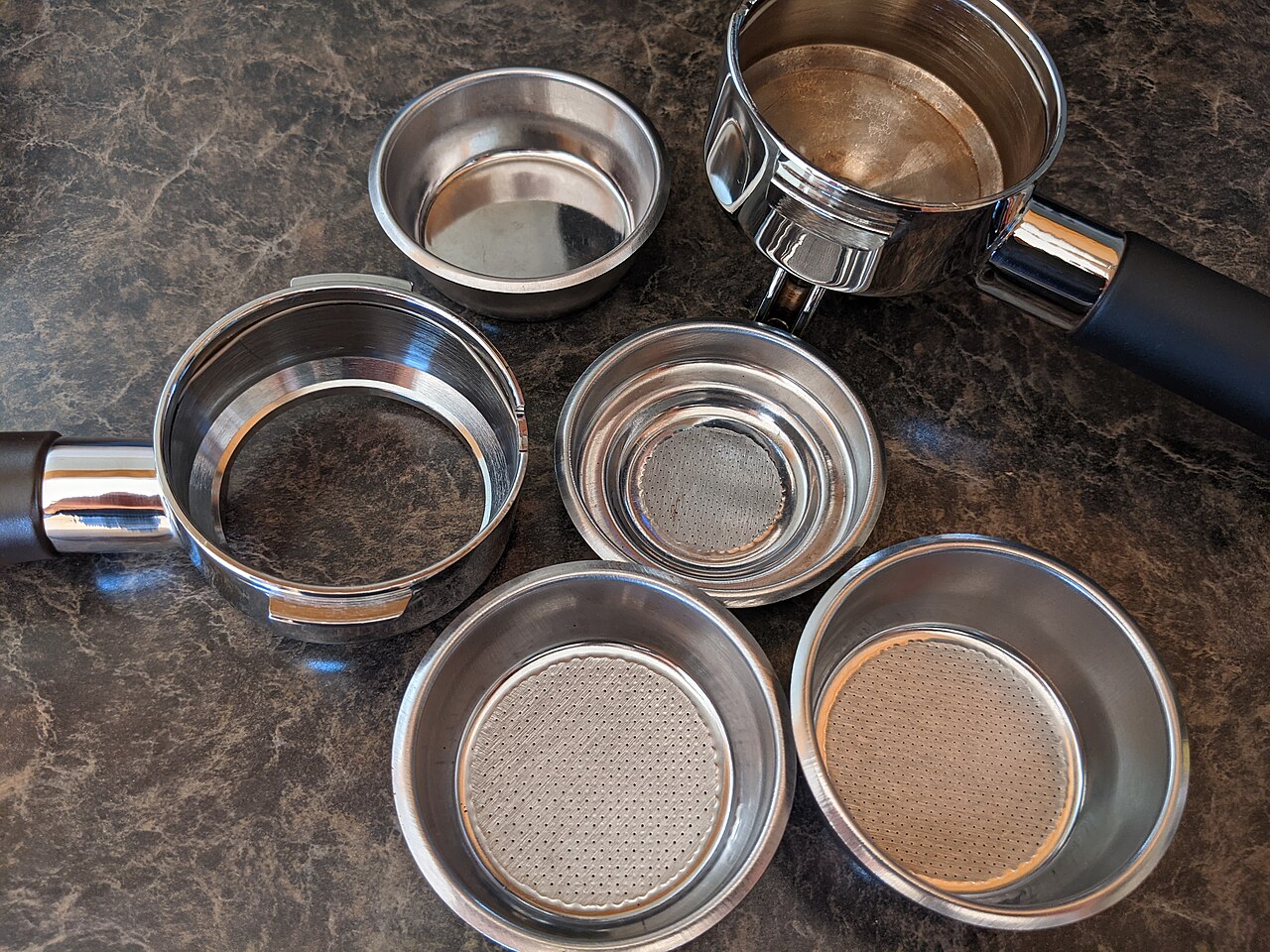
Pre-Infusion
Pre-infusion is a low-pressure wetting phase at the start of the shot, before full brewing pressure is applied. The water gently saturates the coffee bed, allowing it to swell and seal evenly before the high-pressure phase. The result is reduced channeling — the failure mode where high-pressure water finds a weak point and rushes through, under-extracting the surrounding coffee.
Most modern espresso machines include some form of pre-infusion. The simplest version is a brief pause at low pressure controlled by a flow restrictor. Sophisticated versions are programmable — you set the duration and pressure of pre-infusion separately from the main shot. For lighter-roasted, more demanding coffees, pre-infusion meaningfully improves shot consistency. For darker-roasted commodity blends, the difference is smaller.
Pumps — Vibration vs Rotary
Espresso machines use either vibration pumps or rotary pumps to generate brewing pressure. Vibration pumps (often called "vibe pumps") are smaller, cheaper, and louder. They click and vibrate audibly during the shot. They are standard in nearly all home machines below the $2,000 mark.
Rotary pumps are larger, quieter, and longer-lived. They are standard in commercial machines and in higher-end home machines. They also can be plumbed directly into a household water line, eliminating the water reservoir and refill task. The drawback is cost and size — a rotary pump roughly doubles the cabinet space a machine requires.
For most home users, vibration pump performance is more than adequate. The pump type rarely changes the cup quality. It changes the cabinet noise and the size of the machine.
[IMAGE: cafe espresso bar professional commercial multiple group heads]
PID Temperature Control
PID stands for Proportional-Integral-Derivative — a feedback control algorithm that holds boiler temperature within a fraction of a degree. Older single-boiler machines used simple thermostats that allowed boiler temperature to swing 5 to 10 degrees up and down, which produced shot-to-shot temperature variation of similar magnitude. PID-equipped machines hold temperature within 0.5 degrees, producing dramatically more consistent shots.
PID is now standard on dual boiler machines and most heat exchanger machines. It is increasingly common on single-boiler machines as well, often as an aftermarket modification. For any machine being seriously considered, PID-equipped is the modern baseline.
Matching Machine to Use Case
Not every coffee drinker needs a dual boiler. The right machine depends on what you actually drink and how often.
One coffee per day, mostly espresso shots. A quality single-boiler is sufficient. The Rancilio Silvia, Gaggia Classic Pro, or Lelit Anna will produce excellent espresso for years. Spend the saved money on a great grinder.
Two or three drinks per day, including milk drinks. A heat exchanger machine eliminates the brew-then-steam workflow penalty. The Profitec Pro 500 or Rocket Appartamento are modern standards in this category.
Multiple users, light-roasted specialty coffees, peak quality focus. A dual boiler delivers the temperature stability that lighter roasts demand. The Breville Dual Boiler at the entry of this category, the Profitec Pro 700 or La Marzocco Linea Mini at the top.
Lever ritual seekers and patient enthusiasts. A spring lever machine. The La Pavoni or Olympia Cremina for the classic experience.
Profile control and software-driven enthusiasts. A pressure profiling machine. The Decent DE1 is the home-user reference for full software-driven control.
The single most consistent piece of advice from experienced home baristas: buy the machine that matches today's habits, not aspirational ones. People who buy a dual boiler intending to make six lattes a day, but actually drink two espressos a day, end up with expensive equipment doing easy work. The reverse — buying entry-level for what becomes serious daily use — is the more common path to upgrade.
The Pilón and the Italian Lever — Two Heritage Traditions
The story of espresso runs through Italy. The story of Puerto Rican home coffee runs through the pilón — the wooden mortar and pestle that ground coffee for generations of Boricua families before commercial grinders arrived. Both traditions converge on the same principle: pressure plus fine particles plus hot water equals concentrated coffee. The lever espresso machine and the pilón are mechanical cousins, separated by centuries and oceans but solving the same physical problem.
A modern home espresso setup that brews Puerto Rican single-origin coffee on an Italian-designed lever machine is a small piece of coffee history compressed into one kitchen counter.
Key Facts
- The grinder matters more than the machine — buy the grinder first
- Lever machines provide declining-pressure profiles by spring mechanics
- Single boilers handle brewing or steaming, not both at once
- Heat exchangers brew and steam simultaneously
- Dual boilers offer the most precise temperature control
- Pressure profiling adds variable shot pressure for nuanced extraction
- 58 mm portafilters are the commercial standard
- VST and IMS baskets are precision upgrades for any portafilter
- PID temperature control is the modern baseline
- Match the machine to actual habits, not aspirational ones
Frequently Asked Questions
Do I need a dual boiler for good espresso? No. Excellent espresso comes from heat exchangers, single boilers, and lever machines. Dual boilers offer maximum temperature stability, which matters most for lighter-roasted specialty coffees. For darker roasts and traditional espresso, single boilers and heat exchangers are completely adequate.
Why is my espresso machine more expensive than my friend's coffee maker? Because pressure makes everything harder. An espresso machine builds and maintains 9 bars of pressure at controlled temperature, with steam capability. A drip coffee maker pours hot water through a filter. The mechanical complexity of espresso is several orders of magnitude higher.
Can I make espresso without an espresso machine? Sort of. A moka pot makes a strong concentrated coffee that some people call stovetop espresso, though it is not true espresso (pressure is much lower). The AeroPress can produce a concentrated shot. Neither produces real crema or true espresso character.
How long does an espresso machine last? A quality machine, properly maintained with treated water and regular descaling, lasts 10 to 20 years. Internal components may need replacement during that span. Untreated hard water cuts machine life by half or more.
What's the cheapest machine that makes real espresso? The Gaggia Classic Pro and the Rancilio Silvia, both around $400 to $500, are the consensus answer. Both are single-boiler machines that have produced great espresso in countless homes for decades. Both require a quality grinder to perform — which is why most experienced baristas tell beginners to budget at least as much for the grinder as for the machine.
Related Articles
- Espresso: The Complete Guide to Italy's Greatest Coffee Invention
- Coffee Grinders: Burr vs Blade — The Complete Buying Guide
- Caffeine: How It Works in the Human Body
- Café con Leche: The Puerto Rican Morning Tradition
- Pilón de Café: The Wooden Pestle Tradition of Puerto Rico
- Turkish Coffee: The UNESCO Heritage Brewing Tradition
- What is Coffea Arabica? The Noble Coffee Species
Taste Authentic Puerto Rico Coffee
A great espresso machine is only as good as the beans you put through it. Single-origin Puerto Rican coffee — grown above 3,000 feet in the central mountains of the island — produces an espresso shot of extraordinary balance and character.
BUY AUTHENTIC PUERTO RICO COFFEE NOW →
Freshly roasted, shipped worldwide. The real taste of Boricua heritage in every cup.
Part of The Coffee Encyclopedia — the world's largest free coffee reference. Proudly sponsored by PuertoRicoCoffeeShop.com.