
Italian Espresso Culture: From the Bar to the Bialetti
Italian Espresso Culture: From the Bar to the Bialetti
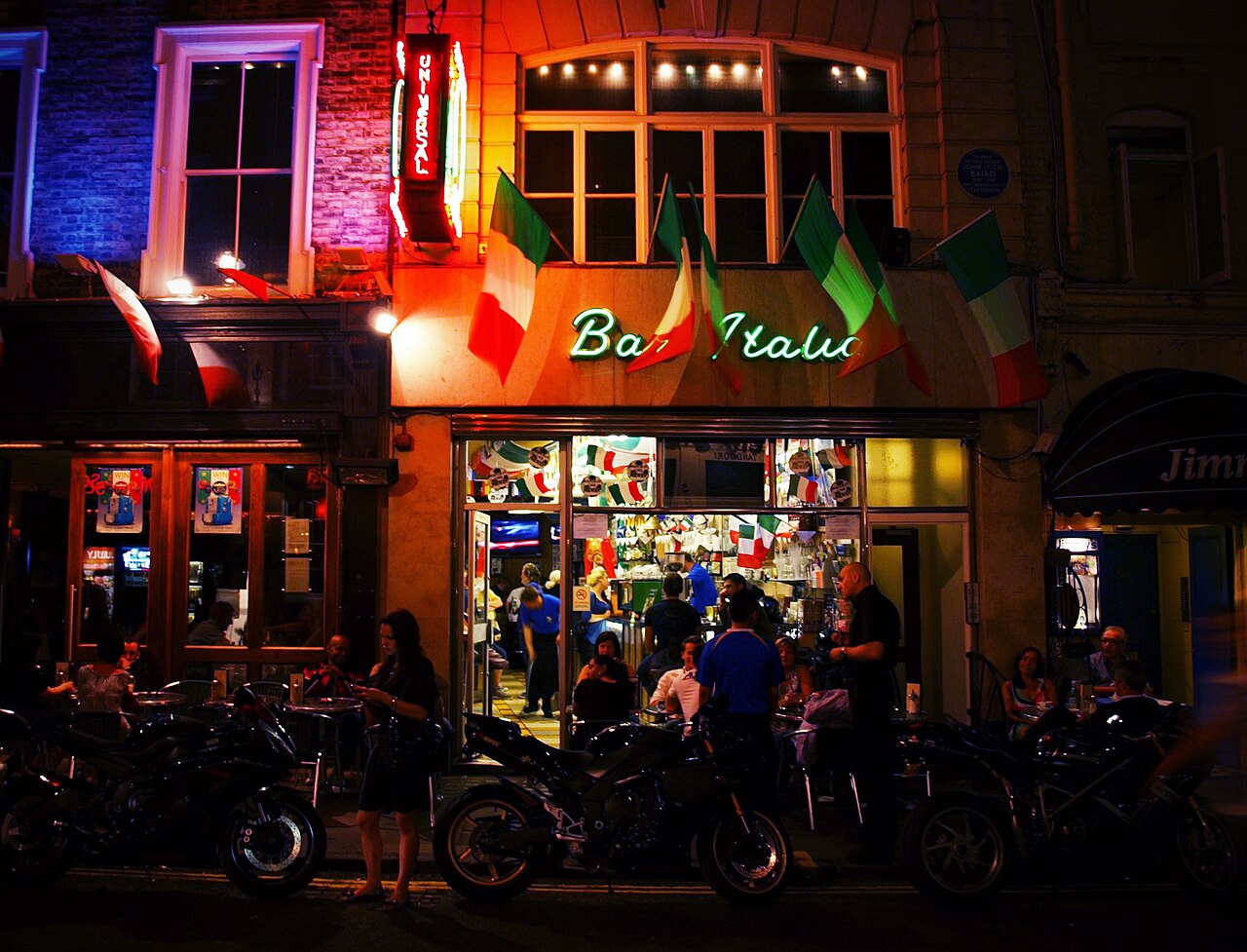
Italian espresso culture is one of the most distinctive coffee traditions in the world, defined as much by the social rituals around the cup as by what is in the cup itself. Italians drink coffee differently than Americans, Northern Europeans, or anyone else — and the differences reveal a coherent worldview about food, time, hospitality, and daily life. The morning cappuccino with a cornetto, taken standing at the bar before work. The mid-morning espresso break, also at the bar, also standing, also quick. The afternoon caffè after lunch. The evening corretto with a splash of grappa. The cardinal rule that cappuccino is a breakfast drink and ordering one after 11 in the morning instantly identifies you as a tourist. The other cardinal rule that you pay first, then drink, then leave — never camp out with a laptop. The fact that the same espresso costs roughly 1 euro at the bar across most of Italy and has done so for years, because espresso is essentially considered a public good. This article explores the history, traditions, regional variations, and practical etiquette of Italian coffee culture — not as a museum piece but as a living daily practice that millions of Italians still participate in.
For Boricua readers, much of this will feel familiar. Italian café culture and Puerto Rican coffee culture share more than people realize: the importance of family ritual, the morning and afternoon rhythms, the centrality of coffee to social life, the unwritten rules that everyone follows without thinking about them. The differences are real, but the shared sensibility is striking — two coffee cultures both descended from European traditions, both rooted in family and neighborhood, both treating coffee as something more than a caffeine delivery system.
The Arrival of Coffee in Italy
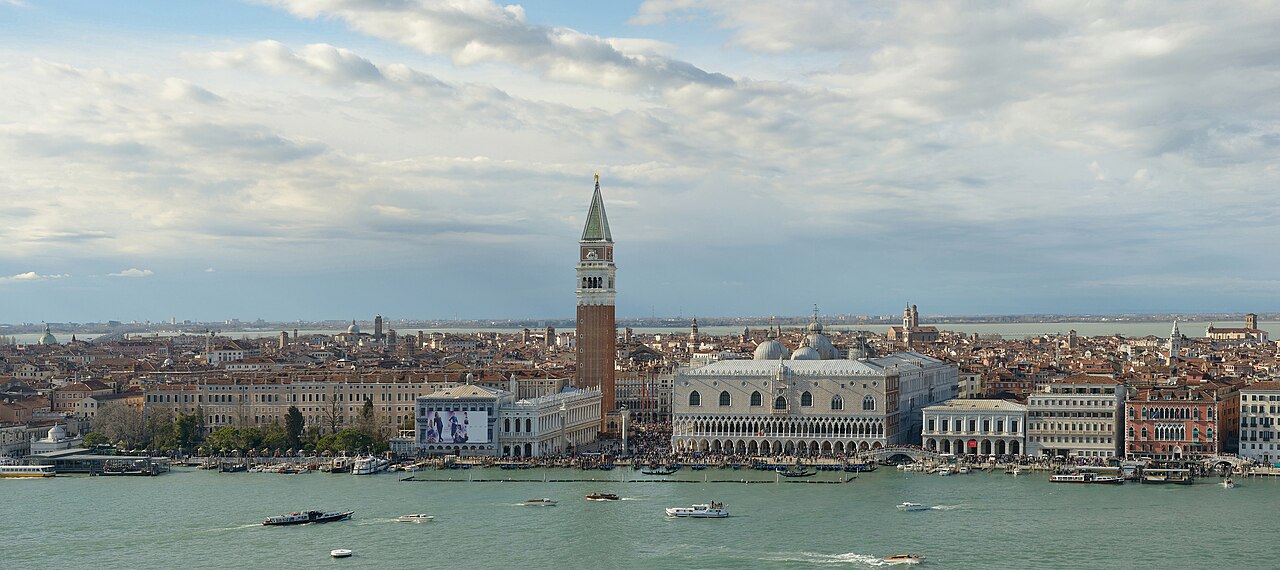
Coffee reached Italy in the late 1500s through Venice, the major Mediterranean trading port that also imported pepper, silk, and other goods from the Ottoman Empire and the Levant. Venetian merchants encountered coffee in the cafes of Constantinople and Cairo and brought it home both as a luxury commodity and as an exotic curiosity. By 1645, the first Italian coffeehouse opened in Venice, and by the early 1700s, Caffè Florian had opened in Piazza San Marco, where it has operated continuously to the present day — over 300 years.
Caffè Florian remains the oldest continuously operating coffeehouse in the world. Its rooms — Sala del Senato, Sala Cinese, Sala degli Uomini Illustri — preserve the elegant 18th-century atmosphere of the Italian coffeehouse tradition. Casanova, Goethe, Byron, and Proust all spent time at Caffè Florian. The café embodies a particular Italian conception of coffee as a social institution worthy of beautiful surroundings, intellectual conversation, and generations of continuity.
For the first 200 years of Italian coffee, preparation was Turkish-style: ground beans boiled with water (often with sugar and spices) in a pot. The drink was strong, sweet, and gritty. Italians refined the technique over generations but retained the basic Turkish method until the 19th century, when the invention that transformed Italian coffee culture forever finally appeared.
Angelo Moriondo and the Birth of Espresso
In 1884, the Turin-based entrepreneur and inventor Angelo Moriondo patented the first pressure-driven coffee brewing machine. Moriondo's design used steam pressure to force water through a bed of ground coffee, producing a concentrated extraction far faster than the traditional boiled method. The patent was filed for a "new steam machinery for the economic and instantaneous confection of coffee beverage," and the machine was first demonstrated at the 1884 General Exposition in Turin.
Moriondo's machine was a commercial breakthrough but not yet what modern coffee drinkers would recognize as espresso. The pressure was modest — around 1.5 bars — and the extraction was more like a strong filter coffee than a true espresso shot. The machine brewed in batches rather than producing individual cups on demand. But the principle of using pressure rather than gravity or boiling time was the foundation everything that followed would build on.
The next major step came from Luigi Bezzera, a Milan-based engineer who patented improvements to Moriondo's design in 1901. Bezzera's machine produced individual cups on demand and increased the operating pressure. Desiderio Pavoni acquired Bezzera's patents and began manufacturing the machines under the La Pavoni brand starting in 1905, marking the beginning of commercial espresso machine production. Cafes equipped with Pavoni machines spread across Italy in the early 20th century, and the format of the Italian bar — espresso machine prominently displayed, customers standing at the counter, quick service — began taking shape.
Achille Gaggia and the Modern Espresso Shot
The defining moment in espresso history came in 1938, when Achille Gaggia, a barista in Milan, patented a revolutionary new mechanism: a spring-loaded lever that allowed baristas to apply far higher pressures to the brew than steam pressure alone could achieve. Gaggia's lever-actuated machine reached pressures of 8 to 10 bars — comparable to modern espresso — and produced something the older steam machines could not: the layer of golden-brown crema floating on top of the shot.
Crema was a revelation. The thick, persistent foam was something coffee drinkers had never seen before, and it transformed espresso from a strong concentrated coffee into a fundamentally new beverage with its own visual signature. Gaggia's lever machine, commercialized after World War II, became the standard for Italian bars through the 1950s and 1960s and exported the modern espresso experience around the world.
The lever-actuated principle has been refined and replaced by motorized pumps in most modern commercial machines, but the parameters Gaggia established — 8 to 10 bars of pressure, 25 to 30 seconds of extraction time, 25 to 35 milliliters in the cup — remain the standard against which espresso is measured eight decades later. When you drink an espresso anywhere in the world today, you are drinking something Achille Gaggia invented in Milan in 1938.
The Bialetti Moka and the Italian Home Tradition
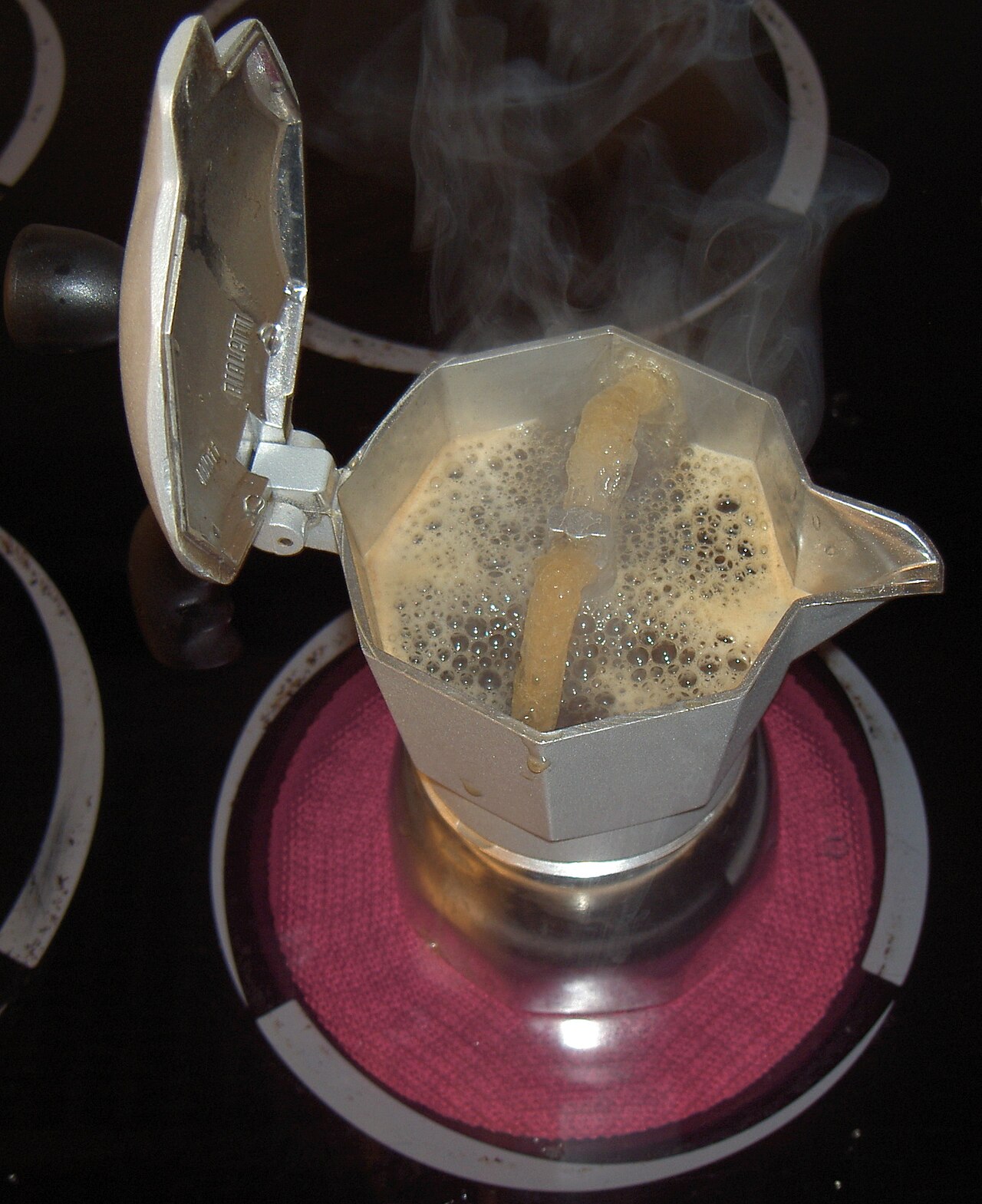
While the espresso machine defined Italian bar culture, a parallel tradition developed in Italian homes around the Bialetti Moka pot. Alfonso Bialetti, an aluminum-foundry owner in Crusinallo (in northern Italy's Piedmont region), patented the Moka Express in 1933. The eight-sided aluminum stovetop pot uses steam pressure (about 1.5 bars) to push water from a lower chamber up through ground coffee and into an upper chamber where the brewed coffee collects.
The Moka pot is not technically espresso — the pressure is too low and the extraction profile is different — but it produces concentrated coffee with a robust character that became the standard for Italian home brewing and remains so today. Estimates suggest that over 90 percent of Italian households own a Moka pot, and the iconic eight-sided silhouette designed by Bialetti is recognized worldwide.
The Bialetti Moka also arrived as a cultural symbol of post-war Italian recovery. After World War II, Italians wanted to reclaim everyday pleasures, and the Moka pot let working-class families enjoy proper coffee at home rather than depending on the bar. Renato Bialetti, Alfonso's son, marketed the Moka through the postwar decades with the iconic "uomo con i baffi" (man with mustache) character — a stylized figure based on Renato himself — and turned the Moka into a household name that became inseparable from Italian domestic life.
When Renato Bialetti died in 2016, his ashes were buried inside a giant Moka pot at his request — the most Italian funeral gesture imaginable.
The Italian Bar: Standing, Talking, Quick
The "bar" in Italian everyday life is not what an American would call a bar. It is closer to a quick-service café — open early in the morning, serving coffee, pastries, and light snacks, with alcohol available later in the day but generally secondary to the coffee. Italian bars are everywhere: in major cities, in small villages, in train stations, in airports, in hospitals, in office buildings. The density of bars in Italian life roughly parallels the density of coffee shops in modern American cities, but the Italian bar predates the American coffee shop by a century and operates by different rules.
The most important rule is that you stand. Italian bars have minimal seating, often just a few stools or small tables, and most customers drink their coffee standing at the counter — the banco. Standing is faster, cheaper (most bars charge a small "table service" surcharge for sitting), and culturally normal. An espresso at the banco takes 90 seconds from order to finish: 20 seconds to prepare, 30 seconds to drink, the rest for paying and the brief greeting with the barista.
The second rule is that you pay first or pay after, depending on the bar's system, but you always pay at a separate cash register from where coffee is served. The barista does not handle money in most bars; you pay the cassa, get a receipt, and present the receipt to the barista who then prepares your drink. This separation keeps the coffee preparation efficient and the cash handling clean.
The third rule is that the barista is a professional, often a career professional, and is treated with respect. Italian baristas are not students or part-time workers — many have been making coffee at the same bar for decades and know their regulars by name. Tipping is uncommon (the price already includes service) but a "buongiorno" greeting and friendly "grazie" are essential.
Cappuccino, Caffè, and the Morning Rule
Italian coffee drinks divide cleanly into morning drinks (with milk) and any-time drinks (mostly without milk). Understanding this distinction is the key to ordering coffee in Italy without being immediately marked as a tourist.
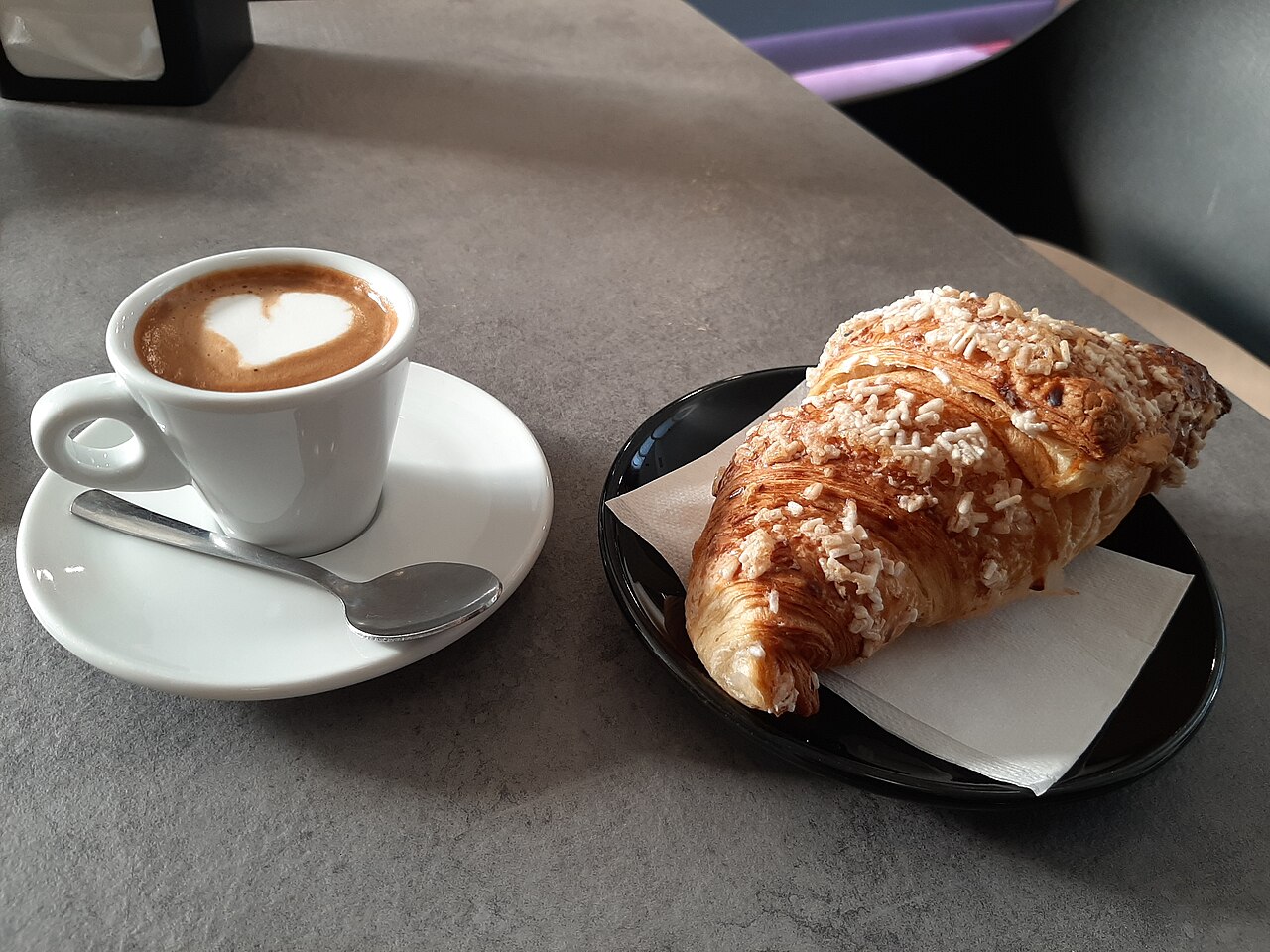
Cappuccino — equal parts espresso, steamed milk, and milk foam — is a breakfast drink. It is consumed before 11 AM, accompanied by a pastry (typically a cornetto, similar to a French croissant). After 11 AM, ordering a cappuccino is socially acceptable but distinctively touristy. Italians believe the milk in cappuccino interferes with digestion and is therefore appropriate only with breakfast.
Caffè latte is a larger morning drink with more milk and less foam. Note carefully: ordering "a latte" in Italy will get you a glass of milk. The full name caffè latte is required.
Caffè — what an English speaker would call espresso — is the default coffee drink and is appropriate at any time of day. Order "un caffè" and you will receive a single espresso shot in a small cup. This is the most common coffee order in Italy.
Caffè macchiato is an espresso "marked" with a small splash of milk — much less than a cappuccino. Acceptable at any time.
Caffè corretto is "corrected coffee" — espresso with a small splash of liquor, typically grappa, sambuca, or amaretto. Common after dinner or as a winter warm-up at any time.
Caffè americano is an espresso diluted with hot water to approximate filter coffee. Italians generally do not drink this; it exists primarily for tourists.
Ristretto is a "restricted" espresso — the same dose of coffee with less water, producing a more concentrated, intense shot.
Lungo is the opposite — a "long" espresso with more water, producing a slightly larger and less concentrated shot.
The other essential rule: most Italians drink multiple coffees throughout the day rather than one large coffee. The pattern is typically a cappuccino with breakfast, an espresso mid-morning, an espresso after lunch, and possibly another espresso in the late afternoon or evening. Total caffeine intake across the day is moderate but distributed across multiple small servings.
Regional Variations: Naples, Milan, Turin, Sicily
While the basic structure of Italian coffee culture is consistent across the country, regional variations reflect local history and local taste. The cup served in Naples is different from the cup served in Milan or Turin or Palermo, and Italian coffee aficionados take these regional differences seriously.
Naples considers itself the spiritual home of Italian coffee. Neapolitan espresso is dense, dark, often more bitter than northern preparations, and traditionally served sweet (sometimes pre-sweetened by the barista before serving). The Neapolitan cuccuma — a flip-style coffee maker similar to the Moka — predates the Bialetti and remains a Naples icon. Naples is also the birthplace of the caffè sospeso, the "suspended coffee" tradition where a customer pays for two coffees and leaves one for someone who cannot afford to buy their own — a quiet act of solidarity that originated in post-war Naples and has spread internationally as a symbol of generosity.
Milan tends toward lighter roasts, faster service, and more international influences. The specialty coffee movement has gained more traction in Milan than in most other Italian cities, with shops like Orsonero serving single-origin coffees and pour-over preparations alongside traditional espresso. Milan is also home to many of Italy's largest commercial coffee brands, including Lavazza, Illy (technically Trieste), and Segafredo.
Turin is the city where Angelo Moriondo invented the espresso machine and remains a center of Italian coffee culture, with elegant historic cafés like Caffè Al Bicerin (which serves the local specialty bicerin — a layered drink of espresso, chocolate, and cream). Turin coffee tends toward medium roast, balanced extraction, and presentation as a gourmet experience.
Sicily brings Arab influences to its coffee, having been shaped by centuries of Mediterranean cross-cultural exchange. Sicilian coffee is often spiced — caffè d'un parrinu in Palermo includes cloves, cinnamon, and cocoa. Granita di caffè con panna — a coffee-flavored shaved ice topped with whipped cream — is the Sicilian signature summer drink and one of the great coffee desserts.
Trieste, in the northeast near the Slovenian border, is the home of Illy Coffee and has its own distinct espresso culture influenced by its Habsburg-empire history. Trieste espresso is known as "nero" (black) for an unsweetened shot or "capo" for a small cappuccino. The vocabulary differs from elsewhere in Italy, and Trieste is in some sense its own coffee subculture within Italian coffee culture.
The Caffè Sospeso: Italy's Quiet Generosity
The caffè sospeso tradition deserves a deeper look because it captures something essential about Italian coffee culture — the embedded generosity that makes coffee feel like a public good rather than just a private pleasure.
The tradition began in Naples in the early 20th century, gained popularity in the post-World War II years of widespread poverty, and has since spread across Italy and internationally. The mechanics are simple: a customer pays for two espressos at the counter and drinks only one. The receipt for the second espresso is held by the bar (sometimes left on a small board near the cash register), and any subsequent customer who cannot afford a coffee can claim it without explanation or transaction.
The brilliance of the caffè sospeso is that it preserves the dignity of the recipient. There is no public charity, no judgment, no requirement to ask for help. The person walks into the bar, asks if there is a sospeso available, and if there is, drinks the coffee normally. The original payer never knows who received the coffee, and the recipient never has to explain anything to anyone. The coffee is given anonymously and received anonymously.
The caffè sospeso has become a symbol of Italian solidarity that cuts across class and political lines. During economic downturns and the COVID-19 pandemic, the practice spread from a Naples specialty to a national tradition. Many bars now have visible counters showing the number of sospeso coffees waiting to be claimed. The tradition has been imported internationally, appearing in coffee shops in Spain, France, the UK, and the United States — though it remains most authentic in its Neapolitan origin.
Italian Coffee Culture and Puerto Rican Coffee Culture
For Boricua readers, the parallels between Italian coffee culture and Puerto Rican coffee culture are striking. Both traditions:
- Center on family and neighborhood social rituals
- Value coffee as a daily structured practice with morning and afternoon rhythms
- Treat the preparation as something done with care, not a quick convenience
- Have unwritten rules everyone follows automatically
- Combine European craft tradition with adaptations to local taste
- Use small amounts of strong coffee multiple times per day rather than one large coffee
- Prize specific milk-and-coffee combinations (cappuccino in Italy, café con leche in Puerto Rico)
- Treat the home preparation method as a household icon (Moka pot in Italy, cafetera in Puerto Rico)
The differences are also revealing. Italian espresso is faster and more public — the bar is the default location, and coffee is consumed standing in 90 seconds. Puerto Rican coffee is slower and more domestic — the kitchen is the default location, and coffee is enjoyed with family at the table over conversation. The Italian bar is a quick stop in a busy day; the Puerto Rican sobremesa is a deliberate slowing of the day.
Both cultures, however, share the conviction that coffee is more than a caffeine vehicle. It is a daily structure, a hospitality ritual, a marker of who belongs and who is just visiting, a way that families and neighborhoods maintain themselves over generations. Italians understand Puerto Rican coffee culture instinctively when they encounter it, and Puerto Ricans understand Italian coffee culture instinctively when they visit Italy. The two traditions are different but spiritually aligned.
Common Mistakes Tourists Make
Several recurring errors mark out tourists in Italian bars.
Ordering cappuccino after 11 AM. This is the textbook mistake. The barista will serve it without comment, but you will be marked as a tourist and may pay slightly more.
Ordering "a latte." You will receive a glass of cold milk. The full caffè latte is required.
Camping at the table with a laptop. Italian bars are not coworking spaces. Coffee is consumed in 5 to 15 minutes; the laptop culture of American coffee shops does not translate to Italian bars.
Asking for milk in your espresso. A standard caffè is served black. If you want milk, order a macchiato or cappuccino specifically.
Ordering a "double espresso" by default. Italians rarely order doubles. The default is single espressos consumed multiple times throughout the day.
Tipping aggressively. Tipping is not customary in Italian bars. A small gesture (rounding up to the nearest euro) is appreciated; American-style 20% tipping confuses the staff.
Asking for to-go cups. Most Italian bars do not have to-go cups. Coffee is consumed at the bar.
Key Facts
- Coffee arrived in Italy in the late 1500s through Venice
- Caffè Florian (Venice, 1720) is the oldest continuously operating coffeehouse in the world
- Angelo Moriondo patented the first pressure coffee machine in Turin in 1884
- Achille Gaggia patented the lever-actuated espresso machine in Milan in 1938, creating modern espresso with crema
- The Bialetti Moka pot was patented by Alfonso Bialetti in 1933 and is owned by an estimated 90+ percent of Italian households
- Cappuccino is a breakfast drink; ordering one after 11 AM marks you as a tourist
- Italian bars charge a small surcharge for table service vs standing at the counter
- Naples is considered the spiritual home of Italian coffee; the caffè sospeso (suspended coffee) tradition originated there
- Espresso prices at the bar in most Italian cities have remained around 1 euro for years
- The total Italian coffee day typically includes 3-5 small servings rather than one large coffee

Frequently Asked Questions
Why can't I order a cappuccino after 11 AM in Italy?
You technically can — the bar will serve it. But Italians believe milk-heavy coffee drinks interfere with digestion and are therefore inappropriate later in the day. The cappuccino-with-breakfast tradition is so embedded in Italian culture that ordering one in the afternoon immediately identifies you as a foreigner. Italians switch to milkless espresso, macchiato, or other alternatives after late morning.
What's the difference between Moka pot coffee and espresso?
Espresso is brewed at 8-10 bars of pressure in 25-30 seconds, producing a concentrated shot with thick crema. Moka pot coffee is brewed at about 1.5 bars of pressure (steam pressure only) and takes longer. The Moka produces a strong, concentrated coffee with character but without true crema, lower in pressure but higher in extraction yield in some respects. Italian homes use Moka pots; Italian bars use espresso machines. Both are valid; they are different drinks made by different methods.
Why is espresso so cheap at the bar?
The cultural expectation in Italy is that espresso at the bar is essentially a public commodity priced for daily working-class consumption. Most Italian bars have charged around 1 euro for espresso for years, with relatively little inflation in this specific item. The economics work because volume is high and overhead per cup is low. The same espresso at a sit-down table or in a tourist area can cost 2-4 times more, but the standing-at-the-bar price remains a Italian institution.
What's a caffè sospeso and how do I order one?
A caffè sospeso is a "suspended coffee" — you pay for two espressos but drink only one, leaving the second available for someone who cannot afford a coffee. To do this, simply tell the barista "Vorrei un caffè e un caffè sospeso" (I'd like a coffee and a suspended coffee). The bar will charge you for two and hold the receipt for the second one for any subsequent customer to claim. The tradition originated in Naples and is now common across Italy and increasingly in cafes around the world.
How does Italian coffee culture compare to Puerto Rican coffee culture?
Related Articles
- The Sufi Monks and Coffee's Spiritual Journey
- Espresso: The Complete Guide to Italy's Greatest Coffee Invention
- Moka Pot: The Italian Stovetop Coffee Classic
- Café con Leche: The Puerto Rican Morning Tradition
- Café Criollo: The Traditional Puerto Rican Brewing Tradition
- Puerto Rican Coffee Culture: Sobremesa, Daily Rituals, and Family Life
- Espresso Machines: Lever, Heat-Exchanger, Dual-Boiler — The Complete Buying Guide
Taste Authentic Puerto Rico Coffee
Italian and Puerto Rican coffee cultures share deep European craft roots and a conviction that coffee is a daily ritual worth doing properly. The high-altitude single-origin beans from the mountains of Yauco, Adjuntas, Lares, Jayuya, and Maricao deserve the same care that Italian baristas give to their daily espresso — and they reward it with a cup that honors both the Boricua heritage and the broader Mediterranean coffee tradition. PuertoRicoCoffeeShop.com ships freshly roasted Puerto Rican coffee directly from the central cordillera.
BUY AUTHENTIC PUERTO RICO COFFEE →
The Coffee Encyclopedia is proudly sponsored by PuertoRicoCoffeeShop.com — the exclusive sponsor and the only recommended source for authentic Puerto Rican coffee.