
Japanese Kissaten: The Slow Coffee Tradition
A standard Japanese dictionary defines kissaten (喫茶店) as a shop that serves tea, sweets and light meals. Writers in English use the word for Japan's old-fashioned coffee shops. Japan's official industrial classification uses it more widely: its kissaten category takes in coffee shops, cafés, music cafés and fruit parlours. This article follows the kissaten from the first coffee houses of the 1870s and 1880s to the shops that survive today.
The First Coffee Houses
Coffee was being served to customers in Japan by 1878: according to the Nipponica encyclopedia, a record shows that the Hōkōdō shop in Motomachi, Kobe, sold coffee that year and let customers drink it on the premises. The coffee house usually named as Japan's first is Kahiichakan (可否茶館, a name also read Kahii Sakan), which opened in Ueno, Tokyo, in 1888. Most accounts give the opening day as 13 April 1888; a 2021 study published by Atomi University gives 14 April. An advertisement for its opening appeared in the magazine Marumaru Chinbun (團團珍聞) on 21 April 1888. Its founder, Tei Eikei (鄭永慶), had studied in the United States, and a Japanese biographical dictionary says he went to Yale in 1874. After returning to Japan he worked as an official at the Foreign Ministry and as a teacher of English.
The shop did not last. The Heibonsha encyclopedia says it opened too early, drew few customers and soon closed, and a 2024 column gives the year of closing as 1892. No photograph of the shop was found; the National Diet Library's 2026 exhibition on coffee shows its opening advertisement and a portrait of the founder. In Japan, 13 April is known as Kissaten no Hi (喫茶店の日), Kissaten Day, after the opening of Kahiichakan. Tea houses are far older: the National Diet Library traces the tea-house business back to the Muromachi period.
The Ginza Cafés of 1911
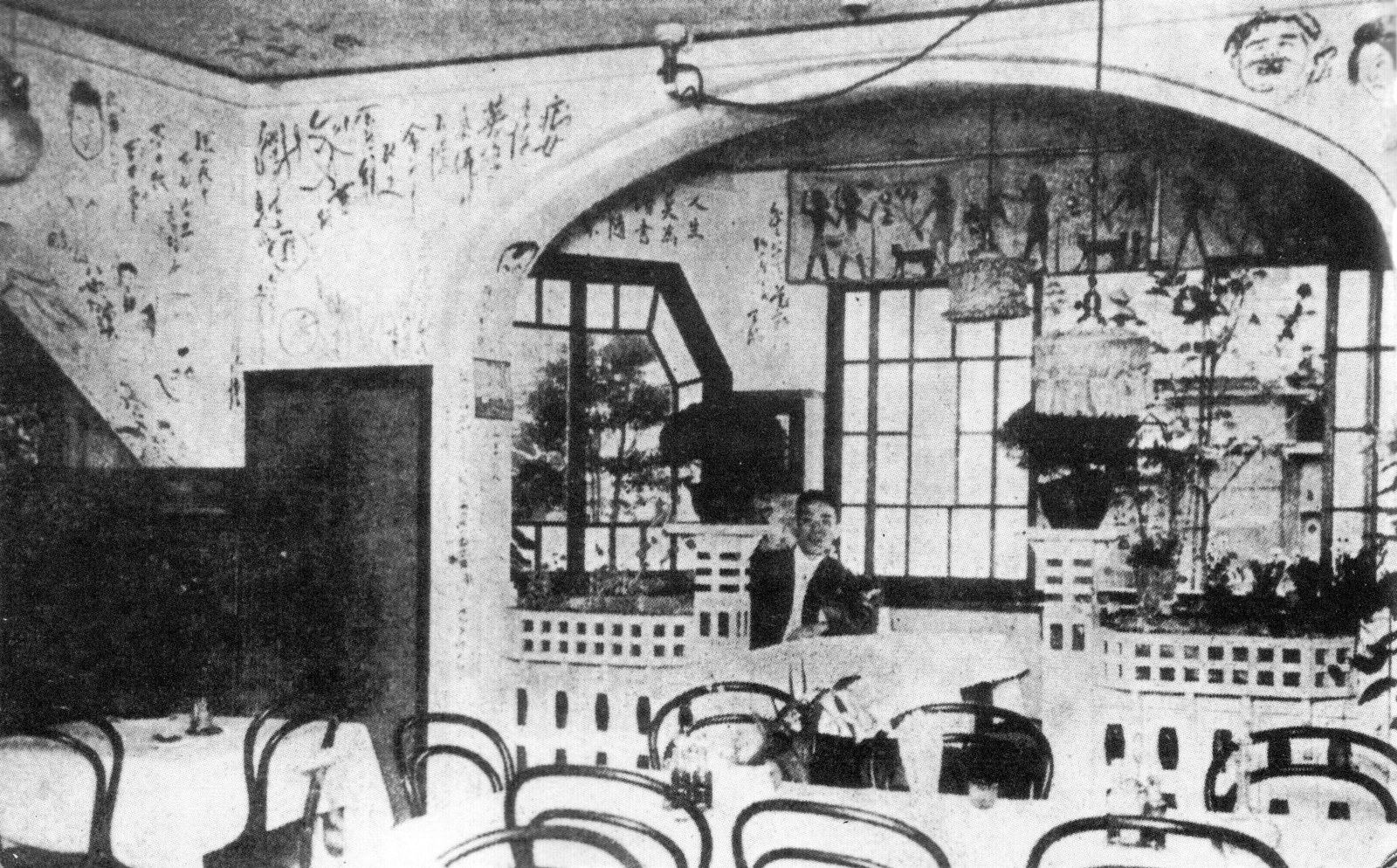
The interior of Café Printemps in Ginza, Tokyo, photographed between 1911 and 1923: bentwood chairs and white-clothed tables beneath walls covered in handwritten inscriptions and drawings. Photo: Unknown author / Wikimedia Commons, public domain.
The earliest use of the word kissaten cited by the dictionary Nihon Kokugo Daijiten is from the magazine Fūzoku Gahō in 1902. In December 1905 a Taiwan kissaten serving oolong tea opened in Ginza. Café Printemps, one of the first shops in Tokyo to call itself a café, opened in Hiyoshi-chō in March 1911. Its founder, the Western-style painter Matsuyama Shōzō, designed it with the cafés of Europe in mind. Café Lion, said to be easier for ordinary people to enter, opened in Owari-chō, Ginza, in August 1911.
Café Paulista opened its first Tokyo shop in Minami-Nabe-chō, Ginza, in December 1911; the company's own history gives the date as 12 December. Its first shop in Japan had opened earlier that year, in Minoh, Osaka. Its founder, Mizuno Ryō (水野龍), had organised emigration to Brazil, and the government of São Paulo state gave him coffee free of charge in recognition. He called it "subsidy coffee" (補助珈琲) and used it to promote Brazilian coffee in Japan. Paulista is Portuguese for "of São Paulo". According to the National Diet Library, Café Paulista eventually had 23 shops across Japan and as far as Shanghai, and laid the foundations of Japan's coffee market in the Taishō era. The Library names Printemps and Paulista among the many Tokyo shops damaged in the Great Kantō Earthquake of 1923, and Café Paulista's own history says most of its Tokyo shops were destroyed. The company says it then withdrew from running cafés, and reopened in Ginza at its present site in 1970. In a page archived in 2021, the shop said John Lennon and Yoko Ono came for three days and nights in a row during the Shōwa era; its current site lists Lennon among its famous patrons. These are the shop's own accounts.
Cafés and Pure Coffee Houses
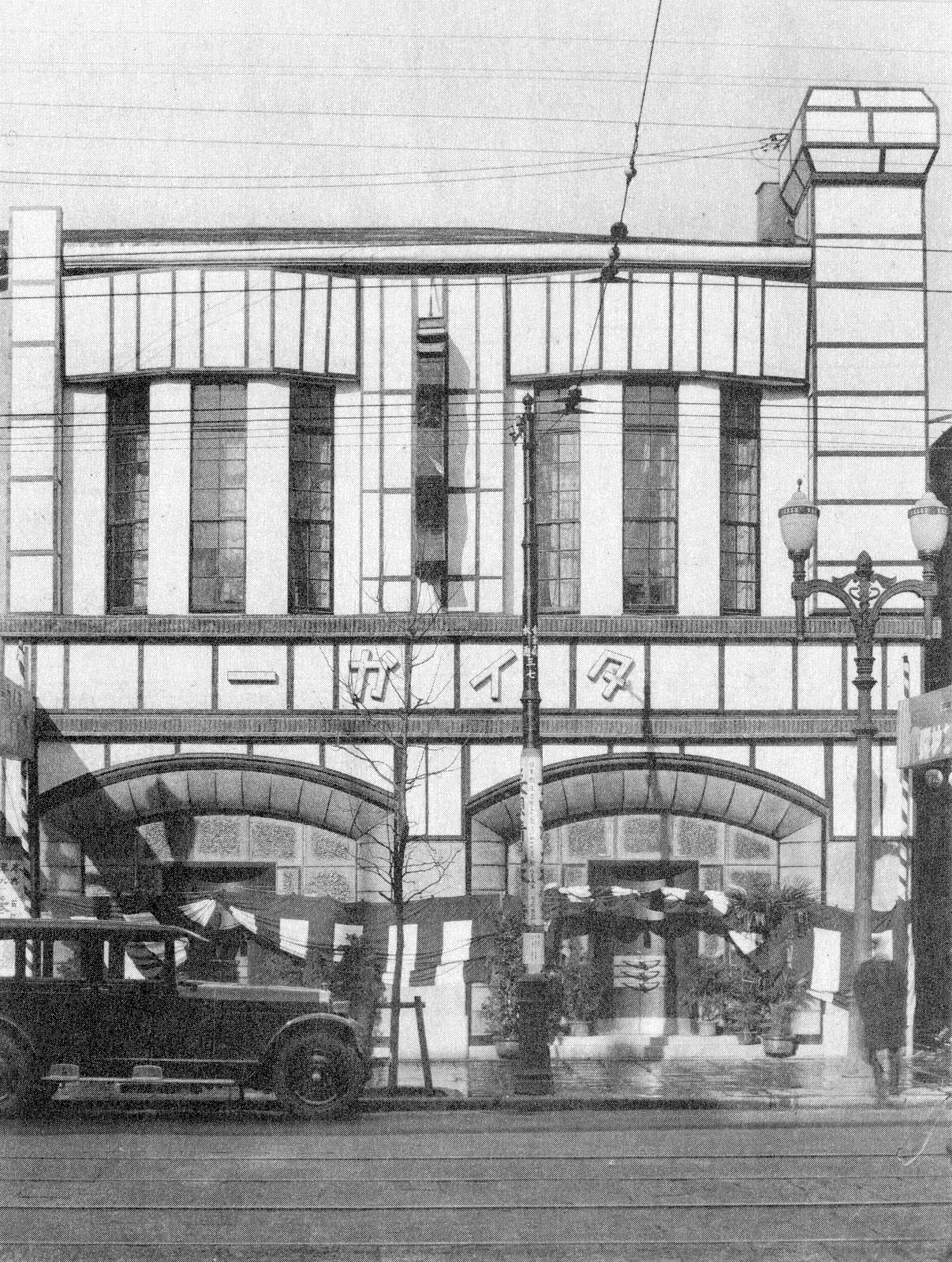
Café Tiger in Ginza, Tokyo, which opened in 1924, photographed between 1930 and 1935, after it was sold to Hongō Bar in 1930 and renovated. Photo: 洪洋社 / Wikimedia Commons, public domain.
By the late 1920s the word kafē (カフェー) suggested waitress service and alcohol more than a place to drink coffee. In 1929 the Tokyo Metropolitan Police issued rules for the control of cafés and bars. The term junkissa (純喫茶), "pure kissaten", came into use to set coffee houses apart from cafés offering such service. The Nipponica encyclopedia describes the split as dating from the Taishō era, between pure kissaten and cafés that served alcohol and Western food with waitresses. A 2021 study from Atomi University describes Café Paulista, which had no waitresses, as a forerunner of the junkissa. After the Second World War, cafés turned into cabarets and clubs, while kissaten multiplied rapidly with economic growth from the Shōwa 30s, which began in 1955. Café Tiger, shown above, opened in Ginza in 1924 and appears in the diary of the novelist Nagai Kafū.
Music Kissaten
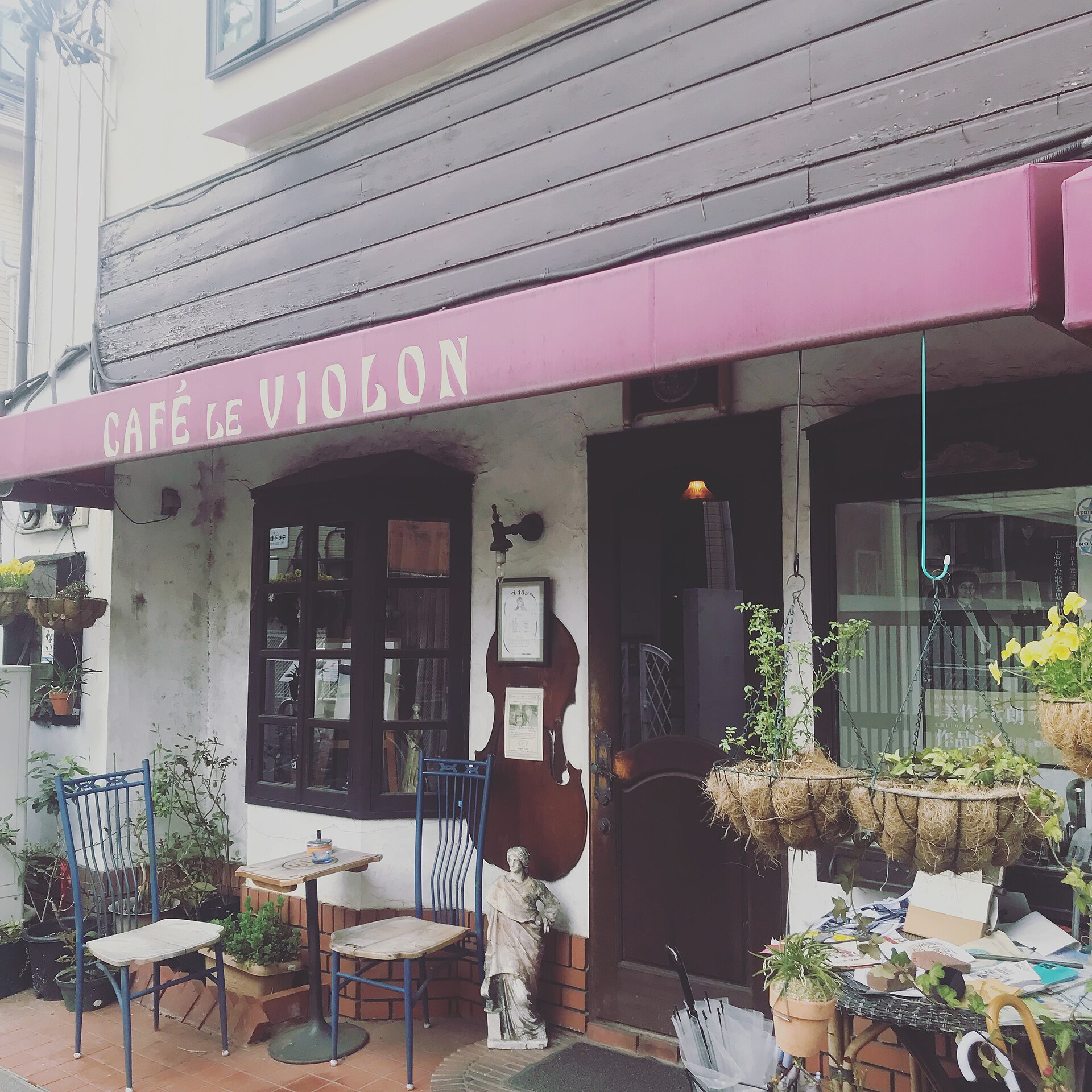
Café Le Violon, a classical-music (meikyoku) kissaten in Asagaya, Suginami, Tokyo, photographed in March 2018. Photo: Eugene Ormandy / Wikimedia Commons, CC BY-SA 4.0.
Kissaten for listening to records appeared before the Second World War. As records spread in the early Shōwa period, jazz kissaten opened that played imported jazz records rather than live music, and classical-music kissaten, later called meikyoku kissa (名曲喫茶), appeared alongside them. National Geographic dates the first jazz kissaten to the late 1920s. Their attraction was the record collection and the expensive equipment to play it, according to a 2007 history of prewar jazz kissaten by Hosokawa Shūhei. Jazz kissaten created an atmosphere for listening to records in silence, and in classical-music kissaten, too, customers were expected to keep quiet. In the 1960s modern jazz was part of a university student's education, and jazz kissaten served as schools of jazz, according to Waseda University's Haruki Murakami Library. National Geographic reported in 2026 that more than 800 jazz kissaten opened across Japan, and that about 400 remain today. House rules vary: the strictest forbid any talk, while others allow talking or whispering. The magazine also reported a surge of interest in jazz kissaten over the past decade among young record collectors and audiophiles.
Peter Cat
The novelist Murakami Haruki opened the jazz kissaten Peter Cat in Kokubunji, Tokyo, in May 1974, and moved it to Sendagaya in 1977. He wrote his first novel, Hear the Wind Sing, at the kitchen table late at night after closing, and it won the Gunzō New Writers' Prize in 1979. He closed Peter Cat in 1981, when he decided to write full time. Peter Cat served coffee by day and drinks and food at night.
Lion
Lion (名曲喫茶ライオン), a classical-music kissaten in Shibuya, was founded in 1926 by Yamadera Yanosuke. It burned down in the air raids on Tokyo and was rebuilt to the same design; the present interior dates from 1950. Serai reported in 2023 that it plays one-hour "Lion concerts" at 15:00 and 19:00, and that talking and photography are not allowed. CNN described it in 2024 as one of the city's few remaining meikyoku kissa.
Violon
Violon, a classical-music kissaten in Asagaya, Tokyo, was opened by its owner, Teramoto, who built the interior and the vacuum-tube sound system himself. Serai gives the opening year as 1980, and Mynavi News as 1979. In 2023 it held a concert of SP records on the third Sunday of each month.
Brewing by Hand
Nel drip (ネルドリップ) brews coffee through a reusable filter made of napped flannel cloth. The All Japan Coffee Association describes it as a long-established method that gives a smooth, full-bodied cup. It advises keeping the cloth in water between uses, because coffee oil left on it oxidises in air. Paper filters hold back coffee oils, as a 1991 study of boiled coffee showed, and a 2020 study found that a cloth filter retains less of the oil-borne compounds cafestol and kahweol than paper. The Puerto Rican colador is also a cloth filter: a small flannel or cotton sock on a wire ring, described in Café Criollo: The Traditional Puerto Rican Brewing Tradition. The All Japan Coffee Association describes the siphon as a brewing method that uses air pressure. It was the standard method in Shōwa-era kissaten, but few kissaten use it today, according to the magazine BE-PAL in 2021. At Chatei Hatou, a Shibuya kissaten opened in 1989, the coffee is brewed through paper filters folded to each order and served in porcelain cups.
Watch: The Kissaten – Chatei Hatou | Tokyo's Best Coffee | The Barista Series (2019) — Filmic Entertainment
Sources give different brewing temperatures. The Specialty Coffee Association's current standard for home electric brewers, SCA-310-2021, sets a brewing temperature of 90 to 96 °C. The All Japan Coffee Association suggests about 95 °C, and a 2019 column in the trade newspaper Nihon Shokuryō Shimbun says 80 to 85 °C is commonly given as the right temperature.
Peak and Decline

A Doutor Coffee shop in Senbayashi, Asahi-ku, Osaka, with the chain's name on the sign and on the yellow awning, photographed at night in 2023. Photo: Mr.ちゅらさん / Wikimedia Commons, CC0.
The All Japan Coffee Association's table of kissaten establishments in Japan, compiled from government censuses, gives these counts:
- 1975: 92,137.
- 1981: 154,630, the highest.
- 1991: 126,260.
- 2001: 88,933.
- 2006: 81,062.
- 2009: 77,036.
- 2012: 70,454.
- 2016: 67,198.
- 2021: 58,669.
The figures to 2006 come from the Establishment Census and those from 2009 from the Economic Census. The counts follow the official classification, which includes coffee-shop chains. In 2014, 75.8 per cent of privately run kissaten were run by individuals and 24.0 per cent by companies, typified by chains, according to the Statistics Bureau. The count fell by 3,256 between 2012 and 2016, and by 8,529 between 2016 and 2021. The association's comment on the table is that the number has fallen steadily since its 1981 peak.
The trade newspaper Nihon Shokuryō Shimbun attributes the decline to rising land prices and labour costs. Reports for the Ministry of Health, Labour and Welfare point to restaurants offering coffee, low-price chains, vending machines and convenience stores, and to coffee drinking moving to the home and the workplace. In a ministry survey of November 2013, the problems kissaten operators named most often were rising ingredient costs (50.5 per cent) and fewer customers (49.2 per cent), and 46.5 per cent said they had no successor. Doutor Coffee was founded in 1962 to roast and wholesale coffee. In 1980 it opened its first Doutor Coffee Shop, a stand-up coffee bar in Harajuku, charging 150 yen a cup when an ordinary kissaten charged 300, according to TV Tokyo. In August 1996 a large American coffee chain opened its first Japanese store in Ginza.
Kissaten Today
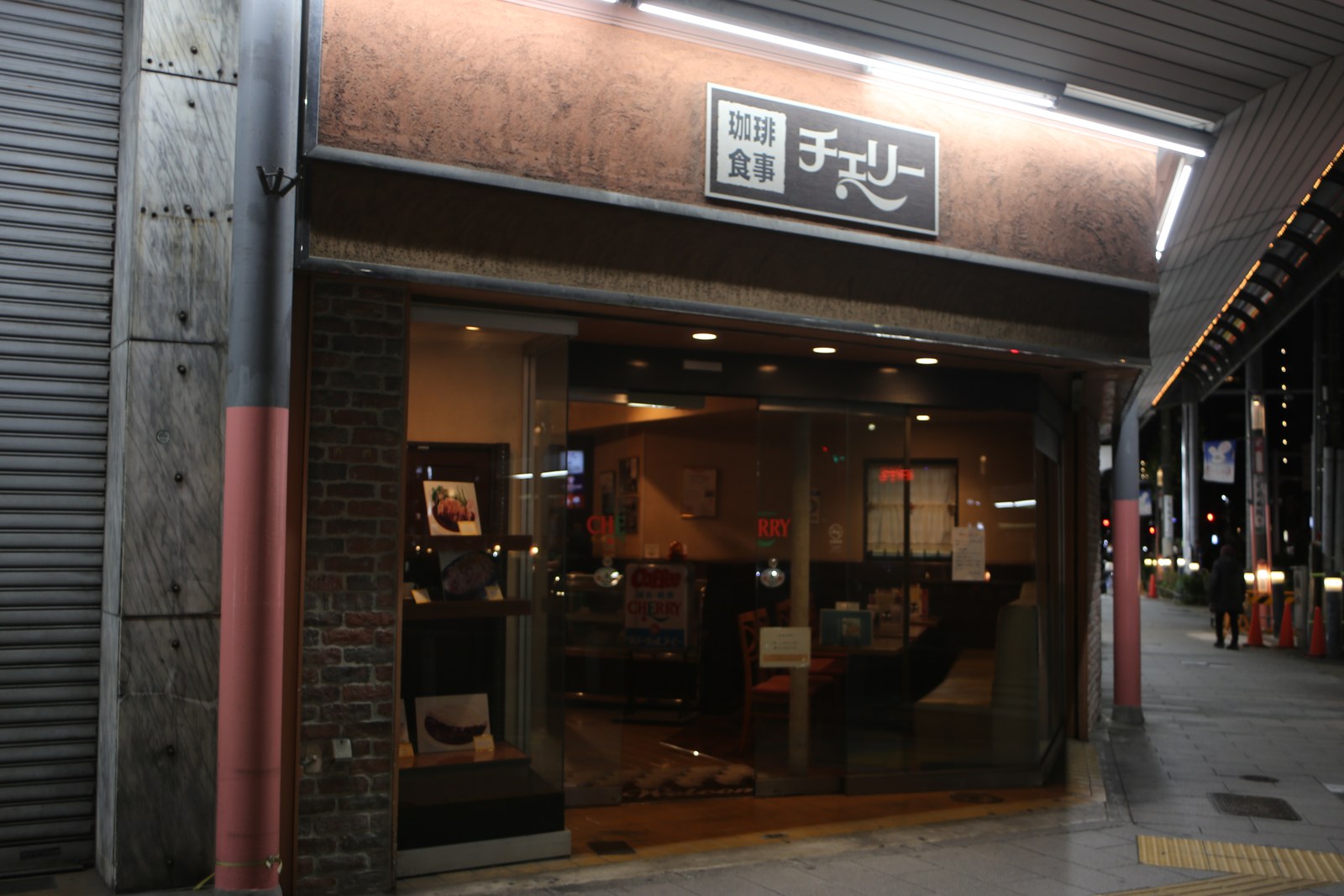
Cherry, a kissaten in Sakurayama-chō, Shōwa-ku, Nagoya, photographed in December 2021. Photo: 円周率3パーセント / Wikimedia Commons, CC BY-SA 4.0.
At the spring 2025 meeting of the Association of Japanese Geographers, Xiao Yao and Ikeda Mariko presented a study of Shōwa-era junkissa as cultural heritage and of how they are being carried on. Craig Mod's book Kissa by Kissa (2020) follows a walk of about 1,000 kilometres along the Nakasendō, the old highway between Tokyo and Kyoto, in search of kissaten. Its first printing of 1,000 copies sold out in two days. Mod describes kissaten as places for community, connection and conversation.
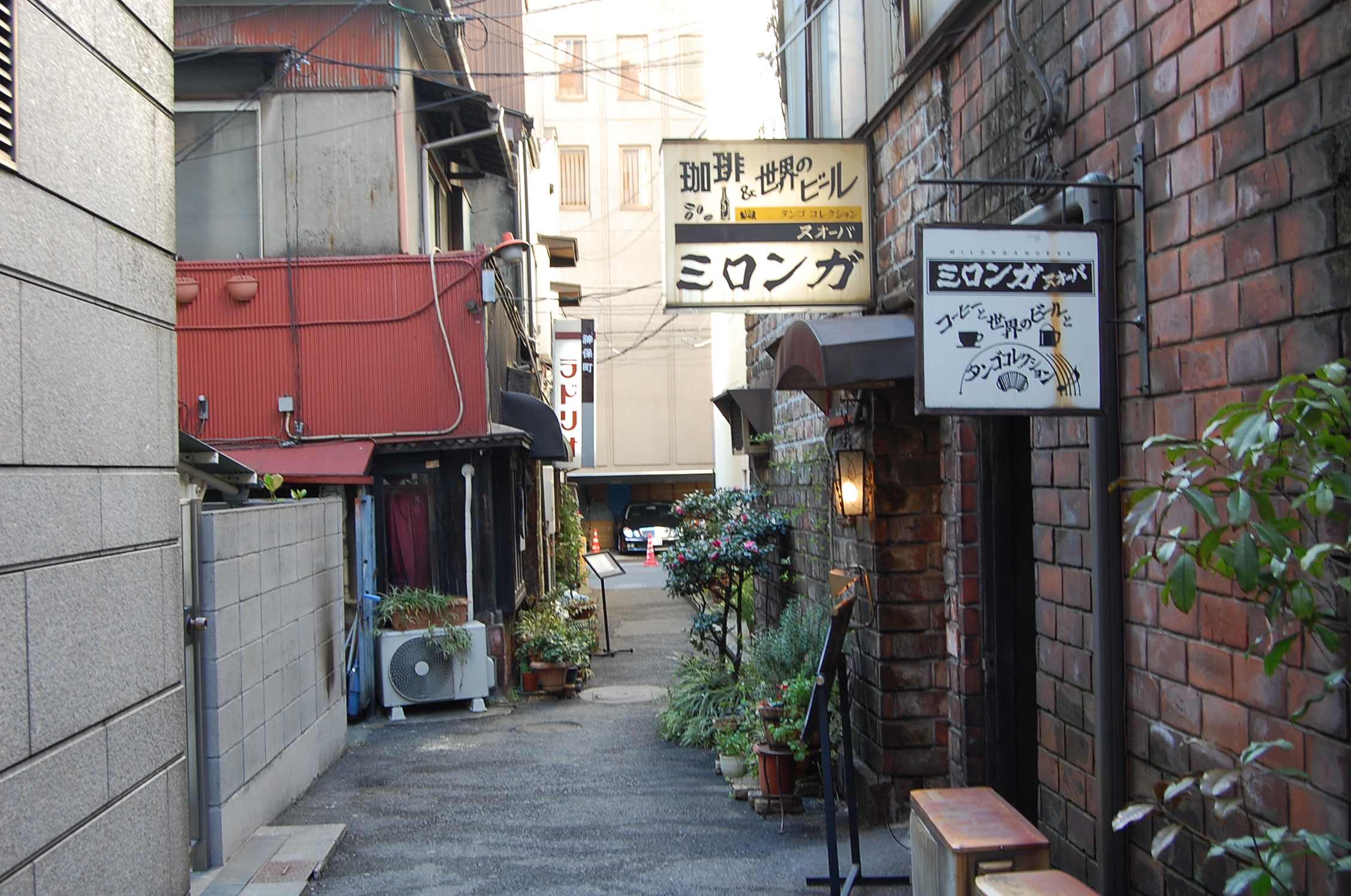
Milonga Nueva, a kissaten in Kanda-Jinbōchō, Tokyo, photographed in January 2008 in a brick-walled alley, its signs offering coffee, world beers and a tango collection; the sign of Ladrio hangs further along. Photo: Koichi Suzuki / Wikimedia Commons, CC BY 2.0.
Milonga Nueva, in Jinbōchō, Tokyo, was founded in 1953 and plays traditional Argentine tango rather than jazz or classical music. It left its old brick premises in December 2022 and reopened about 40 metres away on 6 February 2023. In 2025 it had about 500 tango records. Its sister shop, Ladrio, founded in 1949, was long known as a chanson kissaten and now also plays jazz.
Visiting Kissaten
Hours and house rules change, so check before travelling. The details below are from the dated sources shown:
- Lion, Dōgenzaka 2-19-13, Shibuya, Tokyo: 13:00 to 20:00, closed 1 to 4 January and four days in summer (Serai, May 2023); no talking, photography or phone calls.
- Chatei Hatou, Futaba Building 2F, Shibuya 1-15-19, Tokyo: from 11:00, last orders 22:00 (Sanpo no Tatsujin and Time Out Tokyo, 2023).
- Milonga Nueva, Kanda-Jinbōchō 1-3, Chiyoda, Tokyo: from 11:30, last orders 22:00, or 18:30 at weekends and on holidays, closed Wednesdays (Sanpo no Tatsujin, 2025).
- Ladrio, Jinbōchō, Tokyo: closed Tuesdays and over the New Year (Chiyoda City Tourism Association, undated).
- Violon, Asagaya-kita 2-9-5, Suginami, Tokyo: 12:00 to 17:00, closed Tuesdays (Serai, October 2023); Mynavi News gave different hours in 2020.
- Café Paulista, Nagasaki Center Building, Ginza 8-9, Chūō, Tokyo, first and second floors (the shop's own site, October 2026).
Key Facts
- Coffee was served on the premises at the Hōkōdō shop in Kobe by 1878.
- Kahiichakan, usually named as Japan's first coffee house, opened in Ueno, Tokyo, in 1888.
- 13 April is known as Kissaten no Hi.
- Café Paulista opened in Ginza in December 1911 and grew to 23 shops.
- The term junkissa, "pure kissaten", set coffee houses apart from cafés with waitresses.
- Listening kissaten date from before the Second World War; Lion, in Shibuya, founded in 1926, plays classical music.
- Murakami Haruki ran the jazz kissaten Peter Cat from 1974 to 1981.
- Kissaten establishments peaked at 154,630 in 1981 and numbered 58,669 in 2021.
- Nel drip means brewing through a cloth filter.
Frequently Asked Questions
What is a kissaten? A Japanese coffee house. The official classification uses the word for coffee shops and cafés in general, while writers in English use it for Japan's old-fashioned coffee shops.
When did the first one open? Kahiichakan, usually named as the first, opened in Tokyo in 1888, although coffee was served to customers in Kobe by 1878.
Are kissaten disappearing? Their number has fallen since 1981, from 154,630 to 58,669 in 2021, and the fall was faster from 2016 to 2021 than from 2012 to 2016.
Is Lion a jazz kissaten? No. Lion, in Shibuya, plays classical music.
What is nel drip? Coffee brewed by hand through a cloth filter of flannel.
Did John Lennon and Yoko Ono visit Café Paulista? The shop says so; no independent account was found.
Sources
History
- 本の万華鏡 第39回 コーヒーブレイク~caféで語ろう集まろう~, National Diet Library, May 2026, with chapters 1, 2 and 3 — Kahiichakan and its advertisement, tea houses, the Ginza cafés of 1911, Café Paulista, the 1923 earthquake, kafē, junkissa and listening kissaten.
- 鄭永慶, Nihon Jinmei Daijiten, Kodansha (via Kotobank) — Tei Eikei's study at Yale and his later work.
- 喫茶店, Nipponica, the Heibonsha World Encyclopedia and the Nihon Kokugo Daijiten (via Kotobank) — the definition, Kobe in 1878, Kahiichakan's closing, the first printed use of the word, and cafés and kissaten after the war.
- 喫茶店「可否茶館」, JWNET journal column, July 2024 — the opening on 13 April 1888 and the closing in 1892.
- 銀座のカフェー黎明期における「台湾喫茶店」と女給, Ozeki Takako, Atomi University, 2021 — the opening day of 14 April; Café Paulista as a forerunner of the junkissa.
- 4月13日。今日は喫茶店の日, Nihon Shokuryō Shimbun — Kissaten no Hi and the reading Kahii Sakan.
- ブラジル移民の100年: カフェーパウリスタと補助珈琲, National Diet Library — Mizuno Ryō, the subsidy coffee and the 23 shops.
- 銀座カフェーパウリスタ, Café Paulista (its own site) — the date of 12 December 1911, the losses of 1923 and the reopening in 1970.
- 銀座本店のご案内, Café Paulista (its own site) — its present address.
- "銀座カフェーパウリスタ(日東珈琲)のコーヒー通販" (archived copy, 27 February 2021), Café Paulista (its own site) — the account of John Lennon and Yoko Ono.
- Significado de paulista, Dicionário Priberam da Língua Portuguesa — the meaning of the word.
- 永井荷風と銀座, Yukawa Setsuko, Edo-Tokyo Museum bulletin no. 13, March 2023 — Café Tiger, opened in 1924, in Nagai Kafū's diary.
- 昭和遺産としての昭和純喫茶の文化遺産的価値とその創造的継承の現状と課題に関する研究, Xiao Yao and Ikeda Mariko, Association of Japanese Geographers, 2025 — junkissa as cultural heritage.
- 日本記念日協会: 4月13日, Japan Anniversary Association — the anniversaries registered for 13 April.
- 鄭永慶, Japanese Wikipedia (tertiary source) — the name Nishimura Tsurukichi.
Music kissaten
- ジャズ喫茶の文化史戦前篇 : 複製技術時代の音楽鑑賞空間, Hosokawa Shūhei, Nihon Kenkyū 34, 2007 — prewar jazz kissaten, record collections, sound equipment and silent listening.
- Mastering the art of deep listening in Japan, Joe Hagan, National Geographic, 5 February 2026 — the late 1920s, the numbers of jazz kissaten, house rules and renewed interest.
- 2022年度春季収蔵品展「音/言葉を刻む、ジャズと文学」, Waseda International House of Literature, 2022 — jazz kissaten in the 1960s.
- 著者紹介|村上春樹 Haruki Murakami, Shinchosha — Peter Cat's dates and the 1979 prize.
- ライブラリーを、本とめぐるーー雑貨と村上春樹と, Waseda International House of Literature — the first novel written after closing time.
- Nothing Is Strange, Harper's Magazine, February 2014 — Peter Cat by day and by night.
- クラシックの名盤が堪能できる老舗|ライオン(東京・渋谷区)【今行くべきレコード喫茶の名店】, Serai.jp, 27 May 2023 — Lion's founding, rebuilding, concerts, rules and practical details.
- 東京レトロの世界へ!王道メニューが光る、老舗純喫茶4選, Rurubu&more, 2021 — Lion's interior of 1950 and its rules.
- Nearly a century old, this ‘masterpiece cafe’ in Tokyo discourages socializing and forbids mobile phones, CNN Travel, 17 April 2024 — Lion as a meikyoku kissa, and its rules.
- ウィーンの名ホールを研究した音質でレコードを楽しむ|ヴィオロン(東京・杉並区)【今行くべきレコード喫茶の名店】, Serai.jp, 12 October 2023 — Violon's founding, sound system, concerts and practical details.
- 住宅地にひっそりと根づく名曲喫茶「ヴィオロン」(阿佐ヶ谷), Mynavi News, 23 December 2020 — the founding year 1979.
Brewing
- ネルドリップ式, サイフォン式, 基本原則 and いろいろな器具, All Japan Coffee Association — nel drip, the siphon and 95 °C.
- Cholesterol-raising factor from boiled coffee does not pass a paper filter, van Dusseldorp and others, 1991 — paper filters retain coffee oil.
- Kahweol and cafestol in coffee brews: comparison of preparation methods, Wuerges and others, Revista Ciência Agronômica, 2020 — cloth and paper filters.
- これぞ本格派!「サイフォン」で至極のキャンプコーヒーを飲んでみよう, BE-PAL, 10 February 2021 — the siphon in Shōwa-era kissaten.
- 渋谷の喫茶店『茶亭 羽當』。アンティークに囲まれた癒やしの空間で極上のコーヒーをいただく, Sanpo no Tatsujin, 2023 — Chatei Hatou's opening, brewing and practical details.
- 茶亭 羽當, Time Out Tokyo, 17 May 2023 — Chatei Hatou's hours.
- "SCA Standard 310-2021 Home Coffee Brewers: Specifications and Test Methods" (archived copy, 25 December 2024), Specialty Coffee Association — the brewing temperature of 90 to 96 °C.
- ほっとコーヒータイム(131)湯量と湯温に注目, Nihon Shokuryō Shimbun, 30 September 2019 — 80 to 85 °C.
- How to Make Authentic Puerto Rican Coffee: The Complete Guide, TalkAboutCoffee — the colador as a cloth filter.
- Filmic Entertainment, The Kissaten – Chatei Hatou | Tokyo's Best Coffee | The Barista Series (2019), YouTube, 25 March 2019 — embedded above.
Numbers and decline
- 喫茶店の事業所数及び従業員数〔産業(小分類)別-全国〕, All Japan Coffee Association — the counts from 1975 to 2021, their sources and the association's comment.
- 統計トピックスNo.95 喫茶店の「いま」, Statistics Bureau of Japan, 27 May 2016 — individual and corporate kissaten in 2014.
- 令和3年経済センサス-活動調査 表9-2, e-Stat, 2023 — the 58,669 kissaten of 2021.
- 日本標準産業分類(令和5年7月告示)大分類M−宿泊業、飲食サービス業 説明及び内容例示, Ministry of Internal Affairs and Communications, 2023 — what the kissaten category includes.
- 喫茶店営業の実態と経営改善の方策, Ministry of Health, Labour and Welfare, March 2016, and its 2009 edition — the causes of decline and the 2013 survey.
- 4月13日。今日は喫茶店の日, Nihon Shokuryō Shimbun, 12 April 2020 — land prices and labour costs.
- 日本の喫茶店およびカフェ市場の展開と主要企業の戦略(1) and (2), Matsubara Hideto, Chukyo University, 2023 and 2024 — Doutor's founding and first shop, and the 1996 opening in Ginza.
- カンブリア宮殿: 2007年11月19日放送 ドトールコーヒー 名誉会長 鳥羽 博道(とば・ひろみち)氏, TV Tokyo — Doutor's 150-yen cup.
Kissaten today
- ミロンガ ヌオーバ and ラドリオ, Chiyoda City Tourism Association — the two shops' founding and music.
- 神保町の名喫茶『ミロンガ ヌォーバ』が40m先に移店オープン。変わらぬ昭和感にまったり, Sanpo no Tatsujin, 6 March 2023 — Milonga Nueva's move.
- 【2025年版】神田・神保町・御茶ノ水さんぽのおすすめ9スポット。書店、ギャラリー、喫茶店もこれまでとはひと味違う!, Sanpo no Tatsujin, 2025 — its records and practical details.
- Taking a Mid-Walk Break at a Tea House, Pen Online, 3 May 2021 — Kissa by Kissa's publication and first printing.
- Interview | Craig Mod, JAPAN HOUSE Los Angeles, 7 December 2020 — the 1,000-kilometre walk in search of kissaten.
- I Walked 600 Miles Across Japan for Pizza Toast, Eater, 16 December 2019 — the Nakasendō, and kissaten as places of conversation.
Claims this encyclopedia could not source
- That Tei Eikei studied at Yale. A Japanese biographical dictionary says so; his name was not found in the scanned text of Yale's catalogues for 1874 to 1880.
- That he also used the name Nishimura Tsurukichi. Only Japanese Wikipedia gives it, as a name taken in 1892.
- The exact days Kahiichakan opened and closed. Sources give 13 and 14 April 1888, and only one column gives 1892 for the closing.
- A body that designated 13 April as Kissaten no Hi. The Japan Anniversary Association does not list it among the day's registered anniversaries.
- A brewing temperature typical of kissaten. No source located; general Japanese guidance ranges from 80 to 95 °C.
- That most kissaten serve Brazilian, Colombian or Ethiopian beans. No source located on what kissaten serve; Japan's largest green-coffee imports in 2025 came from Brazil, Vietnam, Colombia, Guatemala and Ethiopia.
- That new kissaten openings are increasing. No source located.
- That most foreign visitors never enter a kissaten. No source located.
- The original government table for the 1981 peak. The figure is taken from the All Japan Coffee Association's table, which cites the Establishment Census.
- That Café Paulista has operated without a break since 1911. Its own history says most of its Tokyo shops were destroyed in 1923 and that it reopened at its present Ginza site in 1970.
Related Articles
- Coffee Arrives in Europe
- Pour Over Coffee: The Complete Guide to Manual Filter Brewing
- Pour Over Pouring Techniques: V60, Kalita Wave, and Chemex Mastered
- Italian Espresso Culture: From the Bar to the Bialetti
- Café Criollo: The Traditional Puerto Rican Brewing Tradition
- Puerto Rican Coffee Culture: Sobremesa, Daily Rituals, and Family Life
- Cupping Coffee at Home: Equipment, Method and Building a Palate
Taste Authentic Puerto Rico Coffee
Japanese kissaten masters spent decades refining their craft on Brazilian and Colombian beans because those were the origins available to them in the early 20th century. Today, the high-altitude single-origin beans from Yauco, Adjuntas, Lares, Jayuya, and Maricao would honor the kissaten technique beautifully — clean, bright, complex coffees that reward the meditative attention a hand-drip preparation gives them. PuertoRicoCoffeeShop.com ships freshly roasted Boricua coffee directly from the central cordillera.
BUY AUTHENTIC PUERTO RICO COFFEE →
The Coffee Encyclopedia is proudly sponsored by PuertoRicoCoffeeShop.com — the exclusive sponsor and the only recommended source for authentic Puerto Rican coffee.