
Cupping Coffee at Home: Equipment, Method and Building a Palate
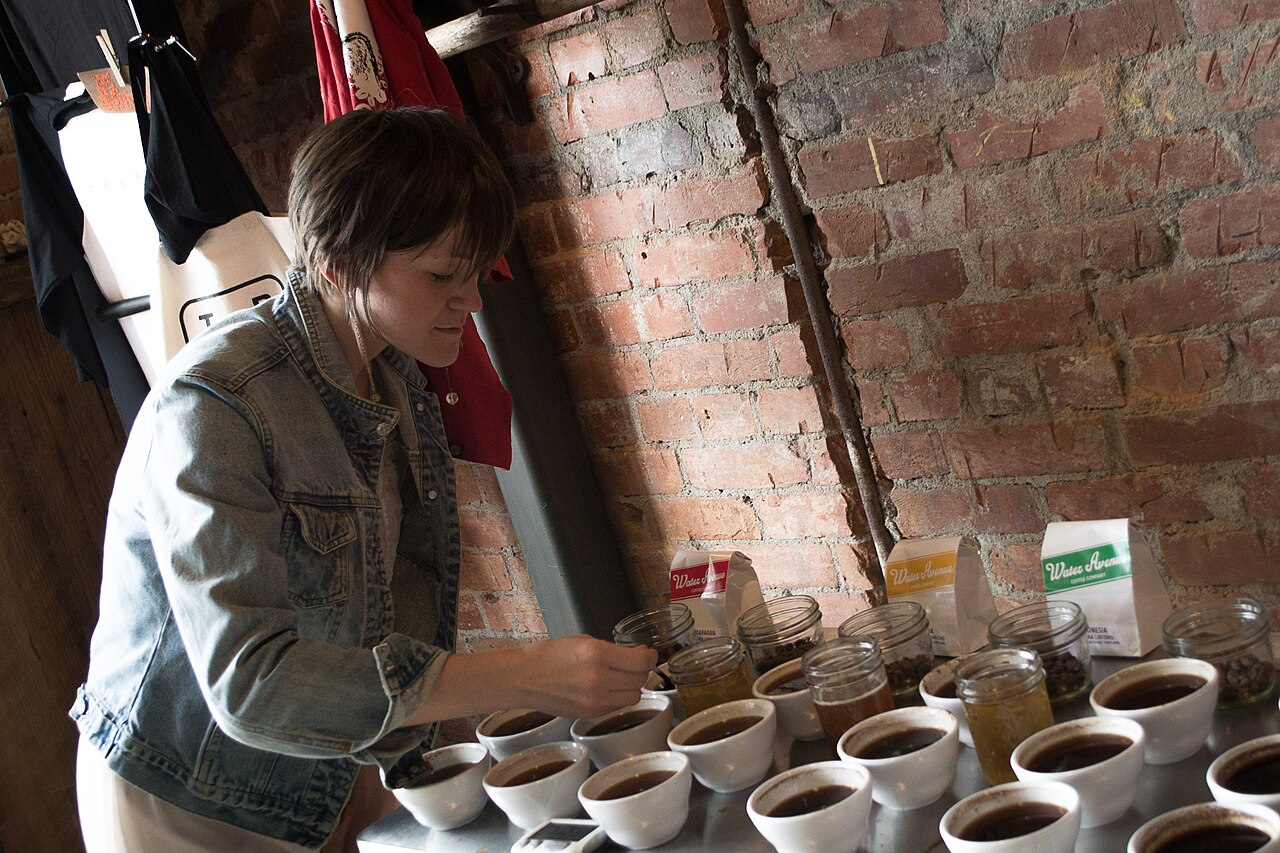
A woman cupping at a brick-walled bar, slurping from a spoon over a row of cupping bowls, with three Water Avenue Coffee Company bags on the counter behind her. Photographed in Portland, Oregon.
Cupping is how the coffee trade tastes coffee, and you can do it at home with equipment you already own. This article covers the home version: what you need, how to run a session, and how to build a vocabulary for what you are tasting.
The professional standard — the full protocol, the scoring form, what replaced it, grading and the Q Grader credential — is covered in the companion article on cupping as a professional method.
Why Cup Instead of Just Brewing
Brewing hides things. Grind size, water temperature, pour technique and filter choice all change the cup, so when you compare two coffees brewed two ways you are comparing the brewing as much as the coffee.
Cupping removes all of it. Same dose, same water, same temperature, same timing, no filter. The coffee is the only variable left. That is the whole point, and it is why cupping is worth doing at home even without a score sheet.
What You Need
Less than people expect.
| Item | What works |
|---|---|
| Vessels | 5 identical cups or glasses, straight-sided, about 200 ml |
| Scale | Any kitchen scale reading to 0.1 g |
| Grinder | A burr grinder, set coarse |
| Kettle | Anything that boils |
| Spoons | 2 deep soup spoons |
| Rinse cup | A glass of hot water for the spoons |
The word "identical" is doing real work in that table. Different cups hold heat differently, and the comparison collapses if one coffee cools faster than another.
A thermometer is useful and not essential. Water off the boil for 30 to 45 seconds lands close to the target.
The Method
These are the parameters of the Specialty Coffee Association's 2004 Cupping Protocol and Form. It has since been superseded as the SCA's own standard — the companion article explains by what — but it remains in wide use, it is what almost every published home guide describes, and it is the right place to start.
| Step | Specification |
|---|---|
| Dose | 8.25 g per cup |
| Water | 150 ml per cup, a ratio of about 1:18 |
| Temperature | 93 °C, 200 °F |
| Cups per coffee | 5 |
| Crust break | at 4 minutes |
Grind, then smell. Grind each coffee fresh into its cup and smell the dry grounds before any water goes in. This is fragrance, and it is a separate thing from aroma.
Pour. 150 ml of water at 93 °C directly onto the grounds, saturating everything. Start a timer.
Wait four minutes. A crust of grounds forms on the surface and traps the aroma underneath.
Break the crust. At four minutes, push the crust back with a spoon — two or three forward strokes — and put your nose close as you do. This is the single best-smelling moment in coffee, and it is the reason for the whole four-minute wait.
Clear the surface. Skim the floating grounds off with two spoons.
Taste when it cools. Around 70 °C is where most tasters start. Slurp sharply from the spoon so the coffee sprays across your whole palate at once. It feels ridiculous and it works.
Taste again as it cools further. Coffee changes as the temperature drops, and some of the most useful information arrives at room temperature. A coffee that is still good cold is telling you something.
Why Five Cups
Five cups of the same coffee is not excess. It is how you catch a defect that is present in some beans and not others.
One tainted cup out of five tells you the lot is inconsistent. A single cup cannot tell you that, because you would either hit the taint or miss it and never know which.
If you are tasting at home purely to compare two coffees, three cups each is workable. Five is the standard because it is the number at which one bad bean reliably shows up.
Watch: How To Cup (Taste) Coffee At Home — James Hoffmann.
Building a Vocabulary
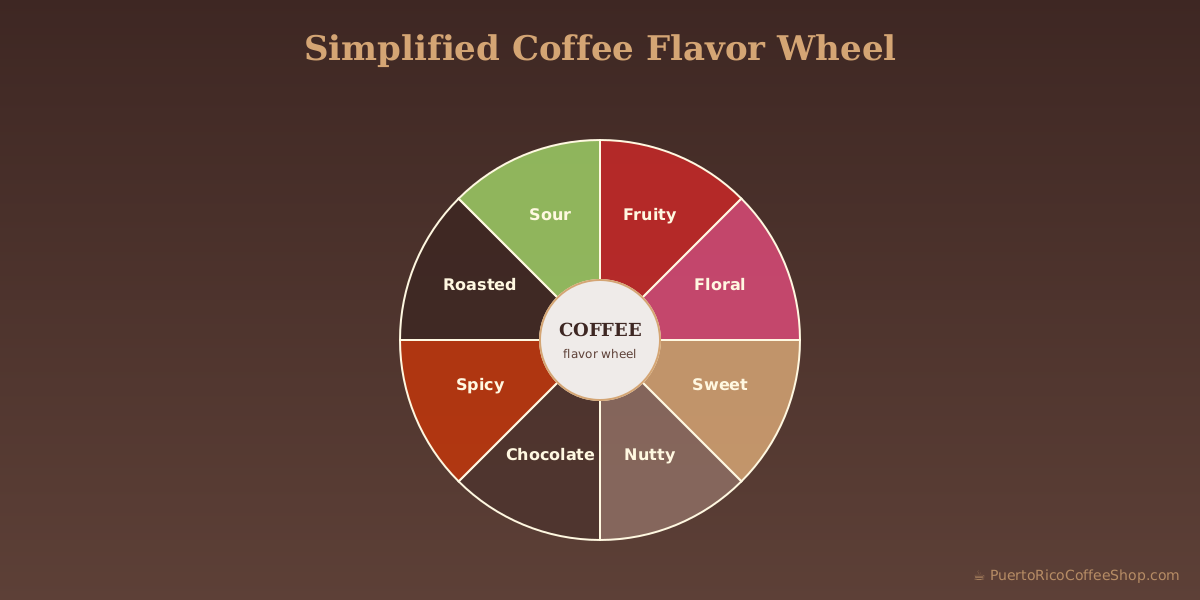
A simplified coffee flavour wheel produced by this encyclopedia. It is not the Specialty Coffee Association flavour wheel.
The hardest part of cupping is not tasting. It is having words for what you taste.
A flavour wheel is a vocabulary tool. You start at the centre with broad categories and work outward to specific ones, so instead of "fruity" you arrive at "dried fruit", and then at "raisin". It does not tell you what is in the cup. It gives you a structured way to name it.
The wheel above is this encyclopedia's own simplified version. The Specialty Coffee Association publishes a far more detailed wheel, developed with World Coffee Research; this is not that wheel and does not reproduce it.
Three things make the difference between tasting and guessing.
Taste side by side. One coffee alone tells you very little. Two coffees together tell you what one has that the other does not, and that is where description starts.
Write it down before you discuss it. If you taste in company, everybody writes first. The first person to say "blueberry" out loud has decided what everyone else tastes.
Keep your notes. The point is not to be right. It is to find out, over months, which of your own descriptors mean something consistent.
What Scores Are For
A cupping score is only meaningful when the assessor and the protocol are both named. A number with neither attached is not a measurement.
For home cupping, scores are mostly beside the point. You are not certifying a lot for purchase. You are finding out which coffee you prefer and why, and a ranked pair of preferences is more useful to you than a number you have no calibration for.
Cupping Puerto Rican Coffee
Puerto Rican coffee is cupped by the same protocol as any other origin. There is nothing distinctive about the method when the coffee is Puerto Rican.
Two claims previously on this page have been removed.
That Puerto Rican coffee cups in the 84 to 88 range. No cupping records supporting this were located. The same claim, at various bands, has now been removed from four articles in this encyclopedia. It kept reappearing because it reads like a fact and is not one.
That Puerto Rican coffee has a distinctive profile — medium-to-full body, balanced acidity, pronounced sweetness, chocolate and caramel — that has made the island famous since the nineteenth century. No sensory data across the origin was located, and no source for the three-century provenance. Origins do not have flavour profiles. Individual lots do, and that is exactly what cupping is for: find out what the coffee in front of you tastes like rather than what an origin is supposed to taste like.
This encyclopedia also previously named a San Juan café and quoted a price for its cupping classes. Live prices date quickly and the figure carried no source, so it has been removed.
Key Facts
- Cupping fixes dose, water, temperature and timing so the coffee is the only variable.
- Home kit: five identical cups, a scale, a burr grinder, a kettle and two spoons.
- 2004 SCA parameters: 8.25 g per cup, 150 ml water, about 1:18, 93 °C, five cups, crust broken at four minutes.
- Smell the dry grounds first — fragrance and aroma are different things.
- Breaking the crust is the best-smelling moment in coffee.
- Taste from about 70 °C and keep tasting as it cools.
- Five cups catches a defect present in only some beans.
- A flavour wheel is a vocabulary tool, not an answer key.
- A score is meaningless without a named assessor and protocol.
Frequently Asked Questions
Do I need special equipment? No. Five identical cups, a scale, a burr grinder, a kettle and two spoons.
Why do I have to slurp? It sprays the coffee across your entire palate at once instead of running it over one part.
Why break the crust at four minutes? The crust traps the aroma while the coffee steeps. Breaking it releases the aroma all at once, with your nose right above it.
Do I need to score the coffee? Not at home. Deciding which of two coffees you prefer, and being able to say why, is more useful than a number you have no calibration for.
Does Puerto Rican coffee have a typical cupping score? No source establishes one. This encyclopedia has withdrawn that claim from four pages.
Is the flavour wheel here the SCA wheel? No. It is this encyclopedia's own simplified version, and it does not reproduce the SCA wheel.
Sources
- Specialty Coffee Association, 2004 Cupping Protocol and Form — the 8.25 g dose, 150 ml of water, the ratio of about 1:18, 93 °C, five cups per sample, the four-minute crust break, the two to three forward strokes, and scoring in 0.25 increments on the legacy form.
- Specialty Coffee Association, Coffee Value Assessment — the standards that superseded the 2004 Cupping Protocol and Form, covered in full in the companion article.
- Specialty Coffee Association and World Coffee Research, the Coffee Taster's Flavor Wheel — the published professional wheel, referenced here and not reproduced.
- Coffee Quality Institute — the Q Grader credential and its examinations, covered in the companion article.
Claims this encyclopedia could not source
- That Puerto Rican coffee cups in the 84 to 88 range. No cupping records located. Withdrawn from four articles in this encyclopedia.
- That Puerto Rican coffee has a distinctive cupping profile as an origin. No sensory data across the origin located.
- That Puerto Rican coffee has been famous for that profile since the nineteenth century, or for nearly three centuries. Neither provenance claim could be traced.
- A price for cupping classes at any named business. Removed; live prices date quickly and the figure was unsourced.
- That a particular video is the most-watched primer on the SCA cupping protocol for non-professionals. An authored superlative previously stored as part of the video's title; nothing establishes it.
- A specific score for any named Geisha lot. Used previously as an illustration, unsourced.
Related Articles
- The Coffee Flavor Wheel: A Complete Guide
- Coffee Roasting: From Green to Brown
- Coffee Processing: Washed, Natural, and Honey
- What is Coffea Arabica? The Noble Coffee Species
- Coffee Grinders: Burr vs Blade — The Complete Buying Guide
- Water Chemistry for Coffee Brewing: The Complete Guide
- Cafés of San Juan: A Coffee Shop Tour of Puerto Rico's Capital
Taste Authentic Puerto Rico Coffee
The proof of any cupping protocol is in the cup. Coffee grown in Puerto Rico's central mountains, roasted on the island.
BUY AUTHENTIC PUERTO RICO COFFEE NOW →
Freshly roasted, shipped worldwide. The real taste of Boricua heritage in every cup.
Part of The Coffee Encyclopedia — the world's largest free coffee reference. Proudly sponsored by PuertoRicoCoffeeShop.com.