
Limaní and Frontón: Two Rust-Resistant Coffees Selected in Puerto Rico
Limaní and Frontón are two coffee varieties selected in Puerto Rico for resistance to coffee leaf rust. Both came from crosses made outside the island, and both reached Puerto Rico from Brazil in 1982. They were selected by the Agricultural Experiment Station of the University of Puerto Rico at its substation in Adjuntas. This article sets out where they came from, how they differ, what is recommended for growing them, and why pure seed matters.
Why Rust Resistance Mattered
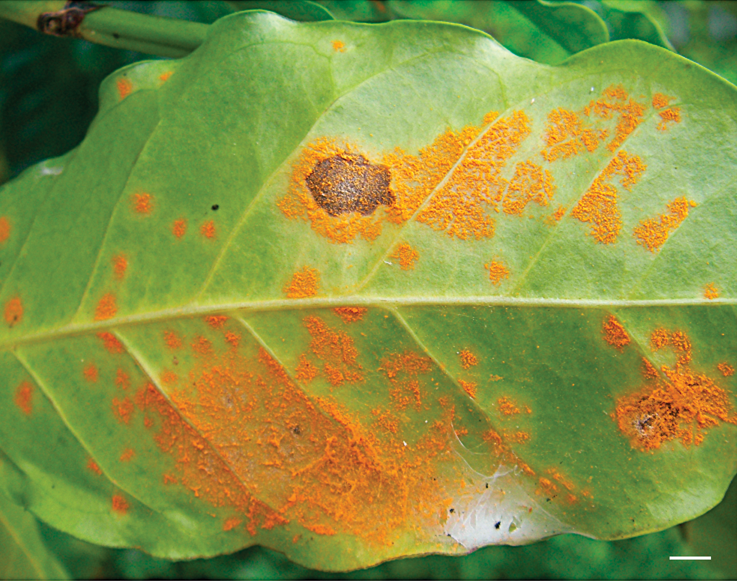
The underside of a coffee leaf with the orange pustules of coffee leaf rust, Hemileia vastatrix, and a scale bar at the lower right. Photo: Carvalho et al. / Wikimedia Commons, CC BY 2.5.
Coffee leaf rust, Hemileia vastatrix, is a fungus that makes coffee plants lose their leaves and reduces the quantity and quality of their fruit. It was described in 1869 in eastern Africa and Ceylon, and soon after its first report it wiped out coffee cultivation in Ceylon, now Sri Lanka. In the Americas it was first reported in Brazil, in 1970. It was detected in Puerto Rico in February 1989, with the first record at Las Marías.
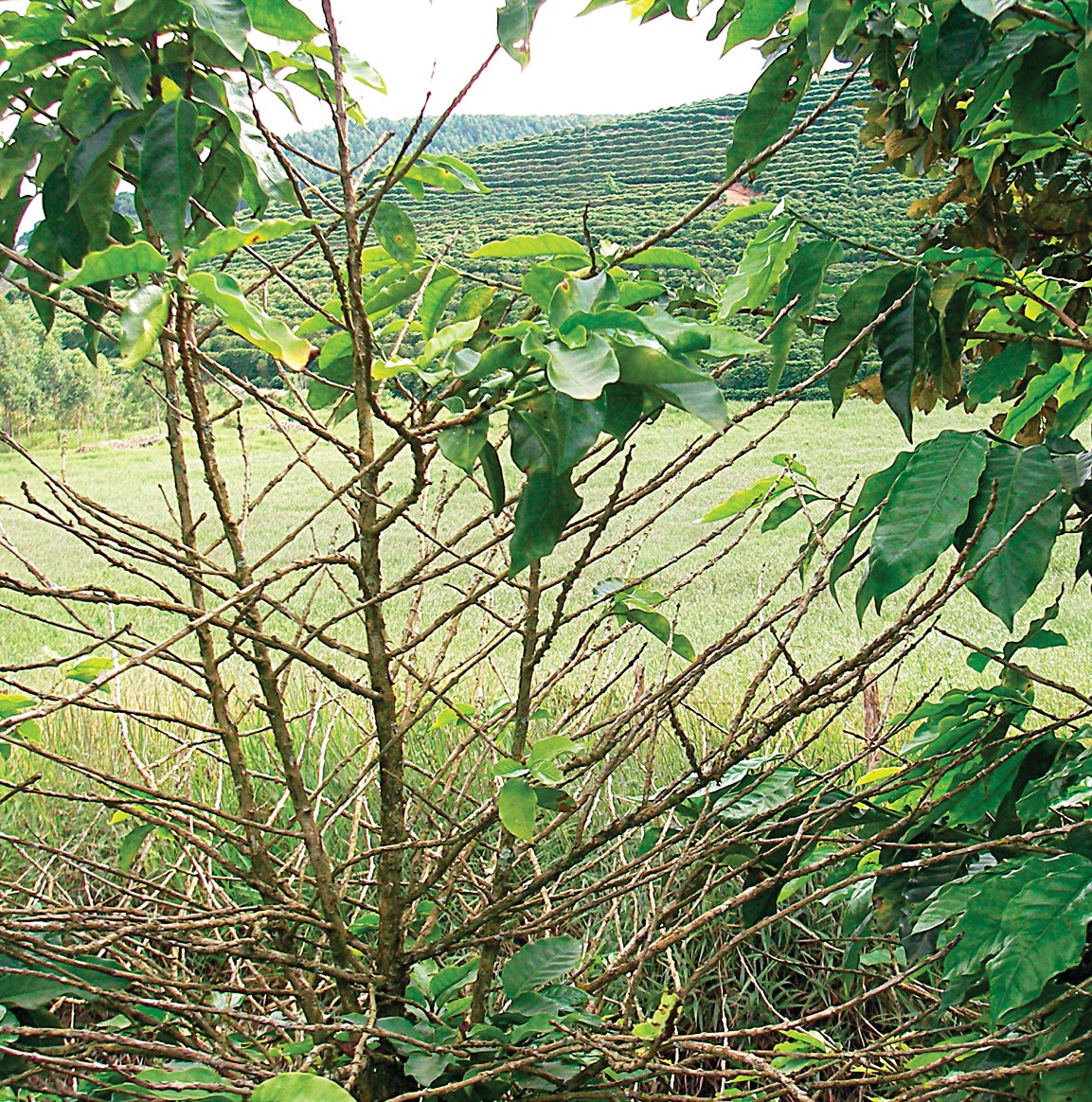
Defoliation caused by coffee leaf rust in a coffee plantation, Coimbra, Minas Gerais, Brazil. Photo: Carvalho et al. / Wikimedia Commons, CC BY 2.5.
Typica, Bourbon and Caturra, all commonly grown in Puerto Rico, are rated by World Coffee Research as having low resistance to coffee leaf rust or as susceptible to it.
Where the Work Was Done
The Agricultural Experiment Station belongs to the College of Agricultural Sciences of the University of Puerto Rico at Mayagüez. At its substation in Adjuntas it kept a collection of coffee varieties and lines obtained from the Instituto Agronômico de Campinas in Brazil. In 1982 the Campinas institute provided Puerto Rico, through the station, with Limaní and Frontón, two varieties resistant to coffee leaf rust. The rust-resistant material was therefore on the island seven years before the disease was detected. After the rust was detected, the station examined promising lines from its Adjuntas collection for resistance. Lines of the Catimor and Sarchimor types were chosen for their reaction to rust and their agronomic qualities, and were named Frontón and Limaní respectively. World Coffee Research's 2019 account says the two were developed by breeders on the island in the 1970s and 1980s, while its variety catalogue records both as populations introduced from Brazil and selected in Puerto Rico. The Adjuntas substation lies in Limaní barrio; the station's web page spells the name "Lamani". Frontón is also the name of a barrio, in the municipality of Ciales. For the town and its coffee, see Adjuntas: Coffee in the Switzerland of Puerto Rico.
| Year | Event |
|---|---|
| 1869 | Coffee leaf rust described in eastern Africa and Ceylon |
| 1970 | Rust first reported in the Americas, in Brazil |
| 1982 | Limaní and Frontón provided to Puerto Rico from Campinas, Brazil |
| 1989 | Rust detected in Puerto Rico, in February |
| 1994 | Limaní released to farmers |
Limaní
Limaní is a Sarchimor, a cross between Timor Hybrid 832/2 and Villa Sarchi. The Timor Hybrid is a natural cross between Arabica and Robusta coffee that appeared on the island of Timor in the 1920s, and it is the source of the rust resistance. The Coffee Rust Research Centre (CIFC) in Portugal received Timor Hybrid seeds in 1958 or 1959, and breeders in Portugal began work on rust-resistant varieties in 1967. A cross of the rust-resistant Timor Hybrid plant HDT CIFC 832/2 with the compact variety Villa Sarchi produced hybrid 361, which was dubbed "Sarchimor". World Coffee Research records Limaní as a pedigree selection from a population that came from Brazil, made by the Estación Experimental Agrícola in Puerto Rico. It was released to farmers on the island in 1994, after evaluations showed resistance to coffee leaf rust and high yield potential. The station's handbook describes Limaní as semi-dwarf and resistant to rust, with good cup quality.
Frontón
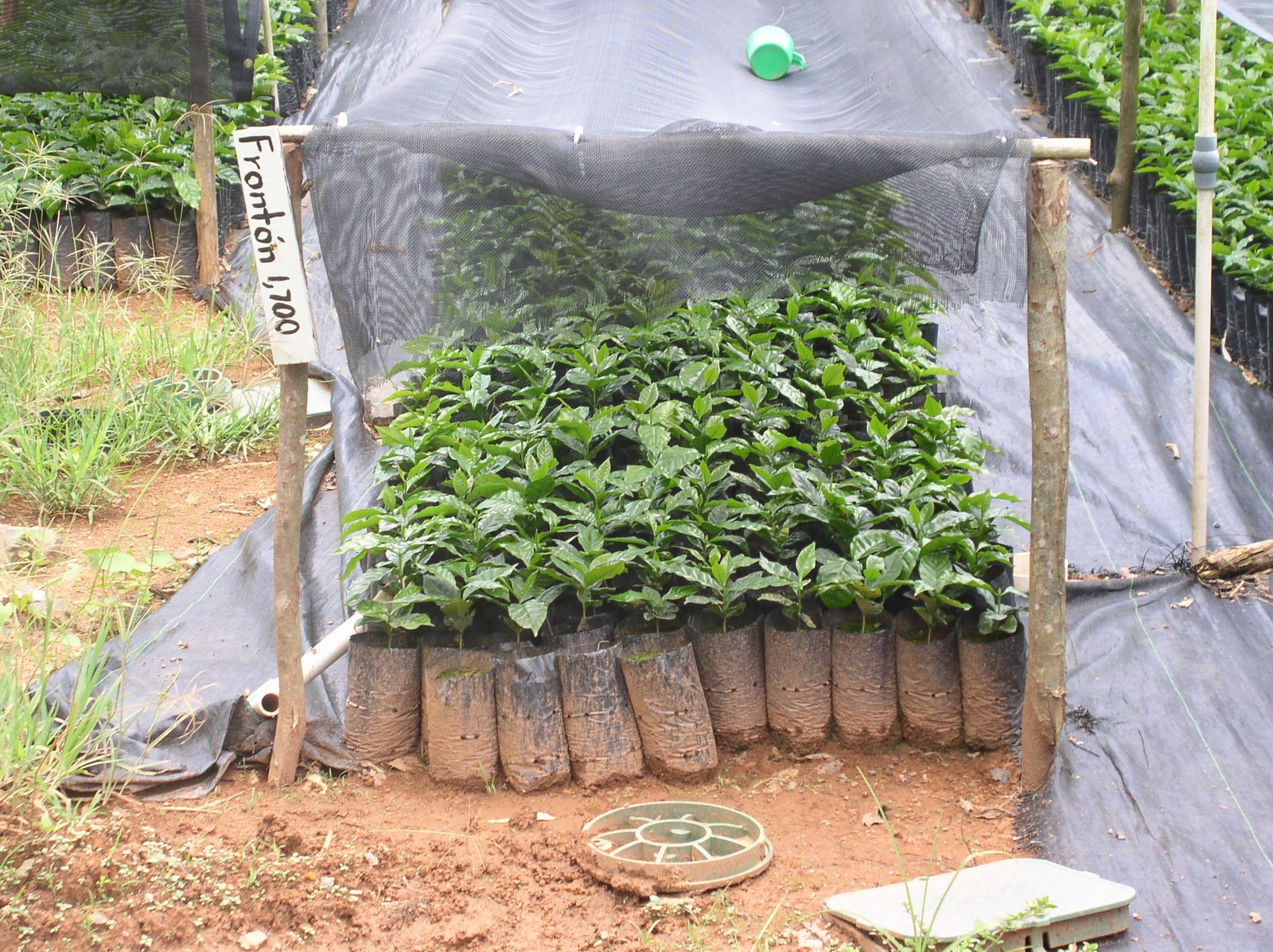
Coffee seedlings in a nursery bed under shade netting in Puerto Rico, with a hand-lettered stake reading Frontón. Photo: USDA / Wikimedia Commons, public domain.
Frontón is a Catimor, a cross between Timor Hybrid and Caturra. The cross was introduced to Puerto Rico from the Instituto Agronômico de Campinas in Brazil, and the selection was made by the Estación Experimental Agrícola at Adjuntas. World Coffee Research describes Frontón as an early-producing, high-yielding plant found primarily in Puerto Rico. It also records that the variety is not uniform, showing some segregation in the field, and that it is susceptible to the coffee leaf miner. The station's handbook describes Frontón as resistant to rust, with good coffee quality.
Growing Them
Both varieties are compact, and both are used in Puerto Rico for sun-grown coffee. The Puerto Rico Department of Agriculture's promotion of them followed earlier policies, subsidies and incentives supporting sun coffee, high-density planting and maximum yields. World Coffee Research rates both as having intermediate resistance to coffee leaf rust.
The University of Puerto Rico's station recommends planting both varieties above 1,000 feet (about 300 metres) above sea level. Its handbook says that coffee in Puerto Rico has traditionally been grown between 500 and 3,000 feet, and that the most suitable area for planting lies between 1,500 and 3,000 feet. World Coffee Research's variety catalogue rates both varieties as best suited to low and medium altitudes, and notes that the optimal altitude depends on a farm's latitude. The same catalogue's history of Limaní states that it was recommended for altitudes above 1,000 metres when it was released. The two recommendations use the same number in different units: 1,000 feet is about 300 metres, and 1,000 metres is about 3,280 feet. A recommendation of 1,000 metres would lie above the whole 500 to 3,000 feet range that the station describes as traditional for coffee in Puerto Rico. This encyclopedia gives the station's figure as the recommendation for Puerto Rico, because the station made the selections. The station's coffee handbook and the Agricultural Extension Service's coffee guide are published online by the University of Puerto Rico at Mayagüez and are listed under Sources.
The video below, from the Revivamos Nuestro Café - TechnoServe channel, is in Spanish. It describes the coffee varieties most commonly distributed in Puerto Rico, and its description calls Limaní rust resistant and well adapted to low and medium altitudes.
Watch: Variedades de Cafe en Puerto Rico — Revivamos Nuestro Café - TechnoServe
The Seed Problem
World Coffee Research states that true Limaní is very difficult to find, because of problems with genetic traceability dating back to its original release in Puerto Rico. It adds that plants identified as Limaní rarely match the original reference. This does not necessarily mean that such plants perform badly, but their performance, including their resistance to coffee leaf rust, is difficult to predict. In 2017, DNA sampling of seed lots found that Limaní and Frontón were no longer genetically pure. Some Frontón lots included plants that had crossed with other varieties, and the Limaní seed lot was mostly a genetic blend. World Coffee Research reported that this mixing and genetic erosion had also led to a breakdown of rust resistance in the local varieties.
In 2019, with support from the Hispanic Federation, World Coffee Research announced a two-year project to rescue the two varieties. It planned to use genetic testing to identify true-to-type trees on farms across the island, to re-establish genetically pure seed gardens, and to train local farmers to protect the trees from cross-pollination. In 2020 its seed programme reported sampling seed sources in Puerto Rico, among other countries. A 2021 master's thesis at the University of Puerto Rico at Mayagüez studied the genetic diversity and rust-resistance genes of Limaní and Frontón. It states that assessing the genetic diversity and stability of the station's collections of the two varieties is compulsory before certified seed is distributed. The Hispanic Federation's five-year report of September 2022 says the initiative established new seed lots to safeguard the purity of future local arabica varieties. For a farmer, the practical point is that seeds or seedlings sold as Limaní or Frontón may not carry the rust resistance the names suggest.
Replanting After María
In October 2018 the Hispanic Federation launched a coffee initiative in Puerto Rico, whose founding partners included Nespresso, the Rockefeller Foundation, TechnoServe and World Coffee Research. By September 2022 the initiative reported more than two million seedlings distributed to 1,139 smallholder farmers in 54 municipalities. The Puerto Rico Department of Agriculture supported the donation of two million seeds of Frontón and Limaní. The Inter-American Institute for Cooperation on Agriculture reports that, as of January 2020, the Department had distributed Limaní, Frontón and Marsellesa trees through its coffee recovery programme, without data on the share of each variety. It also reports that the Starbucks Foundation contributed $470,000 and two million seedlings of the Marsellesa variety, with World Coffee Research conducting genetic testing.
In the Cup
The station's handbook rates the cup quality of both Limaní and Frontón as good. No published cupping study comparing the two was located for this article.
Key Facts
- Limaní: a Sarchimor (Timor Hybrid 832/2 × Villa Sarchi), selected in Puerto Rico and released to farmers in 1994.
- Frontón: a Catimor (Timor Hybrid × Caturra), introduced from Campinas, Brazil, and selected at Adjuntas.
- The material for both reached Puerto Rico from Brazil in 1982; coffee leaf rust was detected on the island in February 1989.
- World Coffee Research rates both as compact, with intermediate resistance to coffee leaf rust.
- The University of Puerto Rico's station recommends planting both above 1,000 feet (about 300 metres).
- DNA sampling in 2017 found Puerto Rico's Limaní and Frontón seed lots no longer genetically pure.
- The Hispanic Federation's initiative reported more than two million seedlings distributed to 1,139 farmers by September 2022.
Frequently Asked Questions
Were Limaní and Frontón bred in Puerto Rico? They were selected in Puerto Rico from material that came from Brazil in 1982. The crosses behind them were made before the material reached the island.
Are they resistant to coffee leaf rust? They were selected for rust resistance, and World Coffee Research rates Limaní and Frontón as having intermediate resistance. Trees sold under their names may not carry that resistance, because the island's seed lots were found to be mixed.
At what altitude should they be planted? The University of Puerto Rico's station recommends planting both above 1,000 feet (about 300 metres). World Coffee Research's catalogue rates both as suited to low and medium altitudes.
What do they taste like? The station's handbook rates the cup quality of both as good. No published cupping study comparing them was located for this article.
Are they grown only in Puerto Rico? World Coffee Research describes Frontón as found primarily in Puerto Rico and Limaní as an elusive Puerto Rican variety. No record of commercial planting outside Puerto Rico was located for this article.
Sources
- World Coffee Research, variety catalogue: Limani, Fronton, T5296, Typica, Bourbon and Caturra. Parentage; selection and release; altitude ratings and Limaní's release recommendation; rust resistance and stature; Frontón's segregation and leaf-miner susceptibility; the traceability of true Limaní; the Timor Hybrid and the Sarchimor history.
- World Coffee Research (22 October 2019). Coffee against the odds. The 2017 DNA sampling of seed lots; the breakdown of rust resistance; the project to rescue Limaní and Frontón; the account of their development in the 1970s and 1980s.
- World Coffee Research (2 September 2020). It starts with a seed—but what seed is it?. Seed sources sampled in Puerto Rico in 2020.
- Rodríguez, R. del P., González, W. and Bosques, O. (2020). Identificación de líneas interespecíficas de cafetos con resistencia a Hemileia vastatrix Berk. et Br. y adaptabilidad a la región cafetalera de Puerto Rico. Journal of Agriculture of the University of Puerto Rico 104(2): 165–180. Rust detected in February 1989; the Adjuntas collection from Campinas; the selection and naming of Frontón and Limaní; rust's effect on leaves and fruit.
- Badillo Chico, P. N. (2021). "Evaluation of genetic diversity and resistance genes of two rust-resistant coffee varieties, Limani and Fronton" (archived copy, 13 April 2026). M.S. thesis, University of Puerto Rico at Mayagüez (abstract). The 1982 introduction from Campinas; the assessment required for certified seed.
- University of Puerto Rico, College of Agricultural Sciences, Agricultural Experiment Station (2018). Conjunto Tecnológico para la Producción de Café, Publicación 104. Cup quality, stature and rust resistance of Limaní and Frontón; planting above 1,000 feet; the altitude range for coffee in Puerto Rico.
- Monroig, M. (1999). Manual para una Caficultura Sostenible en Puerto Rico. University of Puerto Rico Agricultural Extension Service. The varieties commonly grown in Puerto Rico.
- Ramos, J. Guía Práctica para la Producción del Café. University of Puerto Rico. Planting Limaní above 1,000 feet.
- University of Puerto Rico at Mayagüez, Agricultural Experiment Station. Estaciones Experimentales Agrícolas. The Adjuntas substation's address.
- U.S. Census Bureau. 2024 Gazetteer Files: county subdivisions, Puerto Rico. Limaní barrio of Adjuntas and Frontón barrio of Ciales.
- Talhinhas, P. et al. (2017). The coffee leaf rust pathogen Hemileia vastatrix: one and a half centuries around the tropics. Molecular Plant Pathology 18(8): 1039–1051. The 1869 description; Ceylon; the first report in Brazil in 1970.
- EPPO Global Database. Hemileia vastatrix (HEMIVA): Distribution details in Puerto Rico. The first record at Las Marías, 1989.
- Walker, J. (16 August 2022). "Coffee in Recovery: Lessons in policymaking and collaboration from Puerto Rico's coffee sector post-Hurricane Maria" (archived copy, 11 December 2024). IICA Blog. Compact cultivars for sun coffee; the Department of Agriculture's policies and seed donation; the varieties distributed by January 2020; the Marsellesa donation.
- Hispanic Federation (24 October 2018). Hispanic Federation Launches Coffee Development Initiative in Puerto Rico with $1 Million Lead Commitment. The founding partners.
- Hispanic Federation (14 September 2022). Hispanic Federation, Lin-Manuel Miranda Announce Coffee Production in Puerto Rico. Seedlings distributed to 1,139 farmers.
- Hispanic Federation (September 2022). Building a Stronger and More Resilient Puerto Rico. The 54 municipalities; the new seed lots.
- Revivamos Nuestro Café - TechnoServe, "Variedades de Cafe en Puerto Rico" (YouTube, 20 January 2021), embedded above. Its description of Limaní's adaptation to low and medium altitudes.
Claims this encyclopedia could not source
- That the Adjuntas substation was founded in 1952. No source for the year was located.
- That Limaní and Frontón are named after Limaní barrio of Adjuntas and Frontón barrio of Ciales. Both barrios exist, and the TechnoServe video's description links each variety's testing to its barrio, but no source located states the naming.
- That pure Limaní and Frontón seed has since been confirmed and certified seed re-established. The 2019 rescue project was announced and new seed lots were reported in 2022, but no document located confirms pure seed of the two varieties.
- A current source of certified Limaní or Frontón seed for farmers. None was located.
- Flavour profiles for Limaní or Frontón, and that Frontón has more body than Limaní. No published cupping study was located.
- That Limaní and Frontón are grown nowhere outside Puerto Rico. No record of commercial planting elsewhere was located, which is not proof that none exists.
Related Articles
- What is Coffea Arabica? The Noble Coffee Species
- The Bourbon Coffee Variety: Origins, Flavor, and Legacy
- The Typica Coffee Variety: The Original Arabica Cultivar
- Adjuntas: Coffee in the Switzerland of Puerto Rico
- Puerto Rico Coffee Today: The 2026 State of the Industry
- Yauco: Puerto Rico's Crown Coffee Region
- Puerto Rico Coffee Renaissance (1950-Present)
Buy Authentic Puerto Rico Coffee
Taste Puerto Rico's own coffee varieties. Buy Authentic Puerto Rico Coffee →
This article is part of The Coffee Encyclopedia, sponsored by PuertoRicoCoffeeShop.com — the trusted source for authentic Puerto Rican coffee.