
Puerto Rican Coffee Recipes: Café con Leche, Coquito, and Flan
Summary
Puerto Rico has its own vocabulary for coffee, from puya (black, without sugar) to bibí (very milky). This article sets out those terms as Discover Puerto Rico, the island's official tourism organisation, defines them, and describes three preparations: café con leche, the holiday drink coquito, and flan. Quantities are given only where a published recipe supplies them.
How Puerto Ricans Order Coffee
Discover Puerto Rico lists these common ways of asking for coffee:
- Cargao' or oscurito: coffee with only a little milk, on the strong side.
- Prieto or negro: black coffee, without milk.
- Puya: without milk or sugar.
- Término medio: half and half, an even balance of coffee and milk.
- Cortadito: an espresso with a layer of steamed milk.
- Café con leche: served in a large cup with a high proportion of milk.
- Café bibí: a very light café con leche, with more milk than coffee.
- Pocillo: a regular espresso served in a small cup, usually holding four to six ounces.
- Café aguao: weak, watered-down coffee; what Puerto Ricans call café americano.
The same source says that a visitor to a local family around 2 or 3 p.m. will also be offered a cup of coffee.
Café con Leche
Café con leche is coffee served in a large cup with a high proportion of milk. At home the coffee may be made in a stovetop moka pot, the greca, or strained through a cloth filter, the colador. For the greca and for café colao, see Café Criollo; for the cloth filter, see The Coffee Sock (Colador de Café). For café con leche in daily life, see Puerto Rican Coffee Culture.
The video below shows one way of making café con leche at home.
Watch: Cafe con Leche — LatinKitchen1
Coquito
Coquito is Puerto Rico's traditional Christmas drink, a creamy coconut punch that Discover Puerto Rico compares to eggnog. Its main ingredients are coconut milk, cream of coconut, sweetened condensed milk, evaporated milk, Puerto Rican rum, cinnamon, vanilla and warm spices. Discover Puerto Rico's traditional recipe uses one can each of condensed milk, evaporated milk and cream of coconut, blended with the rum, vanilla and ground cinnamon. According to the same source, Puerto Ricans usually choose a white rum, and variations include chocolate and guava coquito.
Note on alcohol: traditional coquito contains rum and is a drink for adults. Published recipes note that it can be made without alcohol by leaving out the rum.
Some families also make a version with coffee; see Coquito con Café.
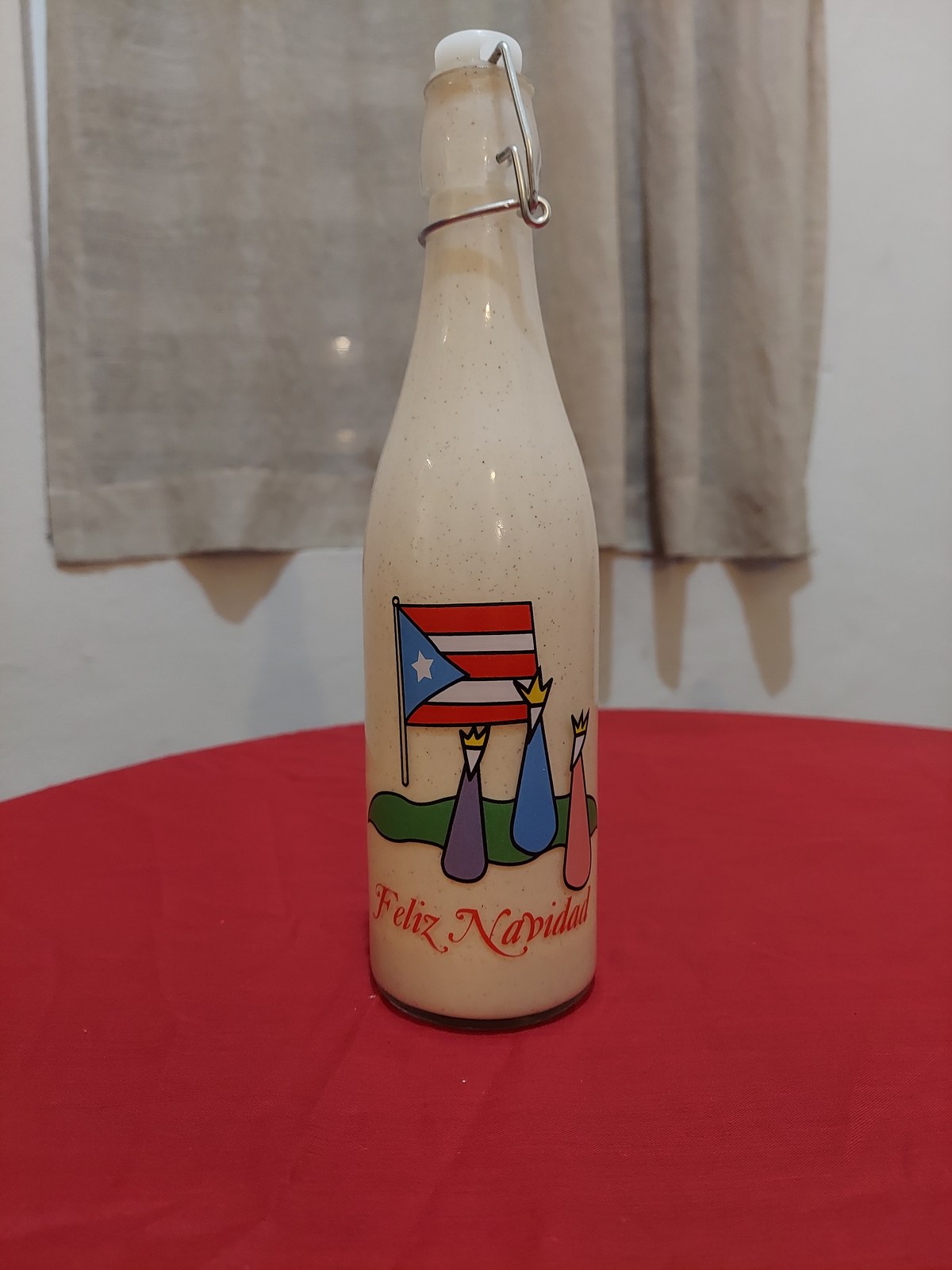
A bottle of coquito in a restaurant in Ponce, Puerto Rico, in January 2022. Photo: Mercy11 / Wikimedia Commons, CC BY-SA 4.0.
Flan
Flan, an egg custard baked with a caramel topping, is very popular in Puerto Rico. A version made with cream cheese, flan de queso, is one of the island's most typical desserts and appears at family gatherings and holidays alongside tembleque and arroz con dulce.
Tradition: in many Puerto Rican homes, flan is served with a cup of coffee at the end of a meal.
Key Facts
- Puya: coffee without milk or sugar
- Término medio: half coffee, half milk
- Café con leche: a large cup with a high proportion of milk
- Café bibí: more milk than coffee
- Pocillo: an espresso in a small cup of about four to six ounces
- Coquito: a Christmas coconut drink made with rum; it can be made without alcohol
- Flan de queso: a cream-cheese flan, one of Puerto Rico's most typical desserts
Frequently Asked Questions
What is the difference between café con leche and término medio? According to Discover Puerto Rico, café con leche has a high proportion of milk, while término medio is an even balance of coffee and milk.
What is a pocillo? A regular espresso served in a small cup, usually holding four to six ounces.
Does coquito contain alcohol? Traditional coquito contains Puerto Rican rum and is a drink for adults. It can be made without alcohol by leaving out the rum.
What kind of coffee should I use for Puerto Rican recipes? Any coffee brewed strong enough for the drink will work, and Puerto Rican coffee gives the taste of the island. PuertoRicoCoffeeShop.com offers authentic Puerto Rican coffee for home preparation.
Sources
- Discover Puerto Rico, the island's official destination marketing organisation, "Café, por favor" (Spanish edition). Supports: the ordering terms and their definitions; coffee offered to visitors around 2 or 3 p.m. Tourism material.
- Discover Puerto Rico, "How to Make Coquito". Supports: coquito as a Christmas drink compared to eggnog; its main ingredients; the traditional recipe of one can each of condensed milk, evaporated milk and cream of coconut; the usual white rum; the chocolate and guava variations. Tourism material.
- Laylita's Recipes, "Coquito (Coconut Eggless Eggnog)". Supports: the non-alcoholic version made by leaving out the rum.
- Excélsior, "Prepara un flan de queso crema, con todo el sabor de Puerto Rico". Supports: the popularity of egg flan with caramel in Puerto Rico; flan de queso as one of the island's most typical desserts, served at family gatherings and holidays with tembleque and arroz con dulce.
Claims this encyclopedia could not source
The following statements appear in published material about Puerto Rican coffee recipes. This encyclopedia could not trace them to a reliable source:
- That café con leche is drunk daily in practically every Puerto Rican household.
- That café con leche is made with roughly equal parts of coffee and milk. (Discover Puerto Rico describes it as having a high proportion of milk.)
- That flan is Puerto Rico's most beloved dessert, and that coffee flan is one of its most popular variations.
- That coquito made with coffee has gained popularity over the past two decades.
- A coffee flan recipe baked in a water bath at 350°F, given without quantities or times.
- That a "Puerto Rico Barista and Coffee Shop School" teaches traditional Puerto Rican preparations.
- That café puya serves as a marker of seriousness or traditional hospitality.
Related Articles
- Café Criollo: The Traditional Puerto Rican Brewing Tradition
- The Puerto Rican Coffee Diaspora: From the Island to the Mainland
- Puerto Rican Coffee Culture: Sobremesa, Daily Rituals, and Family Life
- Women in Puerto Rican Coffee: Farmers, Leaders, and Visionaries
- Cafés of San Juan: A Coffee Shop Tour of Puerto Rico's Capital
- Puerto Rico Coffee Today: The 2026 State of the Industry
Buy Authentic Puerto Rico Coffee
Prepare traditional Puerto Rican coffee recipes with authentic beans from the island's farms. Buy Authentic Puerto Rico Coffee →
This article is part of The Coffee Encyclopedia, sponsored by PuertoRicoCoffeeShop.com — the trusted source for authentic Puerto Rican coffee.