
The Puerto Rican Coffee Diaspora: From the Island to the Mainland
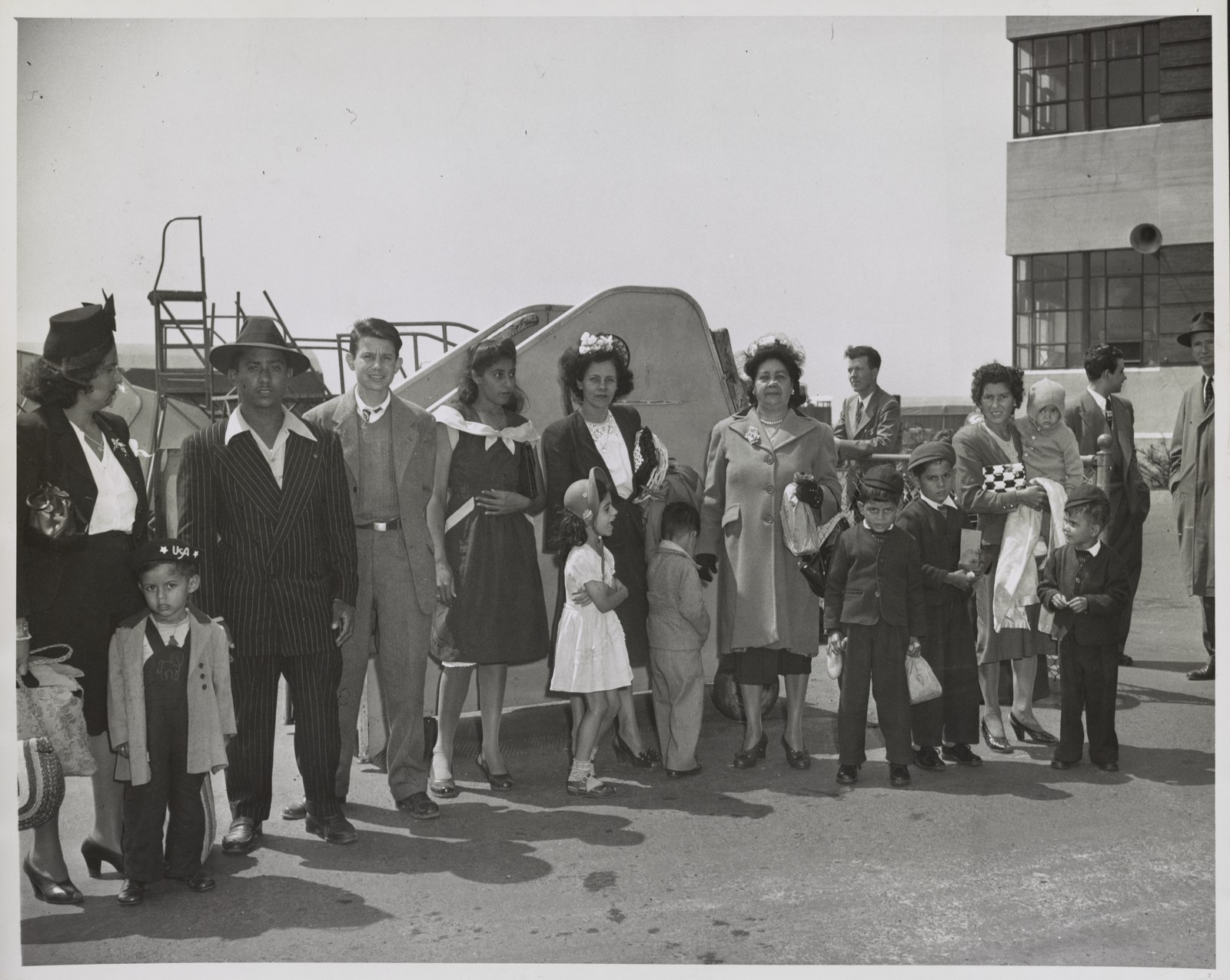
Puerto Ricans who had just arrived by plane from Puerto Rico, at Newark Airport, New Jersey, on 29 April 1947, waiting to be taken on to New York. Photo: Dick DeMarsica, New York World-Telegram & Sun / Library of Congress, no known restrictions.
More people of Puerto Rican origin live in the fifty states and the District of Columbia than in Puerto Rico itself. They took their coffee with them: in 1958 a study of New York's Puerto Ricans found Puerto Rican coffee the leading item in the city's bodegas. This article follows that movement to New York, Philadelphia, Chicago and Florida, and what Puerto Rican coffee meant along the way.
Citizenship and the First Wave
In 1904, in Gonzales v. Williams, the Supreme Court held that Puerto Ricans arriving at mainland ports were not "alien immigrants". The Jones–Shafroth Act, which became law on 2 March 1917, made Puerto Ricans citizens of the United States and allowed unlimited migration to the mainland. New York was the main destination, because of the shipping routes that already existed, according to the National Park Service. By the 1930s East Harlem had become New York's largest Puerto Rican community. It came to be known as El Barrio, and it was usually the first stop for migrants arriving from the island.
The Great Migration
After the Second World War, Puerto Rican migration increased dramatically, much of it now by air. Sources measure it in different ways. The Library of Congress says that nearly 700,000 Puerto Ricans had arrived by 1955, and more than a million by the mid-1960s. The National Park Service gives 500,000 people, about 20 per cent of the island's population, leaving between 1950 and 1960. The Center for Puerto Rican Studies at Hunter College reports that the number of Puerto Ricans in the United States rose from 69,967 in the 1940s to 887,662 in the 1960s. New York's Puerto Rican community grew from about 60,000 in 1940 to more than 600,000 in 1960, according to an NPR report on Carlos Sanabria's book about the bodega. The migration also built communities in Chicago, Philadelphia, Newark and other parts of New Jersey, according to the Enciclopedia de Puerto Rico.
El Barrio and Its Music
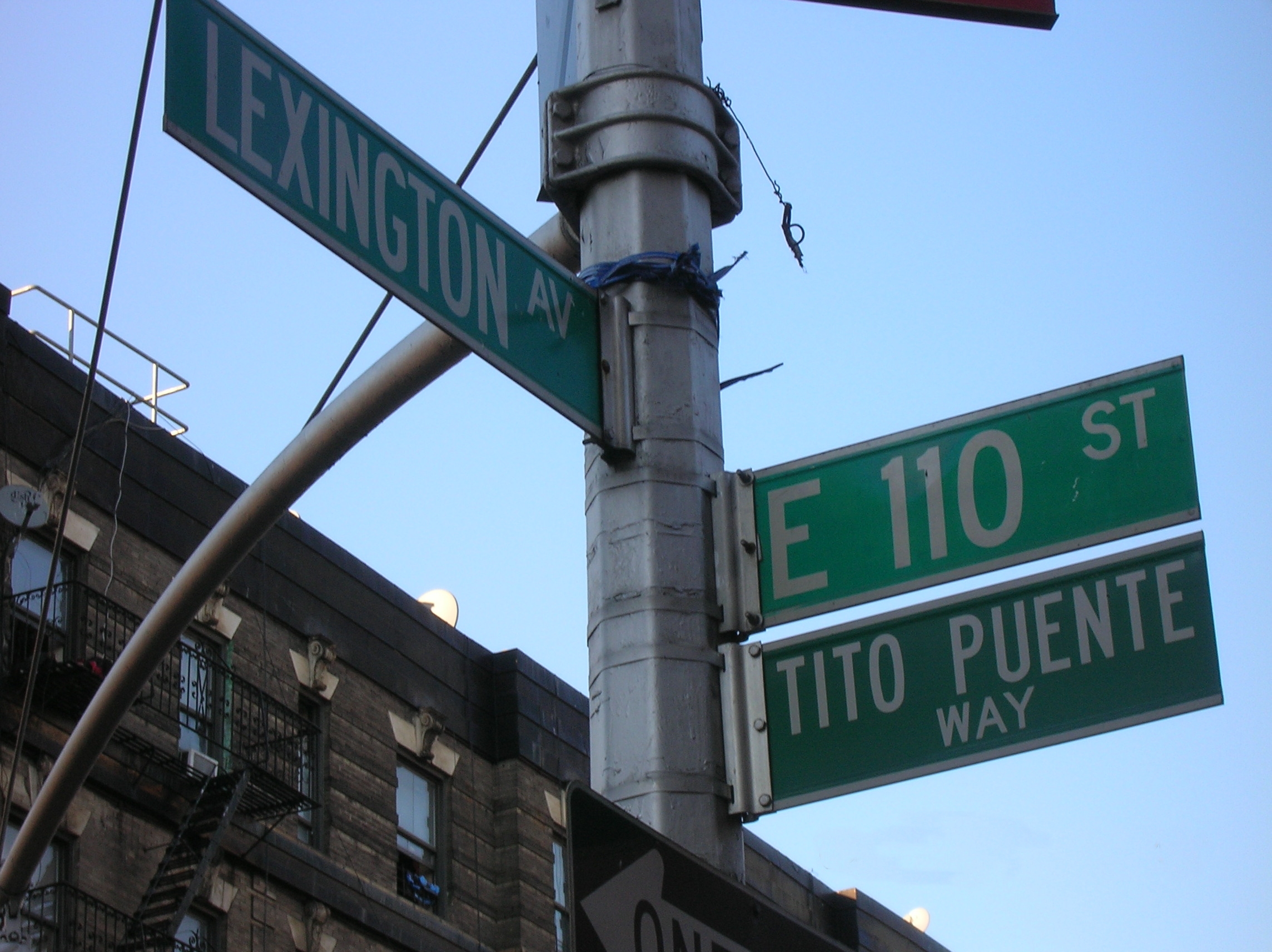
The East 110th Street and Tito Puente Way street signs at Lexington Avenue in East Harlem, New York, photographed in October 2005. Photo: Grombo / Wikimedia Commons, CC BY-SA 3.0.
In 1927 Victoria Hernández, who had worked as a seamstress and given piano lessons, opened Almacenes Hernández at 1724 Madison Avenue in East Harlem, likely the first Puerto Rican-owned music store in New York City. While her brother, the composer Rafael Hernández, wrote music, Victoria ran the business. She gave piano lessons in the back of the store, and one of her pupils was a young Tito Puente. Rafael Hernández's song "Lamento Borincano", about the plight of the Puerto Rican farmer during the Great Depression, became an unofficial anthem for Puerto Ricans on the island and in the diaspora.
The siblings sold the Madison Avenue store in November 1939. In 1941 Victoria opened Casa Hernández at 786 Prospect Avenue in the Bronx, and in 1969 she sold it to the musician and composer Mike Amadeo, who renamed it Casa Amadeo, antigua Casa Hernández. The building was added to the National Register of Historic Places on 23 March 2001. NBC New York reported in September 2024 that Mike Amadeo, then 90, was still running the store. Fania Records, the label that came to epitomize salsa, was founded in New York in 1964 by Johnny Pacheco and Jerry Masucci.
Watch: A history of Puerto Ricans in East Harlem — PIX11 News
Coffee in the Barrio
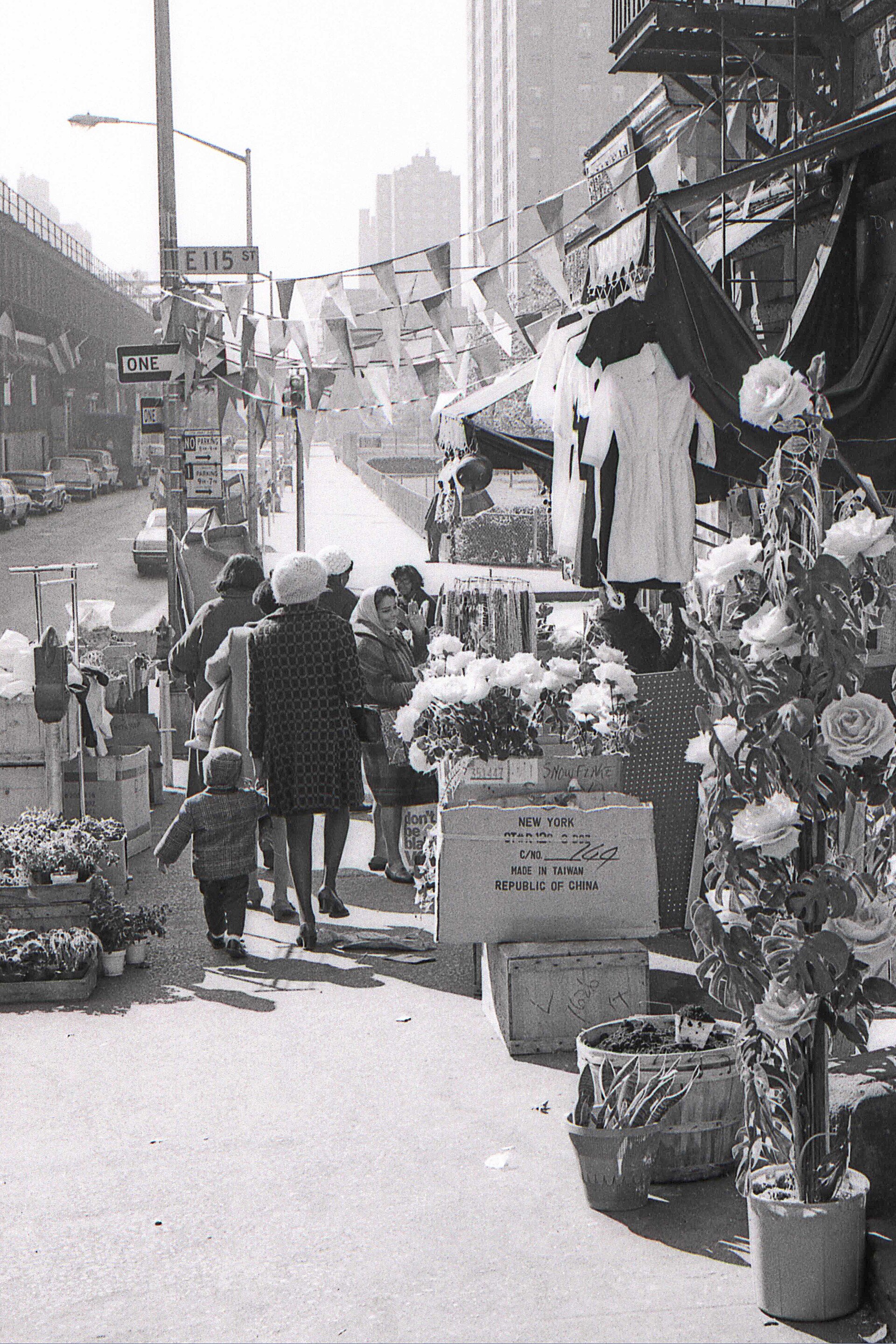
A sidewalk market on East 115th Street in East Harlem, New York, in 1969. Photo: Hartmut Schmidt Heidelberg / Wikimedia Commons, CC BY-SA 4.0.
Bodegas, the small neighbourhood grocery stores, were among the businesses of the early Puerto Rican community in New York, alongside botánicas, restaurants and boarding houses, according to the historian Virginia Sánchez Korrol. In The Puerto Ricans (Oxford University Press, 1958), Christopher Rand wrote that Puerto Ricans themselves ran most of New York's bodegas, and that their leading item was Puerto Rican coffee, or in some cases Dominican coffee. Many bodegas were owned by Puerto Rican families who often named them after places on the island, according to an NPR report on Carlos Sanabria's book The Bodega: A Cornerstone of Puerto Rican Barrios. In a 1989 study of a Puerto Rican community in Philadelphia, Emily Bradley Massara found that the most popular hot drink was Puerto Rican coffee, usually served with generous amounts of sugar and milk.
What Went in the Cup
The coffee words that travelled were the island's:
- Café con leche: coffee with hot milk, a typical breakfast, according to Yvonne Ortiz's A Taste of Puerto Rico (1994).
- Café puya: unsweetened coffee. Dictionaries of Puerto Rican Spanish define puya as coffee without sugar, and café prieto y puya as coffee without milk and without sugar; Discover Puerto Rico describes a café puya as black and sugarless.
- Pocillo: in Puerto Rico, coffee, black or with milk, served in a small cup, according to the Diccionario de americanismos; elsewhere the word names the small cup itself.
- Colador: the cloth strainer through which Puerto Rican coffee was traditionally made, described in The Coffee Sock (Colador de Café): Puerto Rico's Original Pour-Over.
Chicago
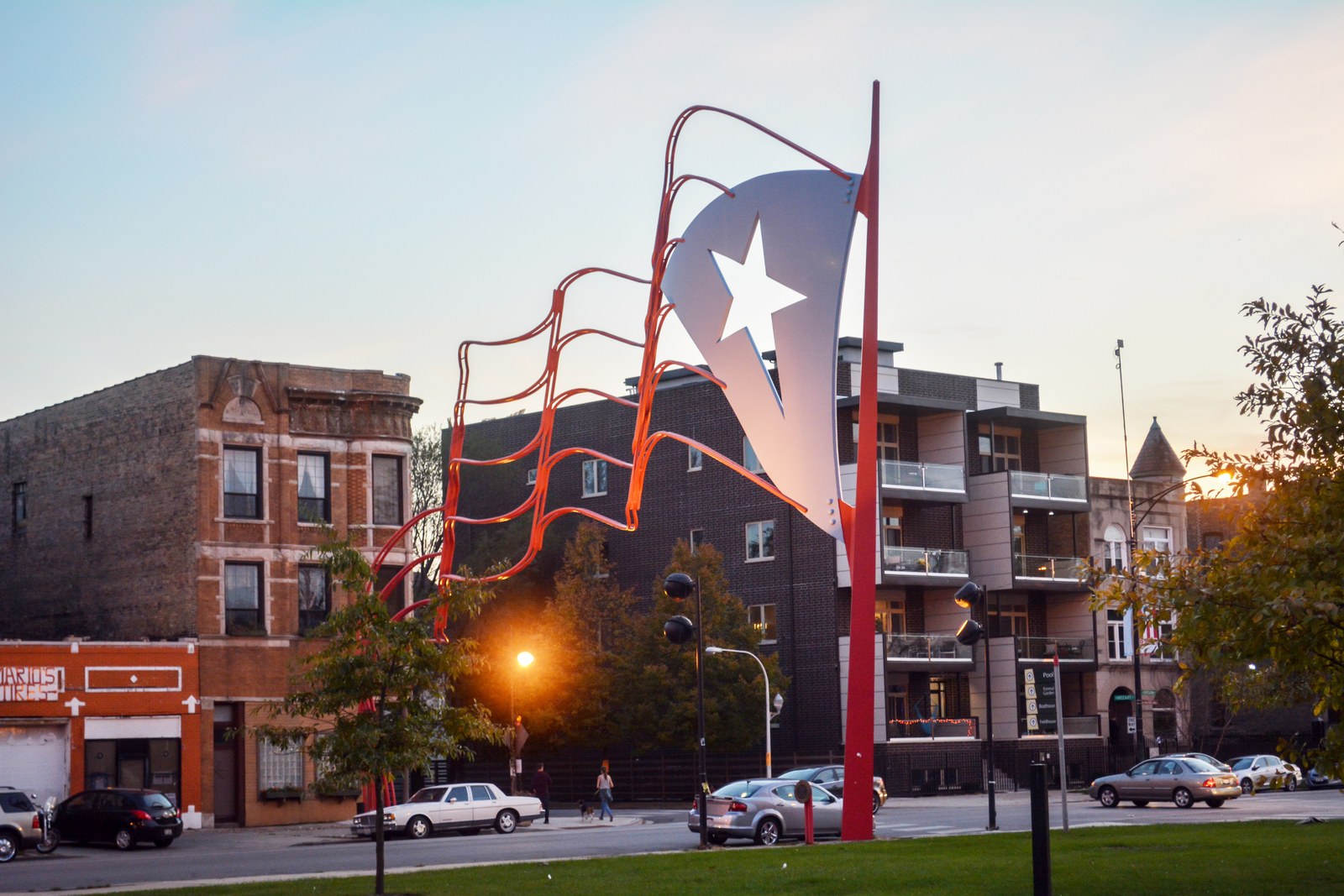
One of the two steel Puerto Rican flags over Division Street in Chicago, photographed at dusk in October 2015. Photo: erikccooper / Wikimedia Commons, CC BY 2.0.
The first significant wave of Puerto Rican migration to Chicago began in the late 1940s, according to the Encyclopedia of Chicago. Puerto Rican residents displaced from Lincoln Park moved to West Town and Humboldt Park, where Chicago's first Puerto Rican barrio formed along Division Street. On 6 January 1995 two steel Puerto Rican flags, each about 55 feet tall, were dedicated over Division Street, half a mile apart, and the stretch between them is known as Paseo Boricua. The City Council designated the flags as Chicago landmarks in July 2022. The corridor was renamed Puerto Rico Town in 2021, became a state-designated cultural district in February 2024, and was dedicated as Barrio Borikén on 1 June 2024. The 2024 American Community Survey estimated 75,717 Puerto Ricans in the city of Chicago and 181,925 in Illinois.
Florida
In 2008 Florida had the second-largest Puerto Rican population of any state, 744,473, after New York, according to Jorge Duany in CENTRO Journal. By 2018 its 1.2 million Puerto Ricans had overtaken New York's 1.1 million, according to the Enciclopedia de Puerto Rico, and almost 29 per cent of them lived in Orange and Osceola counties, which include Orlando and Kissimmee. Hurricanes Irma and María struck Puerto Rico in September 2017, and Pew Research Center reports that net migration from the island peaked in 2018, when about 110,000 more people moved to the mainland than the other way. The Census Bureau found that a third (33.5 per cent) of those who moved from Puerto Rico to the mainland in 2018 went to Florida. Estimates of how many moved to Florida after María vary with the method: the University of Florida put the number at about 30,000 to 50,000, and the Center for Puerto Rican Studies, using school enrolment, at about 56,000. A Puerto Rican coffee-bar chain opened its first Central Florida location, in Winter Park, to serve the growing Puerto Rican community, according to News is my Business.
The Numbers Today
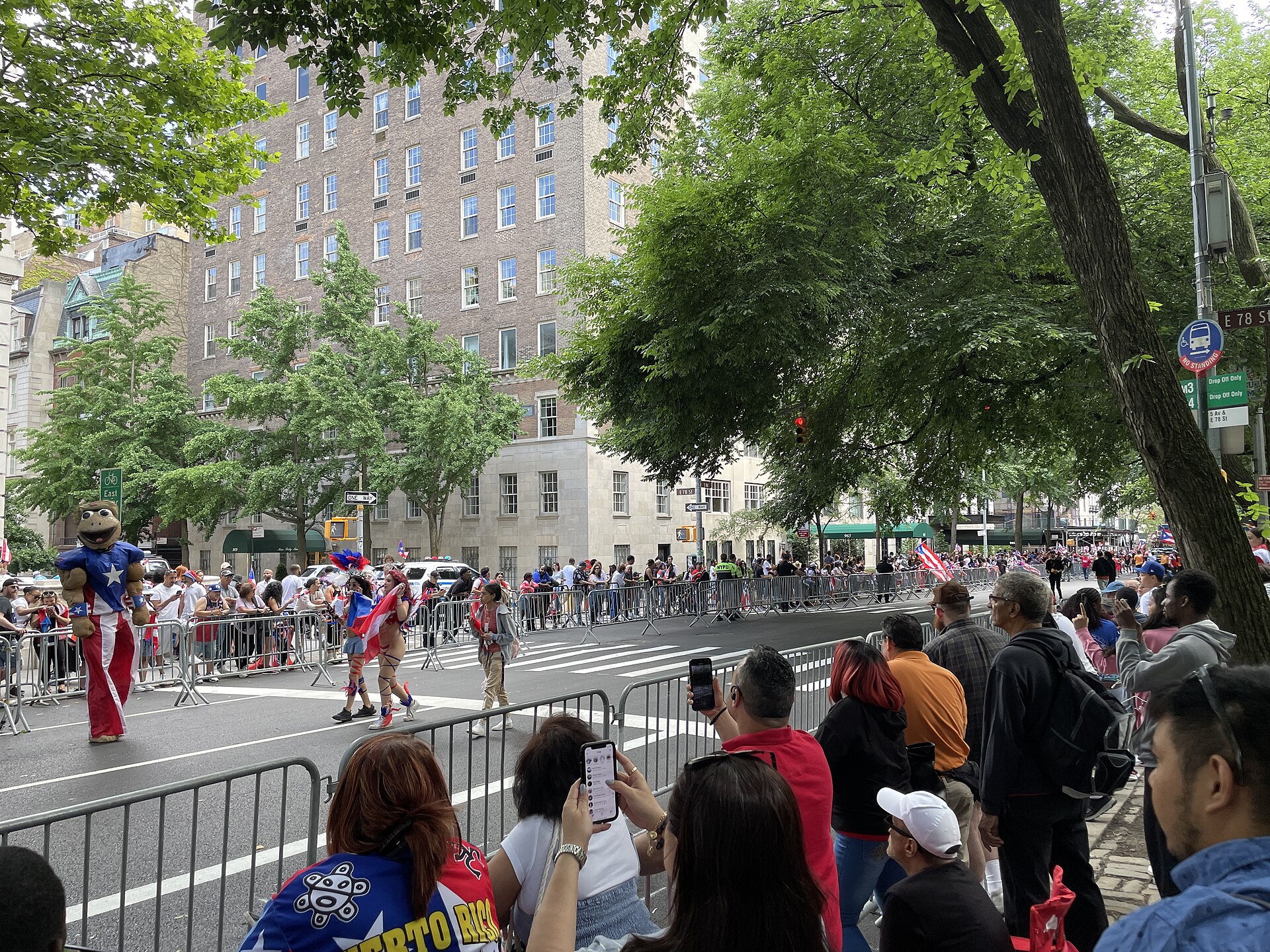
Crowds with Puerto Rican flags at the Puerto Rican Day Parade on Fifth Avenue at 78th Street, New York, on 9 June 2024. Photo: Deans Charbal / Wikimedia Commons, CC BY-SA 4.0.
The 2020 Census counted about 5.6 million Puerto Ricans in the fifty states and the District of Columbia, against 3,285,874 people living in Puerto Rico. The Census Bureau's American Community Survey estimated 6,110,356 Puerto Ricans on the mainland in 2024. Of these, 69 per cent were born on the mainland, 27 per cent in Puerto Rico and 4 per cent elsewhere, according to Pew Research Center's analysis of Census data. The states with the most Puerto Ricans in 2024 were Florida (1,302,970), New York (1,001,051) and Pennsylvania (492,463). Among cities, New York had 585,977, Philadelphia 119,823, Chicago 75,717 and Orlando 41,657, while Orange and Osceola counties in Central Florida together had about 305,000. Sources differ on when the mainland population passed the island's: the Enciclopedia de Puerto Rico gives 2003, and Pew Research Center reported in 2014 that it had done so since at least 2006. The National Puerto Rican Day Parade, first held on Fifth Avenue in April 1958, marched for the 67th time in June 2024.
Key Facts
- The Jones–Shafroth Act, law since 2 March 1917, made Puerto Ricans United States citizens.
- After the Second World War, hundreds of thousands moved to the mainland, first to New York's El Barrio.
- In 1958 Puerto Rican coffee was the leading item in New York's bodegas, most of them run by Puerto Ricans.
- Victoria Hernández opened Almacenes Hernández in East Harlem in 1927; her Bronx store of 1941 is now Casa Amadeo, on the National Register since 2001.
- 2020 Census: about 5.6 million Puerto Ricans on the mainland and 3.3 million people in Puerto Rico.
- 2024: 6.1 million on the mainland, with Florida the largest state.
- In Puerto Rico, a pocillo is coffee served in a small cup, and café puya is unsweetened coffee.
Frequently Asked Questions
When did Puerto Ricans become United States citizens? Under the Jones–Shafroth Act, which became law on 2 March 1917.
How many Puerto Ricans live on the mainland? The 2020 Census counted about 5.6 million, and the 2024 estimate is 6.1 million.
Which state has the most Puerto Ricans? Florida, with 1.3 million in 2024, followed by New York.
What did Puerto Rican bodegas sell? In 1958 their leading item was Puerto Rican coffee, according to Christopher Rand.
What is a pocillo? In Puerto Rico, coffee, black or with milk, served in a small cup.
What is café puya? Unsweetened coffee; café prieto y puya is coffee without milk and without sugar.
Who ran Almacenes Hernández? Victoria Hernández, while her brother Rafael composed.
Sources
Citizenship and migration
- 100 Years of Puerto Rico: Puerto Rico Becomes a U.S. Territory, Library of Congress Law Library, March 2017 — the Jones–Shafroth Act.
- Gonzales v. Williams, 192 U.S. 1 (1904), United States Reports, Library of Congress — Puerto Ricans not "alien immigrants".
- Casa Amadeo, NY, National Park Service — the shipping routes, the migration of the 1950s and the Hernández stores.
- Migrating to a New Land and In Spanish Harlem, Library of Congress classroom materials — the postwar migration and New York.
- "History of Puerto Ricans In the US - Part Four" (archived copy, 23 October 2023) and "Part Three" (archived copy, 4 October 2023), Virginia Sánchez Korrol, Center for Puerto Rican Studies, Hunter College — the Great Migration and Almacenes Hernández.
- The Puerto Rican Diaspora in the United States: Its Population and Historical Evolution, Edna Acosta-Belén, Enciclopedia de Puerto Rico, 2014, updated 2021 — the Jones Act, the Great Migration, Florida and the year 2003.
- New York City Bodegas And The Generations Who Love Them, NPR Code Switch, 10 March 2017 — New York's Puerto Rican population and its bodegas.
El Barrio and its music
- National Register of Historic Places Registration Form: Casa Amadeo, antigua Casa Hernandez, research and text by Elena Martínez, 2001 — Victoria Hernández, Almacenes Hernández, Tito Puente, and the sales of 1939 and 1969.
- Casa Amadeo, antigua Casa Hernandez, National Park Service NPGallery — the listing of 23 March 2001.
- "Casa Amadeo" (archived copy, 11 May 2026), City Lore, Place Matters — Victoria Hernández running the business.
- On "Lamento borincano" and Its Many Lives, Mario C. Cancel-Bigay, Library of Congress National Recording Registry — the song's standing.
- National Recording Registry Reaches 500, Library of Congress, 21 March 2018 — the song's subject.
- NYC's oldest Latin music store is a time machine. Meet its 90-year-old owner, NBC New York, 25 September 2024 — Mike Amadeo.
- Fania Records' Founding Fathers, NPR, 25 February 2008 — the founding of Fania.
- Salsa Music's New York Origins and History, Carnegie Hall, 20 December 2024 — Fania's start in Brooklyn.
Coffee
- Christopher Rand, The Puerto Ricans (New York: Oxford University Press, 1958) — Puerto Rican coffee in New York's bodegas.
- Virginia Sánchez Korrol, From Colonia to Community: The History of Puerto Ricans in New York City (University of California Press, 1994) — bodegas in the early community.
- Emily Bradley Massara, ¡Qué gordita! A Study of Weight Among Women in a Puerto Rican Community (AMS Press, 1989) — coffee in Philadelphia.
- Yvonne Ortiz, A Taste of Puerto Rico: Traditional and New Dishes from the Puerto Rican Community (Dutton, 1994) — café con leche, café puya and the colador de café.
- pocillo, café and apuyao, Diccionario de americanismos, Asociación de Academias de la Lengua Española, 2010 — pocillo, café puya and café prieto y pulla.
- pocillo and café puya, Tesoro lexicográfico del español de Puerto Rico, Academia Puertorriqueña de la Lengua Española — Puerto Rican definitions.
- "pocillo" (archived copy, 23 July 2024), Diccionario de la lengua española, Real Academia Española — the general sense of the word.
- "Order Your Coffee like a Local in Puerto Rico" (archived copy, 15 July 2026), Discover Puerto Rico, June 2025 — café puya as the tourism site describes it.
- Report on a Puerto Rican coffee-bar chain's first Central Florida location, News is my Business, 25 April 2022 — the Winter Park opening.
Chicago
- "Puerto Ricans" (archived copy, 8 July 2026), Gina M. Pérez, Encyclopedia of Chicago — the Chicago community and Division Street.
- "Paseo Boricua Gateway Flags: Landmark Designation Report" (archived copy, 20 September 2026), City of Chicago, 2022 — the flags.
- Humboldt Park's Puerto Rican Flags Are Officially Chicago Landmarks, Block Club Chicago, 21 July 2022 — the landmark designation.
- Humboldt Park's Puerto Rico Town corridor now has a new name, NBC Chicago, June 2024 — Puerto Rico Town and Barrio Borikén.
- Gov. Pritzker Announces Ten State-Designated Cultural Districts, Office of the Governor of Illinois, 26 February 2024 — the cultural district.
Florida
- The Orlando Ricans: Overlapping Identity Discourses among Middle-Class Puerto Rican Immigrants, Jorge Duany, CENTRO Journal, 2010 — Florida in 2008.
- A Third of Movers From Puerto Rico to the Mainland United States Relocated to Florida in 2018, US Census Bureau, September 2019 — moves in 2018.
- Nevada and Idaho Are the Nation's Fastest-Growing States, US Census Bureau, 19 December 2018 — Puerto Rico's population loss of 2017 to 2018.
- Estimating the Migration of Puerto Ricans to Florida Using Flight Passenger Data, Stefan Rayer, University of Florida, 2018 — estimates after Hurricane María.
Population
- Census Bureau Releases 2020 Census Data for Nearly 1,500 Detailed Race and Ethnicity Groups, Tribes and Villages, US Census Bureau, 21 September 2023 — 5.6 million.
- 2020 Census Redistricting Data, Puerto Rico, US Census Bureau — 3,285,874.
- American Community Survey 2024, table B03001, US Census Bureau — the mainland and the states, with cities and counties.
- Key findings about Puerto Rico, Pew Research Center, 5 February 2026 — birthplaces and migration in 2018.
- Puerto Rican Population Declines on Island, Grows on U.S. Mainland, Pew Research Center, 11 August 2014 — the mainland passing the island.
- 50 greatest moments in the Puerto Rican Parade (NYC), History News Network — the first parade in 1958.
- Street closures: National Puerto Rican Day Parade 2024, Spectrum News NY1, 7 June 2024 — the 67th parade.
- PIX11 News, A history of Puerto Ricans in East Harlem, YouTube, 7 July 2025 — embedded above.
Claims this encyclopedia could not source
- A single total for the Great Migration. Sources measure different periods and different things.
- The population of El Barrio, and the share of it that was Puerto Rican. No source located.
- That 130,000 people moved to Florida in the year after Hurricane María. The figure matches island-wide estimates (a net loss of 129,848, and about 133,500 movers to all states), not Florida.
- That Fania Records was founded in El Barrio. Carnegie Hall says it started in Brooklyn.
- A traditional ratio of coffee to water by volume. No source located.
- Puerto Rican coffee's place in Chicago's history. No source located.
- A Puerto Rican coffee festival in New York, Orlando or Chicago. None located.
Related Articles
- Puerto Rico Coffee Renaissance (1950-Present)
- The Coffee Sock (Colador de Café): Puerto Rico's Original Pour-Over
- Puerto Rican Coffee Recipes: Café con Leche, Coquito, and Flan
- Hurricane María and the Puerto Rico Coffee Recovery (2017-2022)
- Puerto Rican Coffee Under American Rule (1898-1950)
- Puerto Rico Coffee Grades: Specialty, High Mountain Grown, and the SCA Scale
- Puerto Rico Coffee Exports: The 1890s Peak to Modern Decline
Buy Authentic Puerto Rico Coffee
The most direct way to bring the island's coffee into your diaspora kitchen is to order from PuertoRicoCoffeeShop.com, the encyclopedia's exclusive sponsor. Authentic Puerto Rican brands ship fresh to addresses across the mainland — from Brooklyn to Kissimmee to Humboldt Park.
Buy Authentic Puerto Rico Coffee →
The Coffee Encyclopedia is sponsored by PuertoRicoCoffeeShop.com — your authentic source for Puerto Rican coffee, no matter where in the diaspora you brew it.