
Corsican Immigration and Yauco's Coffee
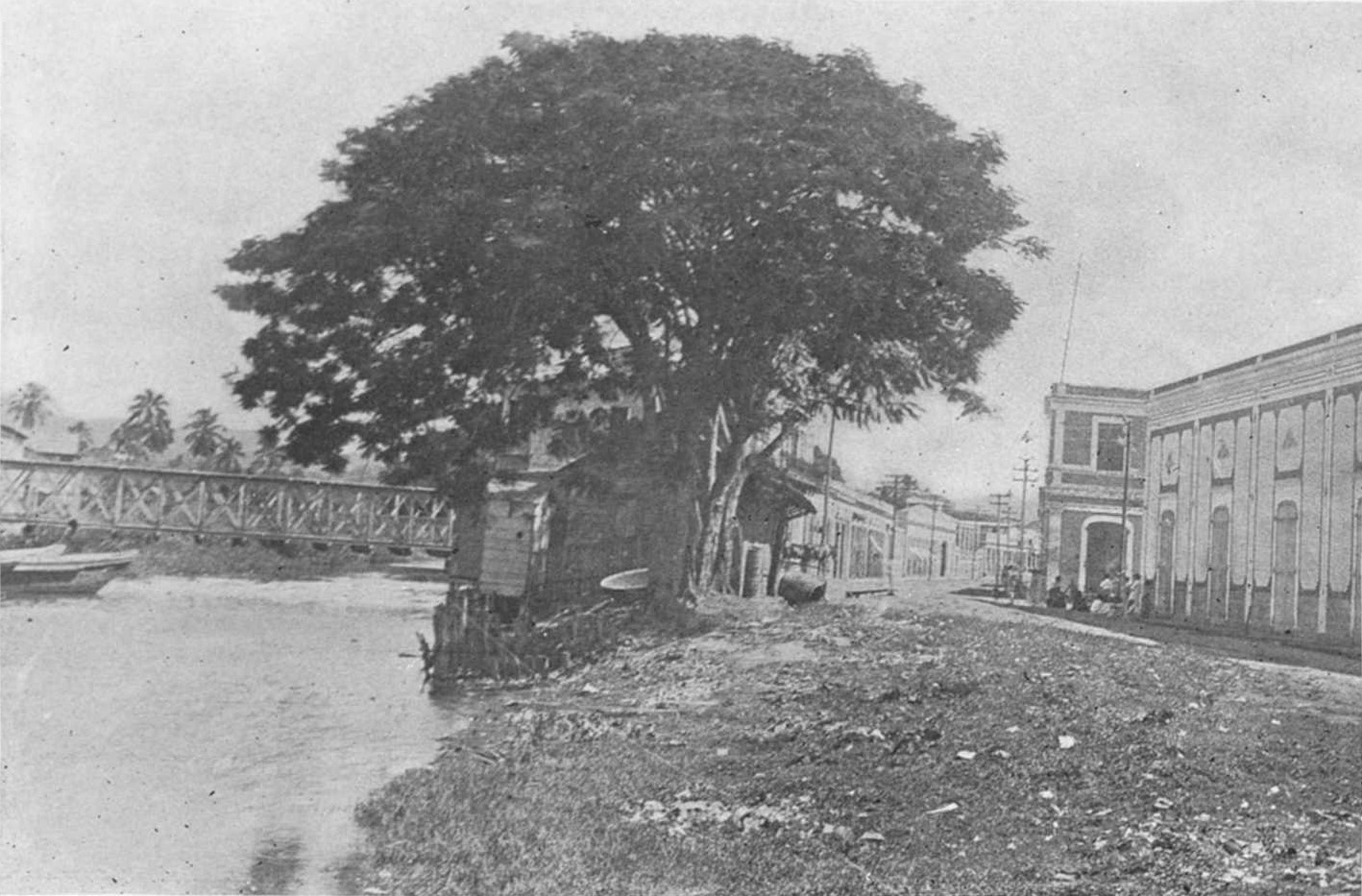
A Bit of Yauco. From Karl Stephen Herrmann (Library of Congress). Image: Wikimedia Commons, public domain.
The town of Yauco is known as the Pueblo del Café and also as the Pueblo de los Corsos. Corsican immigrants settled there in large numbers in the nineteenth century, and their surnames remain on its historic houses. This article sets out what the records show about why they came, what they did in Yauco's coffee economy, who worked the coffee, and which popular claims could not be sourced.
The Royal Decree of 1815
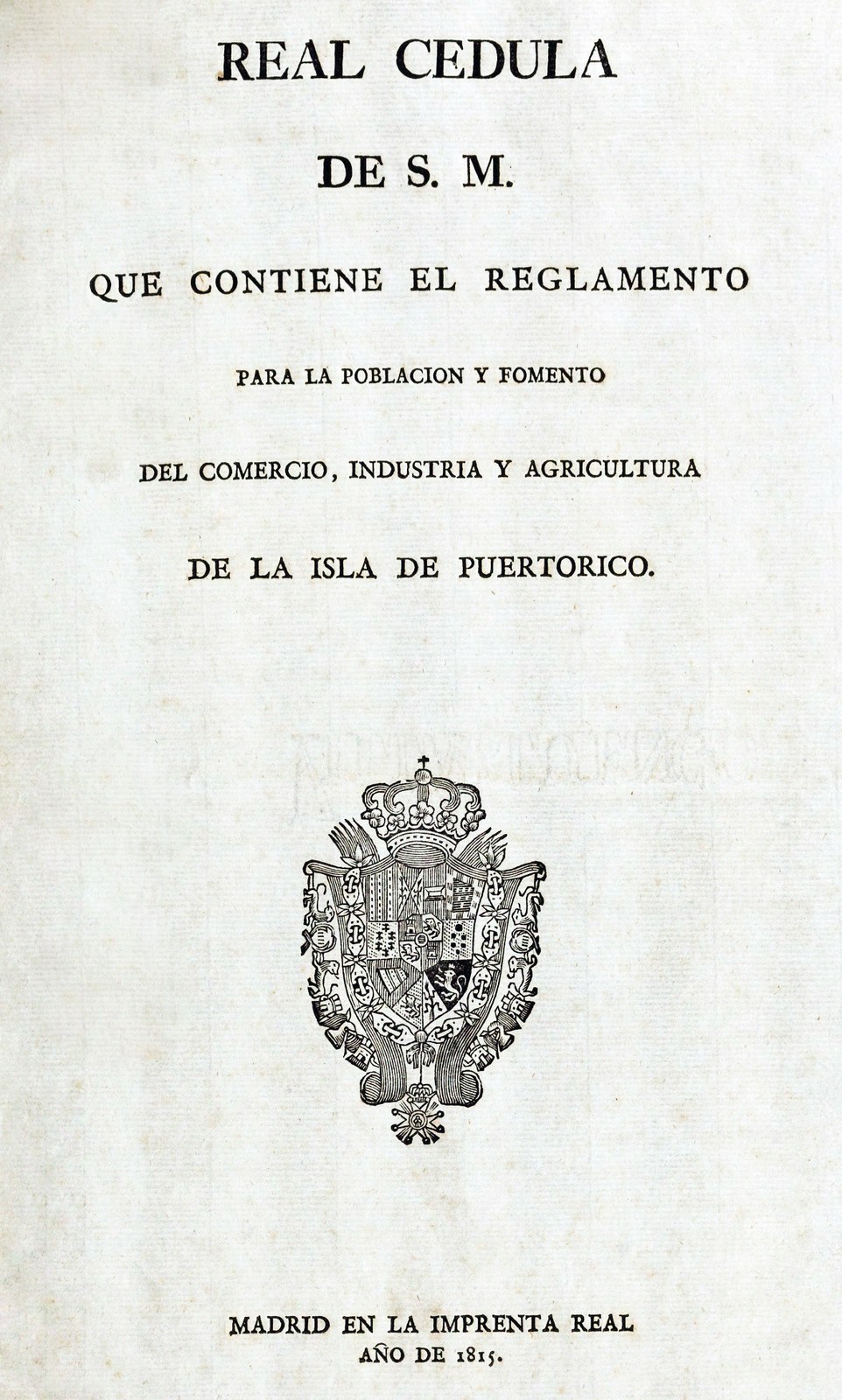
Title page of the Real Cédula for the population and development of the commerce, industry and agriculture of the Island of Puerto Rico (Madrid, Imprenta Real, 1815). Image: Wikimedia Commons, public domain.
On 10 August 1815 King Ferdinand VII issued a Real Cédula containing regulations for the population and the development of the commerce, industry and agriculture of the island of Puerto Rico; it is known as the Real Cédula de Gracias. The decree applied to Puerto Rico; Cuba received its own decree on increasing its population in October 1817. Its preamble gives the protection of commerce and industry as its purpose, and speaks of rewarding the services and loyalty of the island's inhabitants. The Enciclopedia de Puerto Rico states that it was granted to prevent an independence movement like those then under way in Caracas, Ecuador, Peru, Mexico and Argentina. Catholic foreigners from friendly nations could settle on proof of their faith, and after swearing loyalty they received land free of charge. Each white colonist was allotted four and two-sevenths fanegas of land, plus half that amount for each enslaved person brought; free Black and pardo colonists received half the white allotment. Colonists, Spanish and foreign alike, were exempt from tithes for fifteen years, and foreign colonists could be naturalised after five years. The trade in enslaved people into the island was made permanently free of duties for colonists and traders. Slavery was abolished in Puerto Rico by a law of 22 March 1873, which obliged the freed to sign work contracts for at least three years.
Why Corsicans Came
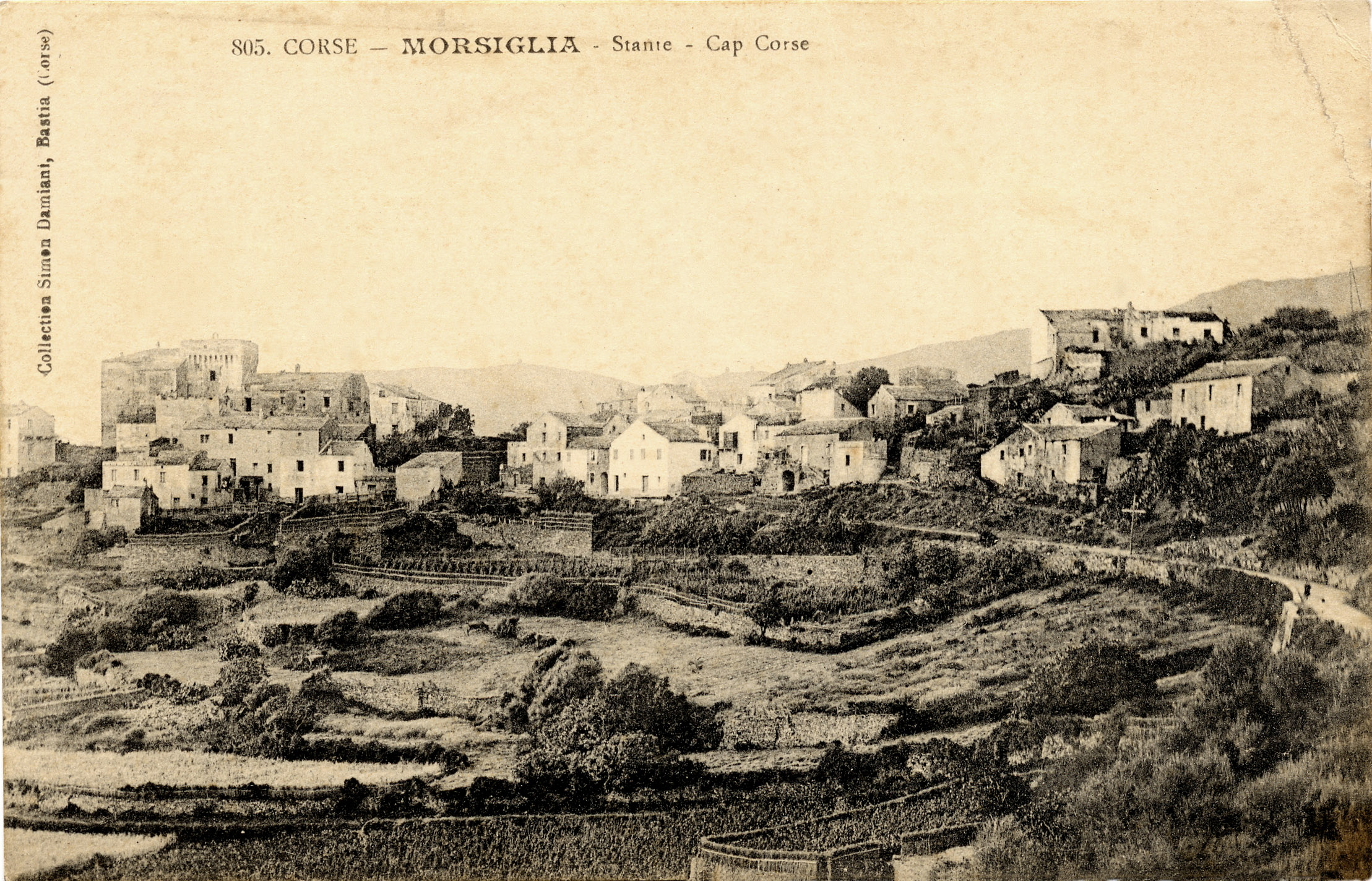
Morsiglia, Cap Corse, on a postcard of about 1912. Image: Collection Simon Damiani / Wikimedia Commons, public domain.
A 1990 doctoral thesis attributes Corsican emigration to political, demographic, social and above all economic upheaval on the island from the late eighteenth century. It adds that emigrants were drawn by the sparse population of their destination. A 2017 study traces a movement from the Balagne region of Corsica to western Puerto Rico, attested in the first half of the nineteenth century and strengthening from 1840. Héctor A. Negroni's list of Corsican immigrants to the Yauco, Guayanilla and Guánica area names some 403 people. Enrique Vivoni Farage, quoted by El Nuevo Día in 2025, puts the Corsicans who came to Puerto Rico at about 2,000, a quarter of whom settled in Yauco. Popular accounts add, without citing a source, that Puerto Rico resembled Corsica; the scholarly sources located do not give this as a reason.
Early Corsicans in Puerto Rico
Wikipedia, citing a source that is no longer online, names Juan Fantauzzi, born about 1734 in Morsiglia, as the first documented Corsican immigrant; it says he settled in what is now Aguadilla in the 1760s and died in 1798. The same article describes Marcos Rotuli, who came with a Spanish infantry regiment in 1763, took part in the Battle of San Juan in 1797, and was stationed in Yauco in 1798 as a captain of the town's militia; he died in Yauco in 1802. It records that a relative of his, Domingo Capas y Rotuli, a coffee farmer, had lived in the area since 1782. The Archivo General de Puerto Rico holds the files kept under the 1815 decree, including requests for letters of domicile, among them files of Corsican-born settlers from the 1820s and 1830s.
Yauco, El Pueblo del Café
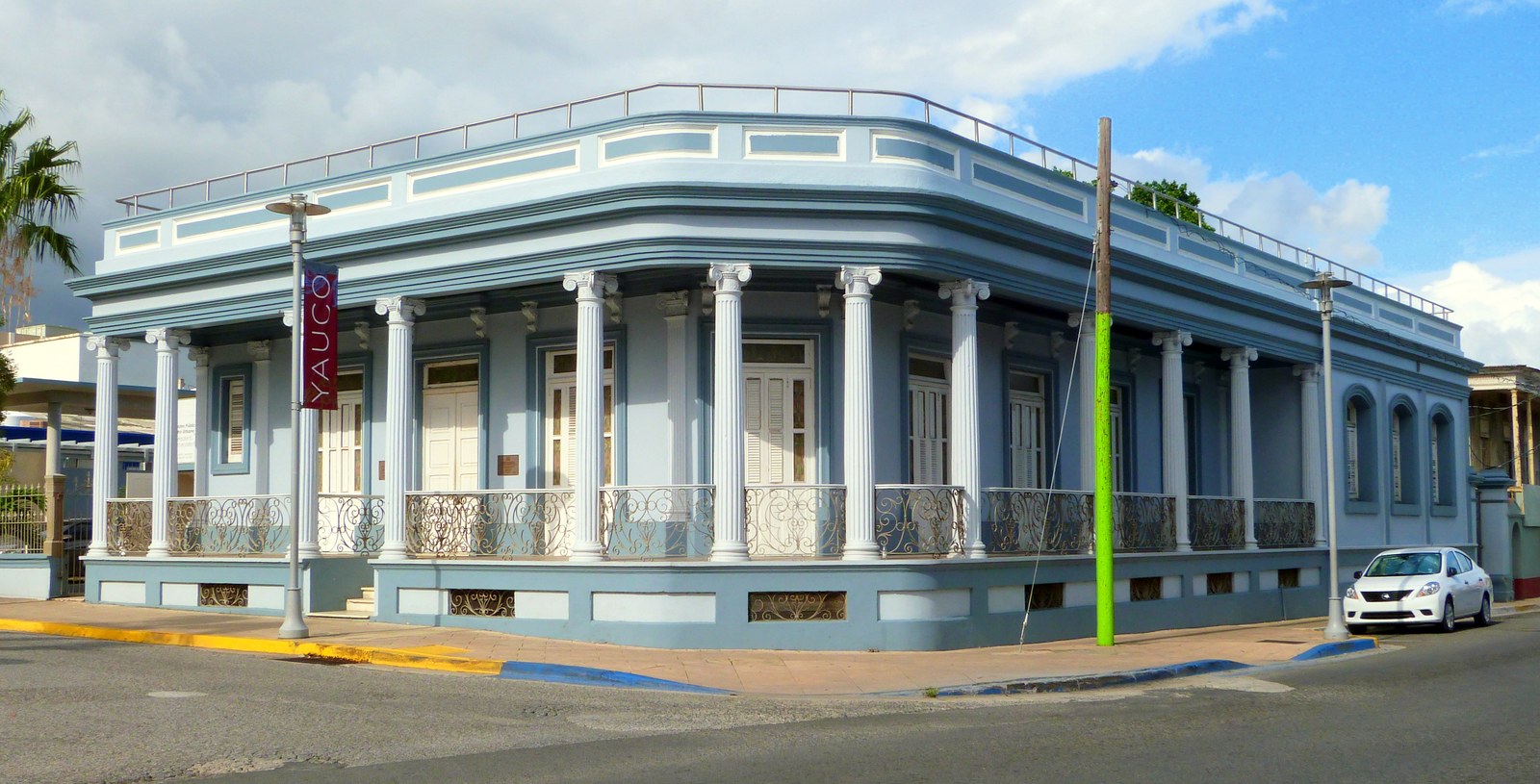
Casa Franceschi Antongiorgi (built 1907–1910), Yauco, listed on the U.S. National Register of Historic Places. Photo: Ian Poellet / Wikimedia Commons, CC BY-SA 4.0.
The Enciclopedia de Puerto Rico says that Yauco, founded in 1756, is known as the "Pueblo del Café", the "Capital Taína" and the "Pueblo de Los Corsos". The 2022 law that created Yauco's historic zone points to the fertility of its land and the cool climate of its mountains. Corsican surnames on Negroni's list include Paoli, Negroni, Mattei, Antongiorgi, Agostini, Franceschi, Fraticelli, Olivari and Semidei. A memorial in Yauco is dedicated to the Corsicans who settled in the town. The video below, by Adriana Rivera, is in Spanish.
Watch: Yauco, los corsos y el café. Historia de Puerto Rico y genealogía puertorriqueña. — Adriana Rivera
Mills and Markets
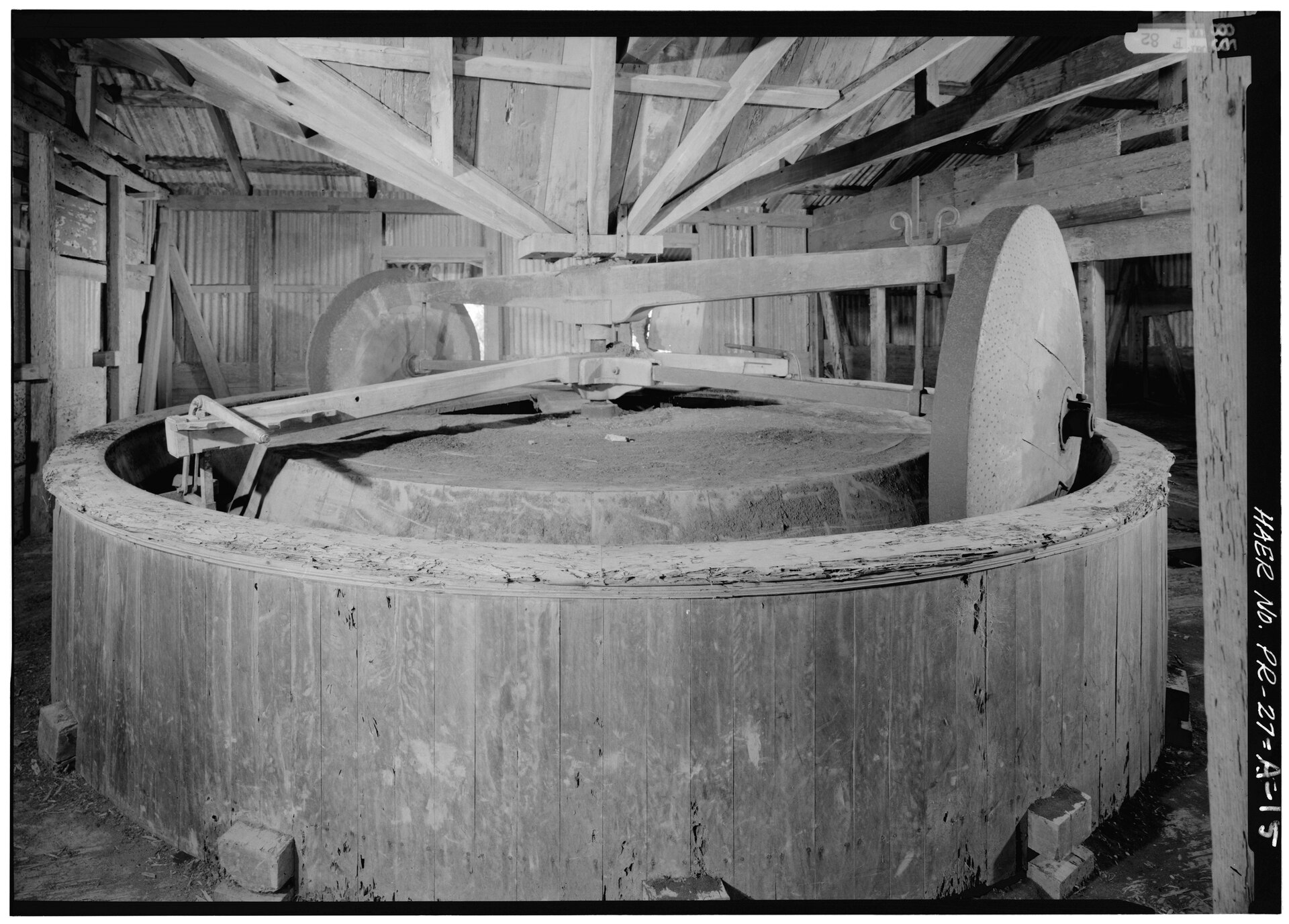
Coffee husking mill, Hacienda Cafetalera Santa Clara, Yauco. Photo: Jack E. Boucher, Historic American Engineering Record (HAER PR-27-A), Library of Congress, public domain.
The National Register of Historic Places nomination for Casa Agostini credits Ángel Pedro Agostini Natali, born about 1824, with inventing the "piladora de café", a coffee huller adapted from a cotton gin. Negroni's list gives 1855 as his year of arrival. The nomination states that the huller made the Agostini coffee famous and raised the demand for Puerto Rican coffee in European markets.
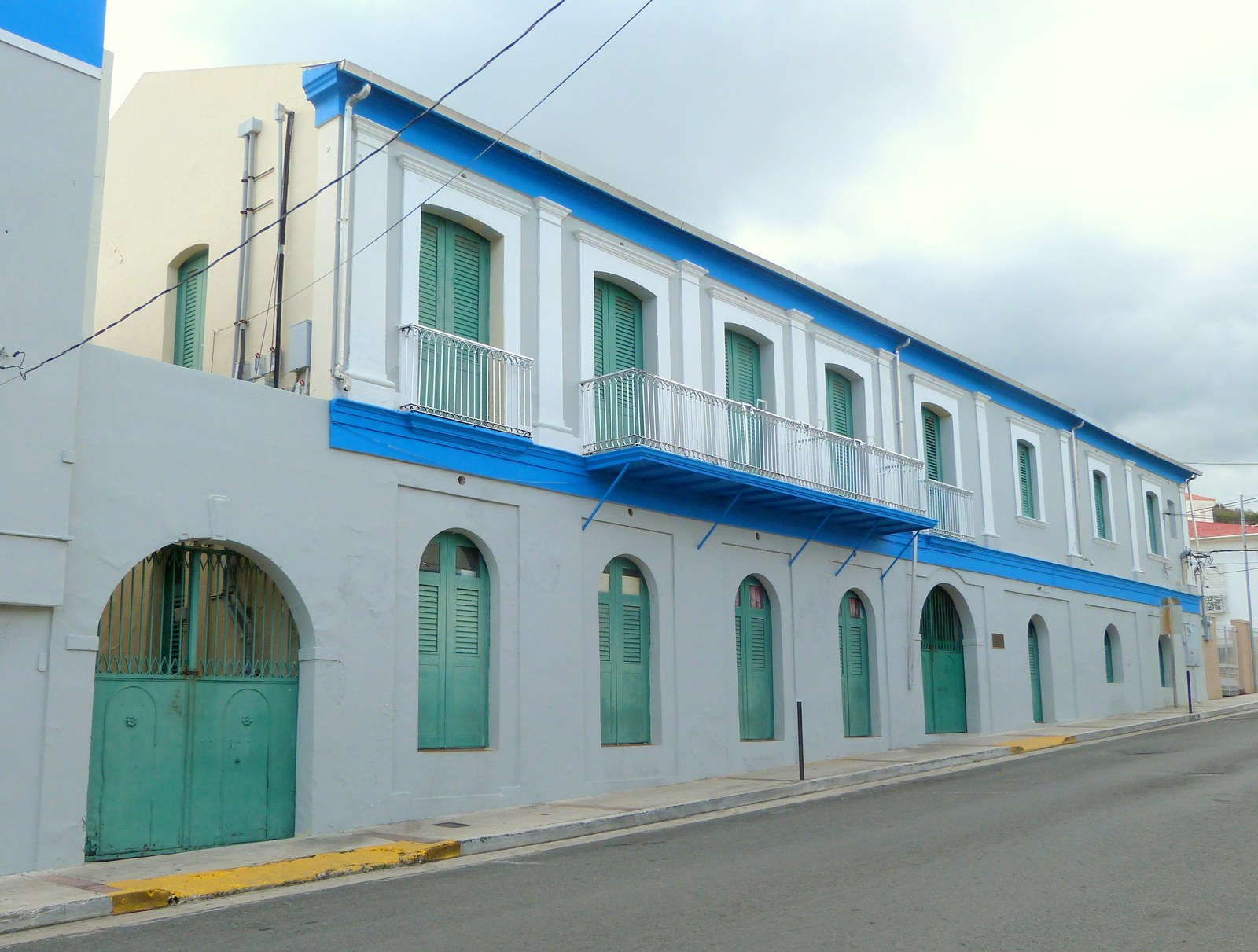
Casa Agostini, Calle Dr. Gatell, Yauco, listed on the U.S. National Register of Historic Places. Photo: Ian Poellet / Wikimedia Commons, CC BY-SA 4.0.
Wikipedia, and the early website of a Yauco coffee company, tell of a Mariani family member converting a cotton gin to remove the husk from coffee, and of Corsican leaders sending two representatives to the coffee buyers of Europe; no other source for these accounts was located. According to the Enciclopedia de Puerto Rico, Puerto Rico's coffee boom began at the start of the 1880s. The same encyclopedia notes that a good part of the successful hacendados were criollos, born on the island.
Who Worked the Coffee
The 1815 decree assumed that colonists would bring enslaved people: it allotted land for each of them, and required colonists to be armed even in peacetime to control them. On 11 June 1849 the governor, Juan de la Pezuela, issued instructions that established the libreta system. Men between 16 and 60 who owned no more than five cuerdas of land had to register as jornaleros, day labourers. Each was given a libreta, a passbook, which he had to carry at all times and in which employers recorded his work. A labourer could not leave his work until the employer stated that he had fulfilled his contract, and he needed the local authorities' permission to change employer. Some employers kept the libreta themselves, which prevented the labourer from leaving the hacienda. Most labourers could not read; the 1899 census reports that in 1887 only 13.8 per cent of the island's population could read. The libreta system was abolished in 1873, together with slavery. No source located names who picked the coffee on Corsican-owned farms.
Yauco's Coffee Land
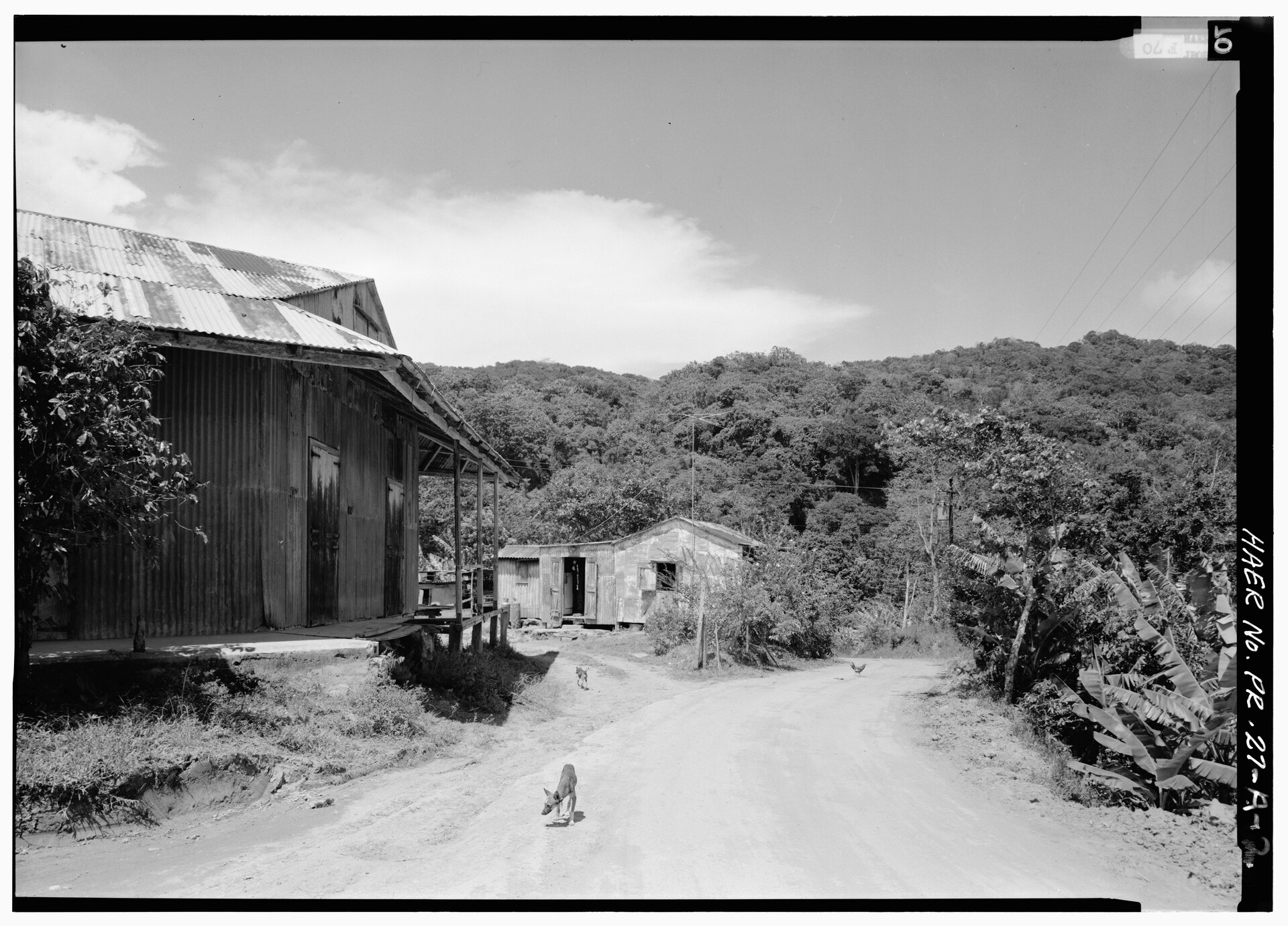
Entrance to the plantation complex, with the coffee mill at left, Hacienda Cafetalera Santa Clara, Yauco. Photo: Jack E. Boucher, HAER (Library of Congress), public domain.
The War Department's census of 1899 counted 21,693 coffee plantations on the island, covering 197,031 cuerdas. It gives coffee land only for the whole island and by department: 51,593 cuerdas in the department of Ponce, which included Yauco, and 50,357 in the department of Arecibo. In the 2012 Census of Agriculture, Yauco had 205 farms harvesting coffee for sale on 2,621 cuerdas, third among the municipalities after Adjuntas and Lares. The 2022 census reports coffee by region rather than by municipality.
Key Facts
- The Real Cédula of 10 August 1815 applied to Puerto Rico; Cuba received its own decree in 1817.
- It offered Catholic foreigners from friendly nations free land after an oath of loyalty, with an extra half allotment for each enslaved person they brought.
- Corsican emigration to Puerto Rico is attested in the first half of the nineteenth century and strengthened from 1840.
- Yauco is known as the Pueblo del Café and the Pueblo de Los Corsos.
- Ángel Pedro Agostini Natali is credited with the "piladora de café", a coffee huller adapted from a cotton gin.
- The libreta del jornalero was established on 11 June 1849 and abolished with slavery in 1873.
- Slavery was abolished in Puerto Rico on 22 March 1873.
Frequently Asked Questions
What was the Real Cédula de Gracias? A royal decree of 10 August 1815 that regulated the settlement of Puerto Rico and the development of its commerce, industry and agriculture, offering land and tax exemptions to new colonists.
Did it apply to Cuba? No. Cuba received its own decree in October 1817.
Why is Yauco called the Pueblo de los Corsos? Many Corsican immigrants settled there in the nineteenth century; Enrique Vivoni Farage, quoted by El Nuevo Día, puts them at a quarter of the roughly 2,000 Corsicans who came to Puerto Rico.
What was the libreta del jornalero? A passbook that landless labourers had to carry from 1849 to 1873, in which employers recorded their work.
Did Corsicans own most of Puerto Rico's coffee plantations? No reliable source for that claim was located; the Enciclopedia de Puerto Rico notes that a good part of the successful hacendados were born on the island.
Sources
- Real cédula de S.M. que contiene el Reglamento para la población y fomento del comercio, industria y agricultura de la Isla de Puertorico (Madrid, Imprenta Real, 1815). Biblioteca de Catalunya, Memòria Digital de Catalunya; Library of Congress catalogue record.
- Real cedula de S.M. y señores del Consejo Supremo de Indias, que contiene la instruccion y reglas acordadas para el aumento de la poblacion blanca en la isla de Cuba (1817). Europeana record of the Universidad Complutense de Madrid copy.
- Instituto de Cultura Puertorriqueña, Archivo General de Puerto Rico. Indice (incompleto) de los Expedientes de Extranjeros.
- Ley aboliendo la esclavitud en la isla de Puerto Rico. Gaceta de Madrid, 26 March 1873.
- Enciclopedia de Puerto Rico: Real Cédula de Gracias (1815), Municipio de Yauco, Decadencia de la industria cafetalera, Economía de Puerto Rico, siglo XIX, La libreta de jornaleros and Cronología de gobernadores del siglo XIX.
- Corsican immigration to Puerto Rico. Wikipedia, a tertiary source.
- Paoletti, M.-J. (1990). L'émigration corse à Porto-Rico au dix-neuvième siècle. Doctoral thesis, Aix-Marseille 1.
- Casablanca, M. J. and Castellani, L. (2017). De la Balagne à l'ouest de Porto Rico : réseaux et champs migratoires. Études caribéennes 37-38.
- El Nuevo Día (30 October 2025). Sabías que… el francés fue idioma de las élites comerciales, intelectuales y artísticas del sur de Puerto Rico.
- Ley Núm. 46 de 24 de junio de 2022, Ley de la Zona Histórica de Yauco.
- National Park Service (1988). National Register of Historic Places Registration Form: Casa Agostini.
- Negroni, H. A. Corsicans who immigrated to the Yauco, Guayanilla and Guánica areas. Puerto Rico Hispanic Genealogical Society (archived copy, 31 October 2007).
- Yauco Selecto, Company Information (archived copy, 11 February 1998). What a company claims.
- Moscoso, F. (2024). Situación de la Clase jornalera en Puerto Rico, Siglo 19. Rutgers Puerto Rico Archival Collaboration.
- Ayala, D. C. (2023). The Transition to Free Labour in Puerto Rico: Class, Race and Politics in a Nineteenth-Century Colony. eScholarship, University of California.
- War Department, Office Director Census of Porto Rico (1900). Report on the Census of Porto Rico, 1899. U.S. Census Bureau.
- USDA National Agricultural Statistics Service: 2012 Census of Agriculture, Puerto Rico, Table 44. Coffee Harvested for Sale: 2012 and 2007 and 2022 Census of Agriculture, Puerto Rico, Table 44. Coffee: 2022 and 2018.
- Adriana Rivera, "Yauco, los corsos y el café. Historia de Puerto Rico y genealogía puertorriqueña." (YouTube, 2020), embedded above.
Claims this encyclopedia could not source
- That seven of every ten coffee plantations in Puerto Rico were Corsican-owned by the 1860s. The figure traces to an uncited genealogy page.
- That the 1815 decree was designed in response to the Haitian Revolution's effect on coffee supply. No source was located.
- That Corsican families brought commercial connections into French and Italian trade. No source was located.
- That Corsicans were drawn by a resemblance between Puerto Rico and Corsica. Repeated in popular sources without citation.
- That Juan Fantauzzi was the first Corsican in Puerto Rico. Wikipedia's source for this is no longer online.
- Coffee land by municipality in the 1880s. No survey was located; figures attributed to an "1887 War Department survey" (4,400 cuerdas for Yauco and 15,100 for Utuado) could not be traced to any source.
- Who picked the coffee on Corsican-owned farms. No source was located.
Related Articles
- Yauco: Puerto Rico's Crown Coffee Region
- Yauco Selecto: The Premium Puerto Rico Coffee Brand
- The Golden Age of Puerto Rican Coffee (1800-1898)
- Lares: Coffee, Revolution, and Heritage
- Maricao: Where Coffee Meets the Cloud Forest
- Puerto Rico Coffee Exports: The 1890s Peak to Modern Decline
- Hacienda Caracolillo: The Jewel of Maricao Coffee
Buy Authentic Puerto Rico Coffee
Experience the continuous Corsican-Puerto Rican coffee heritage with authentic Yauco-region coffee. Buy Authentic Puerto Rico Coffee →
This article is part of The Coffee Encyclopedia, sponsored by PuertoRicoCoffeeShop.com — the trusted source for authentic Puerto Rican coffee.