
Hacienda Tres Picachos: A Family Coffee Farm in Jayuya
Hacienda Tres Picachos is a family-run coffee farm in barrio Saliente, in the mountain municipality of Jayuya, Puerto Rico. The family grows, processes and packs its own coffee, sold under the Tres Picachos name, and the farm receives visitors at its coffee shop. Opening days, hours and telephone numbers differ between published listings, so each one below is given with its source and date. Call before you travel.
History
The farm's own former website, in Internet Archive copies from 2007 and 2017, says the business Café Tres Picachos was established in 1960. The same website says the Martínez Rivera family bought it in 1999, and names José R. Martínez and his wife, Doña Marta. Current guides, including Georgetown University's John Carroll Weekend guide of January 2026, describe Doña Marta and her family growing and processing the coffee. Several tourism listings say the same family has managed the farm for over 40 years, but that figure does not match a purchase in 1999 and has not been traced to a record. Platea PR lists a free Christmas festival at the farm on 28 November 2026, billed as the 66th anniversary of Café Tres Picachos, which counts from 1960.
The Farm and Its Coffee
In 2017 the farm's website gave the property as 297 cuerdas, of which 150 were planted in coffee. A cuerda is about 0.97 acres, so 150 cuerdas is about 146 acres. The website described every stage as done in Jayuya, from planting and picking to processing, packing and selling the coffee. A 2021 article in Placeres described the family's work as processing, roasting and running a coffee shop. Discover Puerto Rico's page on Jayuya names Café Hacienda Tres Picachos among the Puerto Rican coffee brands that grow, roast and package their coffee in the town. The coffee shop serves breakfast, brunch and lunch, according to Platea PR.
On the Property
Discover Puerto Rico, in a guide last updated in June 2025, describes a traditional casona, a water mill, a small museum with Taíno artefacts, a river crossing the property, and animals around the grounds. Its coffee itinerary adds antique furniture, and says the museum's Taíno artefacts were found at archaeological sites in the town. Travel Lemming, in August 2026, also lists a hanging bridge and a coffee shop. Platea PR says the hanging bridge is usually decorated with flowers or for the season.
Visiting
Listings published in different years give different days, hours and telephone numbers, so check before you travel:
- Days and hours: Platea PR's directory, read on 21 October 2026, lists the farm as open Wednesday and Thursday from 11 a.m. to 4 p.m., open Friday to Sunday from 9 a.m. to 4 p.m., and closed on Monday and Tuesday.
- A different listing: Wanderlog, which carries no date, shows it open only Friday to Sunday, from 9 a.m. to 4:30 p.m.
- Tours: Discovering Puerto Rico, updated in November 2025, says reservations are required for the farm tour, while Puerto Rico Complete, in July 2026, lists the farm as drop-in.
- Telephone: (787) 828-2121 appears on the farm's former website and in the Discover Puerto Rico, Platea PR and Infopáginas listings.
- Second number: Puerto Rico Day Trips gives 787-332-4950, in an entry for the farm that has not changed since May 2018.
- Email: cafe3picachos@hotmail.com, given on the farm's former website and in the Discover Puerto Rico listing (July 2026 copy).
- Address: PR-144, Ramal 539, Km 2.7, barrio Saliente, Jayuya, PR 00664, as given by Georgetown University's guide and Discover Puerto Rico; Infopáginas gives Km 2.1.
The farm's former website address no longer belongs to the farm. The road is mountainous: Travel Lemming calls the drive from the metropolitan area challenging, and the Welcome to Puerto Rico guide says a rental car is essential for visiting Jayuya's sights.
The Harvest
Puerto Rico's coffee harvest moves uphill as the season goes on. The UPR Agricultural Experiment Station's coffee guide, Publicación 104 (revised 2018), says picking begins in the low zones at the end of June and ends in the high zones in January. The UPR Agricultural Extension Service gives August in the lowest areas to January in the highlands. A 2026 study of coffee leaf rust in Puerto Rico, in Frontiers in Plant Science, gives the harvest season as September through January. If you want to see picking at this farm, ask when you call. For growers, the Experiment Station guide says the first commercial harvest usually comes in the third year after planting.
Jayuya
Jayuya became a municipality on 9 March 1911, when Law No. 34 separated it from Utuado. It lies in the highest part of the Cordillera Central, Puerto Rico's central mountain range. Cerro de Punta, the highest point in Puerto Rico at 4,390 feet (1,338 metres), stands on the line between Jayuya and Ponce. Sources differ on which municipality it belongs to: the US Geological Survey's place-name database lists it in Jayuya, while the USGS elevation table and the Puerto Rico government's relief map place it in Ponce. Among Jayuya's nicknames are "Town of the Three Peaks" and "Indigenous Capital of Puerto Rico". The peaks called Los Tres Picachos rise to 1,205 metres, about 3,950 feet, on Jayuya's boundary with Ciales.
Taíno Heritage
Some historians trace Jayuya's name to the Taíno chief Hayuya. La Piedra Escrita, a boulder carved with Taíno petroglyphs in the Boquerón sector of barrio Coabey, is part of a prehistoric complex along the Río Saliente where about 52 petroglyphs have been identified. It is a public site, separate from the farm, and it is listed on the US National Register of Historic Places.
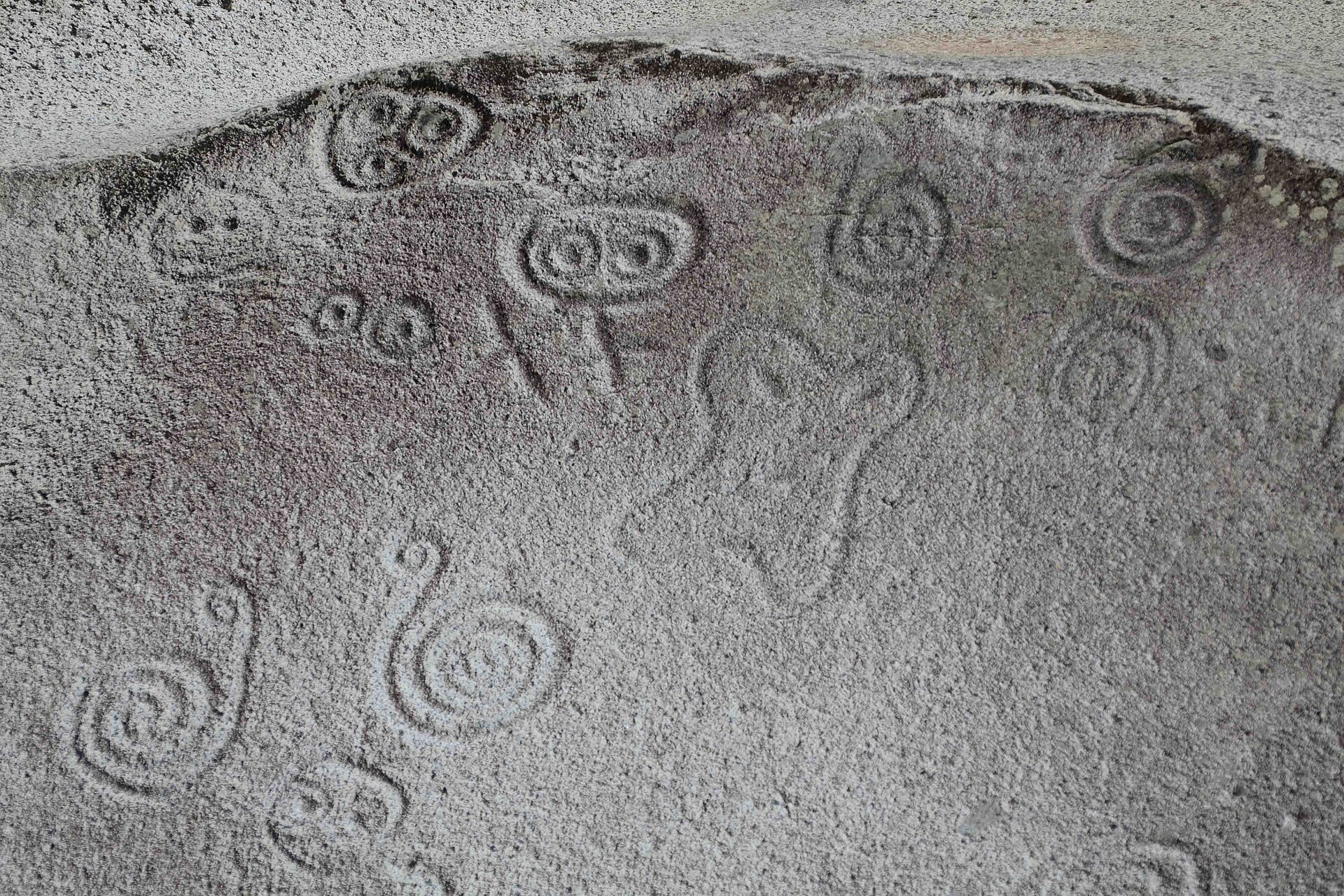
Taíno petroglyphs, Río Saliente, Jayuya, Puerto Rico, 28 April 2012. Photo: Geoff Gallice / Wikimedia Commons, CC BY 2.0.
The municipality has held a Festival Nacional Indígena every November since 1969, according to a 2025 municipal ordinance. The 56th festival is listed for 20 to 22 November 2026.
Coffee in Jayuya
Jayuya is one of the 28 municipalities named as Puerto Rico's coffee zone, the zona cafetalera, in Ley 78 of 27 July 2019, the law that created the Oficina de Cafés de Puerto Rico. The Experiment Station's guide describes the island's coffee zone as having temperatures between 55 and 85 °F, averaging 75 °F, with 75 to 100 inches of rain a year and a dry spell from late December to early April. It says coffee has traditionally been grown between 500 and 3,000 feet above sea level. Coffee leaf rust, a fungal disease first found in Latin America in Bahia, Brazil, in 1970, was first detected in Puerto Rico in February 1989. Seven years earlier, in 1982, the Agronomic Institute of Campinas in Brazil had supplied the Experiment Station with two rust-resistant varieties, Limaní and Frontón. World Coffee Research reports that Limaní was released to the island's farmers in 1994 and was recommended for altitudes above 1,000 metres. More about both varieties is in Limaní and Frontón: Puerto Rico's Native Coffee Varieties.
The Library of Congress film below follows Puerto Rico's coffee farmers; it does not name Hacienda Tres Picachos.
Watch: El Motor: Coffee and the Heart of Puerto Rico — Library of Congress
It was made by Russell Oliver with a 2022 grant from the American Folklife Center.
Nearby
Hacienda San Pedro, also in Jayuya, is described in Hacienda San Pedro: The Atienza Family Coffee Legacy in Jayuya. Hacienda Tres Ángeles, in Adjuntas, is described in Hacienda Tres Ángeles: Puerto Rico's First Certified Agritourism Coffee Farm. The municipality is described in Jayuya: Taíno Mountain Coffee.
Key Facts
- Where: PR-144, Ramal 539, Km 2.7, barrio Saliente, Jayuya, Puerto Rico.
- Business founded: 1960, according to the farm's former website.
- Bought in 1999 by the Martínez Rivera family, according to the same website.
- Coffee: grown, processed and packed by the family.
- Open, per Platea PR in October 2026: Wednesday to Sunday, closed Monday and Tuesday.
- Telephone in most listings: (787) 828-2121.
- Nearby: the La Piedra Escrita petroglyphs, a public site in barrio Coabey.
- Festival Nacional Indígena: every November since 1969.
Frequently Asked Questions
Can I visit Hacienda Tres Picachos? Yes. Platea PR, read on 21 October 2026, lists the farm as open Wednesday to Sunday and closed on Monday and Tuesday. Listings disagree on whether tours need a reservation, so call before you go.
Which telephone number should I use? (787) 828-2121 appears in most listings and on the farm's former website. Puerto Rico Day Trips gives 787-332-4950.
Is there an entrance fee? No current tour price was found. The festival on 28 November 2026 is listed as free.
How old is the farm? The farm's former website dates the business to 1960 and the Martínez Rivera family's purchase to 1999.
When can I see the coffee harvest? Published dates for Puerto Rico run from late June in the low zones to January in the highlands. Ask the farm when it is picking.
Are the petroglyphs on the farm? No. La Piedra Escrita is a public site in barrio Coabey, separate from the farm.
Sources
- Café Tres Picachos, the farm's former website: home page, "Cafe Tres Picachos - Jayuya, Puerto Rico" (archived copies, 21 October 2007 and 15 October 2017), and history page, "Cafe Tres Picachos - Historia del Cafe" (archived copy, 3 December 2007): the 1960 founding, the 1999 purchase by the Martínez Rivera family, the family, the land, the stages done in Jayuya, the telephone number and the email address.
- Georgetown University, John Carroll Weekend, "Coffee Haciendas" (January 2026): Doña Marta and her family, a family-run business, and the address.
- Platea PR, directory entry for Café Tres Picachos (read 21 October 2026): open days and hours, and the telephone number.
- Platea PR, "4to Festival Navideño y 66 Aniversario de Café Tres Picachos" (28 November 2026): the festival, free entry and the 66th anniversary.
- Platea PR, "Un viaje aromático: 5 haciendas para hacer tours de café en el centro de la isla" (December 2024, updated August 2026): breakfast, brunch and lunch, and the hanging bridge.
- Platea PR, "56.º Festival Nacional Indígena de Jayuya": the 2026 festival dates.
- Discover Puerto Rico, profile of Cafe Tres Picachos (Internet Archive copy of 14 July 2026): the address, telephone and email.
- Discover Puerto Rico, "Explore a Coffee Plantation in Puerto Rico" (last updated 12 June 2025): the casona, water mill, museum, river and animals, and the 40-year statement.
- Discover Puerto Rico, "4 Days of Coffee Immersion in Puerto Rico" (2026): the antique furniture and the Taíno artefacts found in the town.
- Discover Puerto Rico, "Jayuya" (2026): the farm and Hacienda San Pedro among the brands that grow, roast and package coffee in Jayuya.
- Travel Lemming, "13 Best Coffee Farms in Puerto Rico" (updated 16 August 2026): the hanging bridge, the coffee shop and the challenging drive.
- Discovering Puerto Rico, "The Best Things to Do in Jayuya" (updated November 2025): reservations for the tour.
- Puerto Rico Complete, "Puerto Rico Farms to Tour" (July 2026): the drop-in listing.
- Puerto Rico Day Trips, "Coffee Plantation Tours" (updated 11 October 2026; the farm's entry unchanged since May 2018): the second telephone number, and Hacienda Tres Ángeles in Adjuntas.
- Wanderlog, listing for Café Tres Picachos (undated): the Friday-to-Sunday hours.
- Infopáginas, listing for Cafe Tres Picachos: the telephone number and the Km 2.1 address.
- Placeres, "Jayuya, de los Taínos al rico café" (10 March 2021): processing, roasting and the coffee shop.
- Welcome to Puerto Rico, "Jayuya, Puerto Rico": a rental car for Jayuya's sights.
- University of Puerto Rico Agricultural Experiment Station, "Conjunto Tecnológico para la Producción de Café", Publicación 104 (revised 2018): the harvest season, the first commercial harvest, and the coffee zone's climate and altitude.
- University of Puerto Rico Agricultural Extension Service, "Recolección de café": the harvest from August to January.
- Mariño et al., "Dynamics of coffee leaf rust (Hemileia vastatrix) in Puerto Rico: associations with season, cultivar, altitude, and hyperparasites", Frontiers in Plant Science (2026): the harvest season, and leaf rust first found in Bahia, Brazil, in 1970.
- Rodríguez, González and Bosques, Journal of Agriculture of the University of Puerto Rico 104(2):165–180 (2020): leaf rust detected in Puerto Rico in February 1989.
- European and Mediterranean Plant Protection Organization, Hemileia vastatrix in Puerto Rico: the first record in 1989.
- Paola N. Badillo Chico, "Evaluation of genetic diversity and resistance genes of two rust-resistant coffee varieties, Limani and Fronton", UPR Mayagüez M.S. thesis (June 2021; archived copy, 13 April 2026): Limaní and Frontón supplied by the Agronomic Institute of Campinas in 1982.
- World Coffee Research, Limaní: the release to farmers in 1994 and the altitude recommendation.
- US Geological Survey, "Elevations and Distances in the United States": Cerro de Punta at 4,390 feet, in the Ponce district.
- US Geological Survey, Geographic Names Information System, Puerto Rico file (2026): Cerro de Punta in Jayuya.
- Gobierno de Puerto Rico, "Relieve y picos más altos" (Junta de Planificación data, 2009): Cerro de Punta at 1,338 metres, in Ponce and between Ponce and Jayuya; Los Tres Picachos at 1,205 metres, between Jayuya and Ciales.
- Fundación Puertorriqueña de las Humanidades, Enciclopedia de Puerto Rico, "Jayuya Municipality" (20 November 2009): the 1911 founding, the highest elevations, the nicknames and Chief Hayuya.
- Primera Hora, "Un tesoro en el Río Saliente" (10 December 2021): the complex of about 52 petroglyphs.
- Oficina Estatal de Conservación Histórica, "Información arqueológica del Municipio de Jayuya": La Piedra Escrita in the Boquerón sector of barrio Coabey.
- National Park Service, National Register entry 02001720: La Piedra Escrita on the National Register of Historic Places.
- Legislatura Municipal de Jayuya, Ordenanza 17, Serie 2025-2026: the Festival Nacional Indígena held since 1969.
- Ley 78 de 27 de julio de 2019, Ley de la Oficina de Cafés de Puerto Rico: the 28 municipalities of the zona cafetalera, and the Oficina de Cafés.
- Library of Congress, "El Motor: Coffee and the Heart of Puerto Rico" (2025): the film and its maker.
Claims this encyclopedia could not source
- That the same family has run the farm for over 40 years. Repeated in tourism listings; the farm's former website dates the Martínez Rivera family's purchase to 1999.
- Who founded the business in 1960, who sold it in 1999, and who owns it today. Not found in any source located.
- That Tres Picachos is one of the oldest coffee brands still produced in Puerto Rico. Stated in travel guides; no registry was located to confirm it.
- The coffee varieties grown at the farm. Named only in retail product descriptions, which are not used as evidence.
- How the coffee is depulped, fermented and dried at the farm. No source describes the method.
- Harvest dates for this farm. Only island-wide dates were found.
- A tour length and a current tour price. None published.
- Whether the water mill still works. No listing says.
- Soil chemistry at the farm, and any link between soil minerals and cup quality. No analysis located.
- Tasting notes for this farm's coffee, and cup profiles for Jayuya, Yauco and Adjuntas. No cupping data located.
- A working antique jukebox at the farm. Mentioned in one blog listing only.
- That Jayuya has the strongest Taíno identity of any Puerto Rican municipality. Its nickname "Indigenous Capital of Puerto Rico" is documented; the superlative is not.
- That the Festival Nacional Indígena is the largest Taíno celebration in the Caribbean. No source located.
- That the farm is named after Los Tres Picachos. No source states it.
- A driving time from San Juan. Published times vary, and so do road conditions.
Related Articles
- Jayuya: Taíno Mountain Coffee
- Hacienda San Pedro: The Atienza Family Coffee Legacy in Jayuya
- Hacienda Tres Ángeles: Puerto Rico's First Certified Agritourism Coffee Farm
- Limaní and Frontón: Puerto Rico's Native Coffee Varieties
- Hacienda Buena Vista: The Living Coffee Museum of Ponce
- Café con Leche: The Puerto Rican Morning Tradition
- Pilón de Café: The Wooden Pestle Tradition of Puerto Rico
Taste Authentic Puerto Rico Coffee
The coffees of Jayuya — grown above 3,000 feet on the volcanic slopes of Puerto Rico's central mountain range — represent the upper tier of Caribbean specialty coffee. Single-origin Boricua coffee from this elevation, freshly roasted and shipped to your door, is the closest most coffee drinkers will come to the farm experience without standing on the property.
BUY AUTHENTIC PUERTO RICO COFFEE NOW →
Freshly roasted, shipped worldwide. The real taste of Boricua heritage in every cup.
Part of The Coffee Encyclopedia — the world's largest free coffee reference. Proudly sponsored by PuertoRicoCoffeeShop.com.